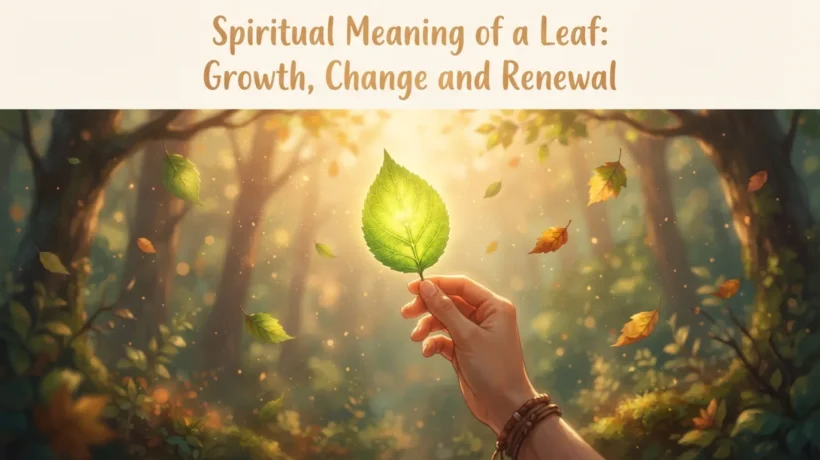
The spiritual meaning of a leaf is commonly connected with growth, renewal, transformation, life cycles, and our connection with nature. A fresh green leaf may represent vitality and a new beginning, while a falling or dry leaf can symbolize transition, release, maturity, or the end of a season.
Leaves naturally change throughout their life. They emerge, grow, mature, change color, fall, and eventually return nutrients to the earth. Because of this cycle, people have long used leaves as symbols for the changing stages of human life.
A leaf can spiritually symbolize growth, renewal, transformation, hope, letting go, and the cycle of life. Its meaning may change according to its color, condition, season, religious context, or the personal meaning someone gives to it.
There is no single spiritual meaning that applies to every leaf in every tradition. Biblical imagery, cultural traditions, nature symbolism, and personal interpretation can all give leaves different meanings.
What Is the Spiritual Meaning of a Leaf?
The spiritual meaning of a leaf often reflects the natural process of growth and change.
A leaf begins small and develops as the plant grows. It receives light, supports the life of the plant, reaches maturity, and eventually changes or falls. This makes it a powerful natural image for personal development and the different seasons of life.
For some people, a new leaf represents the beginning of something hopeful. A changing leaf may represent transformation. A falling leaf may encourage reflection on acceptance and release.
The meaning therefore depends less on the object alone and more on the stage of the leaf and the context in which someone is interpreting it.
What Does a Leaf Symbolize Spiritually?
When people ask what does a leaf symbolize spiritually, the most common themes are growth, renewal, change, life, hope, and letting go.
These meanings come largely from what leaves do in nature. Their symbolism is strongest when it reflects an observable part of their natural life cycle.
Growth and Personal Development
Growth is one of the clearest meanings associated with a leaf.
New leaves appear as a plant develops. They begin small and become stronger as they receive sunlight, water, and nutrients.
For this reason, a leaf can represent personal growth, learning, maturity, and spiritual development.
Someone entering a new stage of life may see a growing leaf as a reminder that progress often happens gradually. Just as a leaf does not reach maturity instantly, personal change can require time and patience.
Growth also does not mean becoming someone completely different. It can mean developing qualities, understanding, and strength that were already beginning to form.
Renewal and New Beginnings
Fresh leaves are strongly associated with renewal.
After winter or a period of dormancy, new growth can signal the beginning of another season. Spiritually, this makes a young leaf a natural symbol of starting again.
A new leaf may represent renewed hope after a difficult period, a change in direction, or the willingness to begin another chapter.
The familiar English expression turn over a new leaf also carries this idea. It means making a fresh start or choosing to behave differently.
This everyday expression shows how deeply leaf imagery has become connected with renewal and personal change.
Transformation and Change
Leaves visibly transform.
A green leaf may become yellow, orange, red, or brown before it falls. This seasonal process makes leaves an especially strong symbol of change.
Spiritually, changing leaves can represent movement from one stage of life into another.
Not every change is comfortable. Some changes involve growth, while others involve endings, uncertainty, or leaving familiar circumstances behind.
Leaf symbolism can therefore reflect the idea that transformation is a normal part of life rather than something that always needs to be resisted.
The Cycle of Life
The spiritual meaning of leaves is also closely connected with the cycle of life.
A leaf begins, grows, reaches maturity, changes, falls, and eventually becomes part of the earth again. That process can be seen as an image of beginnings, maturity, endings, and renewal.
This does not mean a leaf has one fixed message about life and death. Instead, its natural cycle offers a visible reminder that life moves through different stages.
A fresh leaf and a falling leaf belong to the same process.
This is why leaf symbolism can hold both hopeful and reflective meanings at the same time.
Letting Go
Falling leaves are frequently used as symbols of release.
A tree does not keep every leaf forever. When the season changes, leaves fall naturally.
For people using nature as a source of personal reflection, this can represent letting go of habits, expectations, relationships, or phases of life that have reached their end.
Letting go does not always mean forgetting something or declaring it unimportant. It can simply mean accepting that a season has changed.
A falling leaf can therefore serve as a metaphor for releasing what no longer belongs to the present.
Hope and Vitality
Healthy green leaves are closely connected with living growth.
Their color and freshness make them natural symbols of vitality, energy, hope, and renewal.
For someone recovering from a difficult experience, new growth in nature may feel especially meaningful because it shows that life continues after periods of stillness.
This symbolic meaning should not be treated as a prediction that good events are guaranteed to happen.
Instead, the leaf can represent hope because of the new growth it visibly demonstrates.
Connection With Nature
A single leaf is small, but it belongs to a much larger living system.
It depends on the tree or plant, sunlight, water, soil, air, and the surrounding environment.
This can make a leaf a symbol of connection and interdependence.
Spiritually, some people use this image to reflect on how individuals are also part of larger families, communities, ecosystems, and traditions.
The leaf is individual, yet it does not exist independently from the tree that supports it.
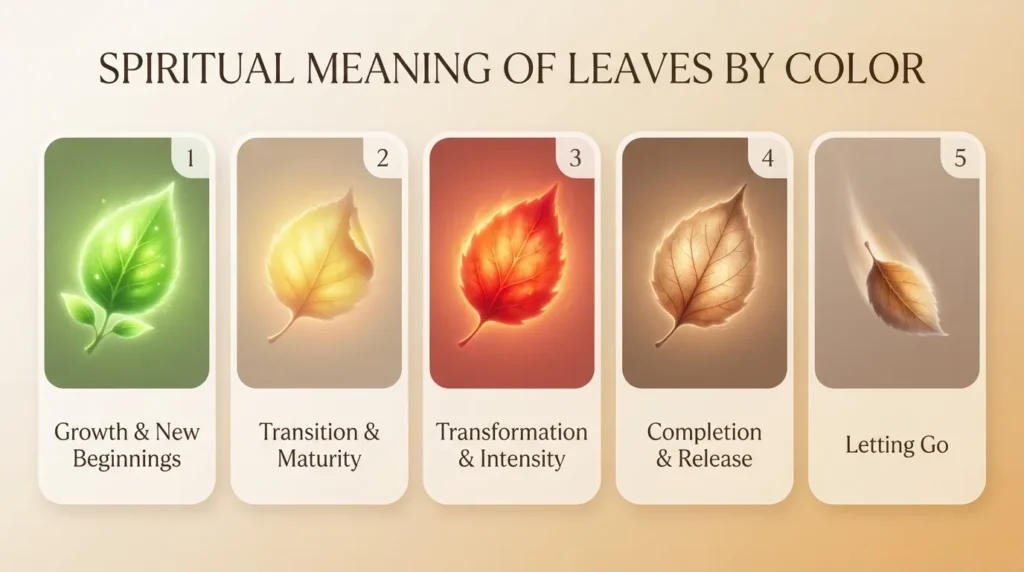
Spiritual Meaning of Leaves by Color
Color can influence how people interpret leaf symbolism, although these meanings are not universal.
Different cultures and individuals may associate colors with different ideas.
Green Leaf Spiritual Meaning
A green leaf commonly represents life, growth, vitality, hope, and new beginnings.
Because green leaves are actively growing, they are naturally associated with development and renewal.
A green leaf can also symbolize freshness and possibility, especially when it appears as part of new seasonal growth.
Yellow Leaf Spiritual Meaning
A yellow leaf can symbolize transition and maturity.
It often appears when a leaf is moving from active growth toward the later stage of its seasonal life.
Spiritually, this can represent the idea that change has begun even if the final transition has not yet occurred.
Yellow should not automatically be interpreted as negative. It can simply represent movement from one stage to another.
Red Leaf Spiritual Meaning
Red leaves can be associated with intensity, energy, passion, and transformation.
Their vivid appearance often makes them stand out during seasonal change.
A red leaf may therefore be interpreted as a symbol of powerful change or a significant period of transition.
Because color symbolism varies widely, this meaning should be understood as an interpretation rather than a universal spiritual rule.
Brown or Dry Leaf Spiritual Meaning
A brown or dry leaf often represents completion, aging, mortality, release, or the ending of a phase.
This meaning comes from its position near the end of the leaf’s natural life cycle.
However, a dry leaf is not only an image of ending.
Once fallen, leaves can break down and contribute nutrients to the soil. This allows an ending to become part of future growth.
For that reason, a dry leaf can also represent the relationship between completion and renewal.
Falling Leaf Spiritual Meaning
A falling leaf is commonly associated with letting go, acceptance, transition, and impermanence.
Its fall marks the completion of one stage in the natural cycle.
For personal reflection, this can represent accepting change rather than holding tightly to something that has already reached its natural conclusion.
A falling leaf does not prove that a specific event is about to happen. Its value is symbolic rather than predictive.
Spiritual Meaning of a New Leaf
A new leaf commonly represents a fresh beginning.
Its appearance can suggest renewal, possibility, development, and movement into a new stage.
Someone beginning a new job, relationship, personal goal, or period of recovery may identify with the image of fresh growth.
This idea also appears in the phrase turn over a new leaf, which refers to making a fresh start or changing one’s behavior.
The symbolism works because new growth visibly represents something beginning again.
What Do Leaves Symbolize in the Bible?
Leaves do not have one universal meaning throughout the Bible.
Their meaning depends on the passage and the larger image in which they appear.
Several biblical passages use leaves in connection with flourishing, healing, life, and restoration.
Leaves and Healing in Revelation 22
Revelation 22 presents a vision that includes the Tree of Life beside the river of the water of life.
Revelation 22:2 describes the tree producing fruit and its leaves being for the healing of the nations.
This passage gives leaves a clear place within an image of life and restoration.
It does not mean that every physical leaf has supernatural healing power.
The meaning belongs to the specific vision of the Tree of Life in Revelation.
Leaves and Healing in Ezekiel 47
A similar image appears in Ezekiel 47.
The prophet describes trees growing beside a river flowing from the sanctuary. Ezekiel 47:12 says their leaves do not wither, their fruit continues, and their leaves are for healing.
The passage connects flowing water, fruitful trees, food, and healing within a larger vision of restoration.
The similarity between Ezekiel 47 and Revelation 22 is especially useful for understanding biblical imagery involving life giving water, trees, fruit, and healing leaves.
The Unwithering Leaf in Psalm 1
Psalm 1 uses a different image.
The person who delights in God’s instruction is compared with a tree planted near streams of water. The tree produces fruit in season, and its leaf does not wither.
Here, the leaf forms part of an image of stability, nourishment, fruitfulness, and flourishing.
The emphasis is not on the leaf as a magical object. It belongs to the larger comparison between a healthy tree and a life rooted in faithful instruction.
These passages show why biblical leaf symbolism should always be interpreted from the surrounding text.
Spiritual Meaning of Leaves in Different Traditions
Different religious and cultural traditions can attach specific meanings to certain trees and leaves.
It is important not to treat all traditions as if they teach the same thing.
Leaves and the Bodhi Tree in Buddhism
The Bodhi tree has an important place in Buddhist tradition because it is associated with the Buddha’s enlightenment.
Because of that connection, the tree and its distinctive leaves can evoke ideas such as awakening, wisdom, reflection, and spiritual understanding.
This does not mean that every leaf in Buddhism carries the same fixed symbolism.
The meaning comes particularly from the historical and religious importance of the Bodhi tree.
Leaves in Hindu Traditions
Leaves from particular plants can also have religious importance in Hindu traditions.
Their meanings and uses depend on the specific plant, deity, ritual, and local practice.
For this reason, it is more accurate to discuss individual sacred plants than to claim that Hinduism gives all leaves one spiritual meaning.
The broader lesson is that religious symbolism depends heavily on context.
Is Seeing a Leaf a Spiritual Sign?
Seeing or finding a leaf can feel personally meaningful, but there is no universal rule proving that a particular leaf is a supernatural message.
A person may connect a leaf with something happening in life, especially during a period of growth, transition, grief, recovery, or change.
The interpretation can also depend on the leaf itself.
A fresh green leaf may remind someone of renewal. A falling leaf may bring thoughts of letting go. A dry leaf may prompt reflection on completion or impermanence.
These associations can be meaningful without being treated as guaranteed messages or predictions.
How to Interpret the Spiritual Meaning of a Leaf
If a leaf feels meaningful to you, context can help you reflect on it more carefully.
- Notice whether the leaf is new, mature, changing, falling, or dry.
- Consider its color and what that color means to you personally.
- Think about the season and the natural process happening around the leaf.
- Consider whether you are currently experiencing growth, transition, renewal, or an ending.
- Separate personal symbolism from specific religious teaching.
- Avoid treating symbolic interpretation as proof that a future event will occur.
This approach allows leaf symbolism to remain meaningful without turning it into an unsupported prediction.
Frequently Asked Questions
What does a leaf symbolize spiritually?
A leaf commonly symbolizes growth, renewal, transformation, hope, life cycles, and connection with nature. Its meaning can change according to its color, condition, season, and cultural or religious context.
What is the spiritual meaning of leaves?
The spiritual meaning of leaves often relates to natural change. Fresh leaves may suggest new beginnings and vitality, while changing or falling leaves can represent transition, maturity, letting go, and impermanence.
What does a green leaf mean spiritually?
A green leaf commonly represents growth, vitality, hope, renewal, and fresh beginnings because green leaves are associated with active plant life.
What does a falling leaf symbolize spiritually?
A falling leaf commonly symbolizes transition, acceptance, letting go, and the completion of a season. It can serve as a reminder that change and endings are natural parts of life.
What does a dry leaf symbolize spiritually?
A dry leaf can represent maturity, completion, mortality, release, or the end of a stage. Because fallen leaves can also contribute to future growth, the symbol may include renewal as well as completion.
What do leaves symbolize in the Bible?
Biblical meanings vary by passage. Revelation 22:2 connects the leaves of the Tree of Life with the healing of the nations, Ezekiel 47:12 uses leaves in a vision of healing and restoration, and Psalm 1 uses an unwithering leaf as part of an image of flourishing.
Is finding a leaf a spiritual sign?
Finding a leaf may have personal symbolic meaning, but there is no universal rule proving that it carries a supernatural message. Its meaning depends on personal beliefs, circumstances, and context.
Conclusion
The spiritual meaning of a leaf is closely connected with the natural journey from growth to change, completion, and renewal.
A green leaf can symbolize vitality, hope, and fresh beginnings. A changing leaf can represent transformation. A falling leaf may suggest letting go and accepting transition, while a dry leaf can remind us that endings can eventually contribute to new growth.
Religious traditions add more specific meanings. Biblical passages use leaves within images of flourishing, healing, life, and restoration, while other traditions connect particular trees and leaves with their own histories and spiritual practices.
The most useful way to understand leaf symbolism is therefore through context. Consider the condition of the leaf, its color, the natural season, the religious or cultural tradition involved, and the personal meaning it holds for you.
A leaf does not need to predict the future to be meaningful. Its natural cycle already offers a powerful image of growth, change, release, and the continuing renewal of life.