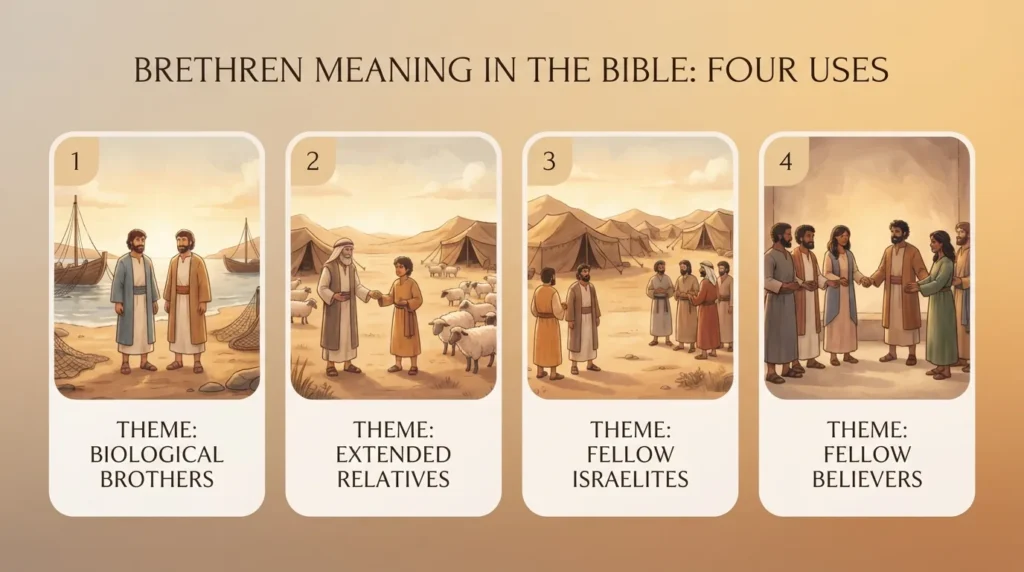
The phrase brethren meaning in Bible refers to brothers, close relatives, fellow Israelites, or fellow believers, depending on the context of the passage. The word does not have one fixed meaning in every verse. To understand it correctly, readers need to identify who is speaking, who is being addressed, and what relationship exists between them.
Brethren is an older English plural form of brother. It appears frequently in older Bible translations, especially the King James Version. Modern English translations may use words such as brothers, relatives, kinsmen, fellow Israelites, or brothers and sisters where an older translation uses brethren.
Brethren means a group connected by family, ancestry, community, or faith. In the Bible, it can refer to biological brothers, extended relatives, fellow Israelites, or members of a Christian community. In some New Testament passages, the group being addressed includes both men and women.
Understanding this wider range of meanings prevents readers from assuming that every use of brethren describes biological brothers.
Brethren Meaning in Bible Across Different Relationships
The clearest way to understand brethren meaning in Bible is to look at the relationship described in each passage.
Sometimes the relationship is biological. In other places it is based on extended family, common ancestry, national identity, or shared faith.
This flexibility is important because biblical writers often use family language more broadly than modern readers may expect.
Brethren as Biological Brothers
In some passages, brethren has its most direct meaning and refers to actual brothers from the same family.
Matthew 4:18 provides a simple example. The King James Version describes Simon Peter and Andrew as two brethren. In this case, the meaning is straightforward because Peter and Andrew were biological brothers.
The surrounding story confirms the relationship. Both men were fishermen, and Jesus called them while they were casting a net into the sea.
Here, there is no need to search for a symbolic or spiritual meaning. Brethren simply describes two men who were brothers by birth.
This example is useful because it establishes the basic meaning of the word before considering its wider biblical uses.
Brethren as Extended Relatives
One of the most helpful Old Testament examples appears in the relationship between Abram and Lot.
Genesis 13 describes tension between the herdsmen of Abram and the herdsmen of Lot because both households had large numbers of animals and possessions.
Abram wanted to prevent conflict. In Genesis 13:8, the King James Version records him telling Lot that there should be no strife between them because they were brethren.
However, Lot was not Abram’s biological brother.
Genesis 12:5 identifies Lot as the son of Abram’s brother. This makes Lot Abram’s nephew. Genesis 13 therefore shows that family language could extend beyond literal brothers to other close relatives.
The broader family connection is what matters in the passage.
Abram’s statement is also connected with his desire for peace. Because they belonged to the same family, conflict between their households was especially undesirable.
Modern translations often make this relationship clearer for today’s readers by using wording such as relatives or kinsmen rather than translating the expression as literal brothers.
This is an important lesson for biblical interpretation. The English word used in one translation should always be read within the wider story.
Brethren as Fellow Israelites
Brethren can also refer to people who share ancestry, nationality, or covenant identity.
Exodus 2:11 provides an important example involving Moses.
After Moses had grown up, he went out to his brethren and observed their burdens. The context shows that these people were the Hebrews who were suffering under Egyptian oppression.
They were not all Moses’ biological brothers.
The term connects Moses with his own people.
This national and ancestral use of family language continues elsewhere in Scripture.
Paul’s Use of Brethren for Israelites
Romans 9 gives an especially clear New Testament example.
Paul speaks with deep concern about his brethren and then immediately explains whom he means. In Romans 9:3 he describes them as his relatives according to human ancestry, while Romans 9:4 identifies them as Israelites.
This context is extremely important.
It demonstrates that seeing the word brethren in the New Testament does not automatically mean the passage is talking about Christians.
Paul himself can use family language for fellow Israelites.
This is why readers should avoid applying one definition to every occurrence. The writer may be talking about biological family in one passage, fellow Israelites in another, and Christian believers somewhere else.
Context determines the meaning.
Brethren as Fellow Believers in Christ
Another major New Testament use of brethren refers to people united by faith.
Paul frequently addresses Christian communities using family language.
Romans 12:1 is a familiar example. In the King James Version, Paul addresses his readers as brethren before urging them to present their bodies as a living sacrifice.
In this context, Paul is addressing members of the Christian community in Rome.
Their relationship is not based on having the same parents or belonging to the same physical household. Their connection comes from belonging to the same community of faith.
This helps explain why family language became so important in early Christianity.
Christian congregations included people from different homes and social backgrounds. Yet believers were repeatedly described using terms associated with family.
The language of brotherhood communicated belonging, responsibility, affection, and mutual care.
Spiritual Family in the New Testament
The New Testament repeatedly presents believers as people who belong to a shared spiritual community.
This does not mean biological family relationships disappear. Instead, another kind of relationship is added.
People who may not be physically related can still be addressed as brothers because they share faith and membership within the Christian community.
Colossians 1:2, for example, addresses faithful believers using the language of brothers. Modern translations may include a note explaining that the audience includes brothers and sisters.
This wider community meaning is one reason readers should not interpret brethren as referring only to men whenever it appears in an address to a church.
Does Brethren Include Women?
Yes, brethren can include women when the context refers to a community containing both men and women.
This point is especially important when reading New Testament letters.
The Greek word adelphos commonly means brother. Its plural form is adelphoi. Depending on the context, the plural can refer specifically to male brothers or more broadly to members of a group that includes women.
The ESV translation preface explains that adelphoi was often used in Greek for groups containing both men and women. For this reason, the ESV sometimes places a footnote explaining that brothers can mean brothers and sisters.
Acts 1 gives a useful contextual example.
Acts 1:14 describes a group gathered for prayer that explicitly included women. The following verses then use the family term brothers when Peter addresses the gathered community.
The surrounding context therefore helps readers understand that a family term may function as an address to the larger group rather than only to individual men.
The same principle applies when reading New Testament letters addressed to churches.
If the writer is addressing an entire congregation, readers should consider the composition of that audience rather than interpreting the English word in isolation.
What Does Adelphoi Mean in the Bible?
The Greek term adelphoi is important for understanding why English Bible translations sometimes differ.
Its singular form adelphos means brother. The plural adelphoi can mean brothers, but the exact scope depends on the sentence and audience.
Sometimes the people referred to are clearly male siblings.
In other contexts, especially when a writer addresses a community, the word can function as a broader family term.
This is why one translation may use brothers while another may use brothers and sisters.
The translations are often trying to communicate the same underlying relationship using different English wording.
Readers should therefore distinguish between the Greek word itself and the English choices translators make.
Why the King James Version Uses Brethren
Modern English speakers rarely use brethren in ordinary conversation, but the word was much more familiar in earlier forms of English.
The King James Version commonly uses brethren as a plural form connected with brother.
Because the word now sounds formal or old fashioned, modern readers sometimes assume it must have a special theological definition.
That is not always the case.
In many passages, it is simply older English representing family or community language found in the biblical text.
Modern Bible versions often replace brethren with wording that is easier for contemporary readers to understand.
The change in vocabulary does not necessarily represent a change in the people being discussed.
It may simply reflect how English usage has changed over time.
Why Bible Translations Use Different Words
A reader comparing Bible translations may notice brethren, brothers, relatives, kinsmen, fellow believers, or brothers and sisters in similar passages.
This happens because translators must communicate meaning, not simply replace every ancient word with one permanent English equivalent.
Consider Genesis 13.
An older translation may describe Abram and Lot as brethren. However, the wider narrative tells us they were uncle and nephew.
A modern translator may therefore choose relatives or kinsmen to prevent readers from mistakenly assuming that Abram and Lot had the same parents.
A similar issue appears in New Testament community addresses.
One translation may retain brothers and provide a footnote explaining that the audience includes women.
Another may place brothers and sisters directly into the text when the context clearly refers to the full Christian community.
These differences are useful rather than confusing when readers understand why they occur.
They remind us that translation involves context.
Is Brethren the Same as Brothers and Sisters in Christ?
Sometimes, but not in every passage.
When brethren refers to a Christian community, the expression may be similar to what Christians today mean by brothers and sisters in Christ.
It describes people who share faith and belong to the same spiritual community.
However, the biblical word should not automatically be interpreted this way everywhere.
Abram and Lot were relatives.
Peter and Andrew were biological brothers.
Moses’ brethren were fellow Hebrews.
Paul’s brethren in Romans 9 were Israelites.
Christian believers are therefore one important category among several.
The question is not simply, what does brethren mean?
The better question is, what does brethren mean in this particular passage?
How to Understand Brethren in a Bible Passage
Readers can use a simple method whenever they encounter the word.
1. Identify Who Is Speaking
First, determine who is using the term.
Is the speaker Abram, Moses, Jesus, Paul, Peter, or another biblical figure?
Knowing the speaker provides the first part of the context.
2. Identify Who Is Being Addressed
Next, determine who the people are.
Are they biological brothers? Are they relatives? Are they Israelites? Are they disciples or members of a Christian congregation?
The surrounding verses often answer this directly.
3. Read Before and After the Verse
A single word can be misleading when removed from its context.
Genesis 13 becomes clearer when Genesis 12 is also considered because the earlier chapter identifies Lot’s family relationship with Abram.
Romans 9 becomes clearer when verse 4 is read because Paul explicitly identifies the people he is discussing as Israelites.
Nearby verses frequently provide the definition readers need.
4. Compare Bible Translations
Comparing translations can reveal how different scholars understand the relationship being described.
If the King James Version uses brethren while another translation uses relatives, brothers, or brothers and sisters, the difference can help reveal the range of meaning in the original expression.
5. Read Translation Footnotes
Footnotes are especially valuable in passages involving adelphoi.
A note may explain that the Greek term can include both men and women or that an English expression represents a broader family relationship.
Translation notes are therefore useful tools rather than unnecessary details.
Common Mistakes When Reading the Word Brethren
One common mistake is assuming that brethren always means biological brothers.
Genesis 13 clearly shows why that interpretation can fail.
Another mistake is assuming that brethren always means Christian believers.
Romans 9 demonstrates that Paul can use similar family language for fellow Israelites.
A third mistake is assuming that the word always excludes women.
In New Testament community addresses, the audience may include both men and women, which is why some modern translations or footnotes use the expression brothers and sisters.
The best approach is to allow the passage itself to define the relationship.
Frequently Asked Questions
What does brethren mean in the Bible?
Brethren can mean biological brothers, extended relatives, fellow Israelites, or fellow believers. The correct meaning depends on the people being discussed and the context surrounding the verse.
Does brethren only mean biological brothers?
No. Genesis 13 provides a clear example. Abram calls Lot part of the same family group even though Lot was his nephew. This shows that biblical family language can extend beyond biological brothers.
Can brethren mean brothers and sisters?
Yes. In some New Testament contexts, the Greek plural adelphoi refers to a community containing both men and women. Readers should look at the audience and surrounding passage to determine whether the term is being used inclusively.
Does brethren always mean Christians?
No. Paul uses family language for Israelites in Romans 9, while Exodus uses similar language for Moses’ fellow Hebrews. Christian believers are one important meaning, but not the only one.
Why does the KJV say brethren instead of brothers?
Brethren is an older English plural form of brother that was commonly used when the King James Version was produced. Modern translations generally use more familiar English expressions while attempting to preserve the meaning of the biblical passage.
Why did early Christians call each other brethren?
Family language expressed the close relationship shared within the Christian community. Calling believers brothers emphasized belonging, mutual responsibility, shared faith, and care for one another. The expression helped describe the church as more than a gathering of unrelated individuals.
Conclusion
The brethren meaning in Bible becomes much clearer when the word is studied in context. Brethren does not have one narrow definition that fits every verse.
It can describe biological brothers such as Peter and Andrew, extended relatives such as Abram and Lot, fellow Hebrews in the story of Moses, Israelites in Paul’s discussion in Romans 9, or members of a Christian community.
In some New Testament passages, the underlying Greek plural adelphoi can also address a community containing both men and women. This explains why modern translations sometimes use brothers and sisters or provide a footnote explaining the wider meaning.
The most reliable approach is simple. Identify the speaker, identify the audience, read the surrounding verses, and compare translations when necessary.
Doing this allows readers to understand brethren according to the relationship intended in each passage rather than forcing the same definition onto every occurrence. The word ultimately reflects one of the Bible’s recurring ways of describing human relationships through the language of family, shared identity, and community.