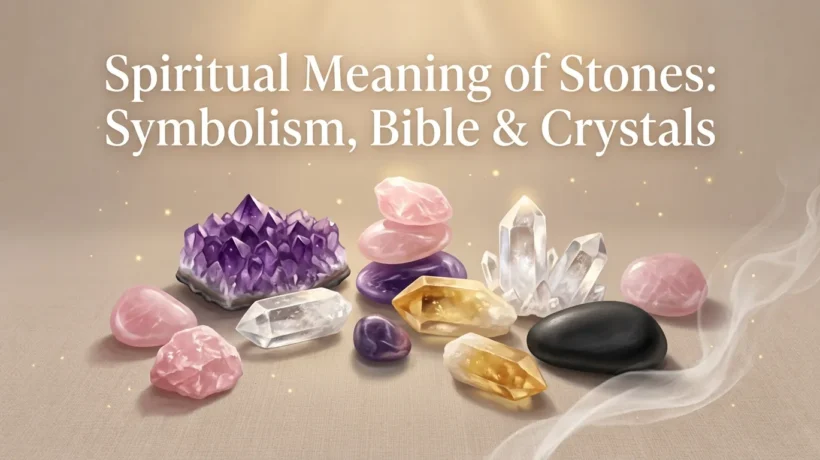
The spiritual meaning of stones centers on strength, permanence, truth, and grounding. Across history, people have used stones to mark sacred places, remember key moments, and carry hope or protection. Each gemstone also holds its own meaning, shaped by its color and story. This guide covers both sides. You will learn what stone itself symbolizes, what the Bible says about stones, and what popular crystals mean.
What Is the Spiritual Meaning of Stones?
Quick Answer: Stones symbolize strength, stability, and lasting truth. Because they outlast people, ancient cultures used them as altars, boundary markers, and memorials. Gemstones add a second layer of meaning through color: pink stones stand for love, blue for clarity, black for protection, and green for growth and renewal.
Read on for the history behind these beliefs and a stone by stone guide.
Why Humans Gave Stones Spiritual Meaning
Stones last longer than almost anything people can hold. That lasting quality made them natural symbols of the eternal. Ancient Egyptians prized deep blue lapis lazuli for jewelry, amulets, and royal burials.
During the Middle Ages, writers gathered stone lore in books called lapidaries. Works such as the Old English Lapidary and the Peterborough Lapidary described the healing and protective powers people linked to each gem. This belief in healing with stones is called lithotherapy.
Three things shaped most of these meanings:
* Color. Red suggested blood and courage, while blue suggested sky and heaven. * Rarity. Scarce gems felt special, so people tied them to royalty and power. * Hardness. Tough stones came to stand for lasting strength.
What Stones Symbolize in the Bible
Stone appears throughout scripture as a sign of truth, memory, and God’s faithfulness.
Stones of Remembrance and Witness
In Genesis 28, Jacob wakes from his dream of a ladder to heaven. He sets up his stone pillow as a pillar and names the place Bethel. Later, Jacob and Laban pile stones into a heap as a witness to their peace agreement in Genesis 31. In Joshua 4, twelve men carry twelve stones out of the Jordan riverbed, one for each tribe. Joshua sets them up at Gilgal. Future children would ask about them and hear the story of the crossing.
The High Priest’s Breastplate and the Foundation Stones
Exodus 28 describes the breastplate worn by Aaron, the high priest. It held twelve precious stones, each engraved with the name of a tribe of Israel. Revelation 21 returns to this image. There, the wall of the New Jerusalem stands on twelve foundations. Gems such as jasper, sapphire, emerald, and amethyst decorate them. The names of the twelve apostles appear on those foundations.
The Cornerstone
Isaiah 28:16 speaks of a precious cornerstone laid as a sure foundation. Psalm 118:22 adds that the stone the builders rejected became the cornerstone. The New Testament applies both verses to Jesus in 1 Peter 2. In Daniel 2, a stone cut without hands grows into a great mountain. It paints a picture of a kingdom that lasts forever. Swedish thinker Emanuel Swedenborg taught in his work Arcana Coelestia that stone in scripture stands for truth.
Spiritual Meaning of Stones by Intention
Many gems share a mineral family. Amethyst, citrine, rose quartz, and clear quartz are all quartz. Ruby and sapphire are both corundum, while emerald, aquamarine, and morganite belong to the beryl family. Even so, each stone carries its own traditional meaning. Pick a goal below to find the stones linked to it.
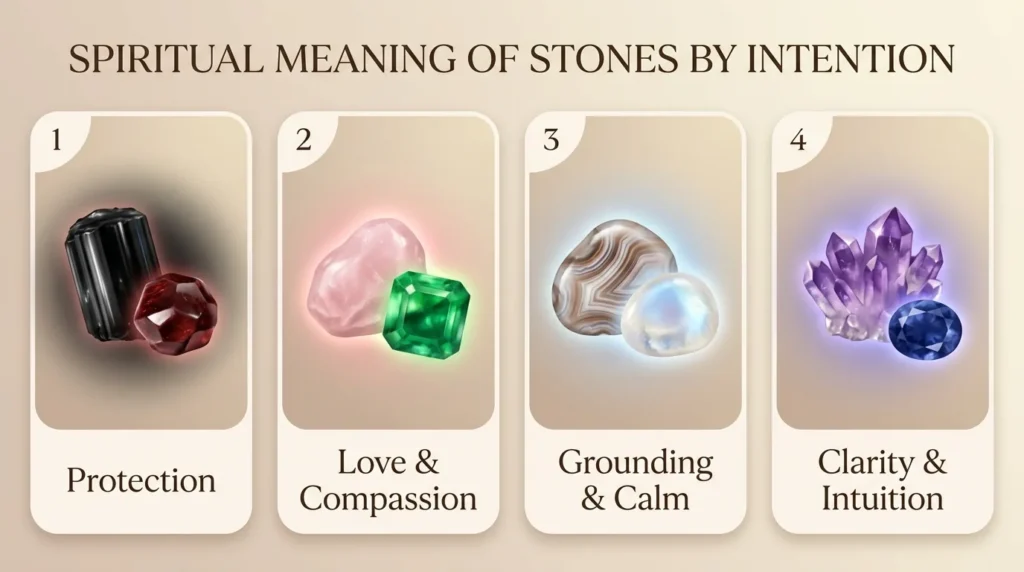
Stones for Protection
| Stone | Look | Traditional Meaning |
|---|---|---|
| Black tourmaline | Glossy black | Shields against negative energy |
| Garnet | Deep red | Loyalty and safe travel |
| Turquoise | Sky blue to green | A protective amulet for centuries |
| Bloodstone | Green with red spots | Courage and endurance |
| Jasper | Earthy red and brown | Stability and steady strength |
| Malachite | Banded green | Protection during big life changes |
Stones for Love and Compassion
These stones are often tied to the heart chakra, the energy center linked to love.
| Stone | Look | Traditional Meaning |
|---|---|---|
| Rose quartz | Soft pink | Self love and forgiveness |
| Morganite | Peach pink | Tenderness and emotional healing |
| Emerald | Vivid green | Loyal love and renewal |
| Ruby | Rich red | Passion and courage |
| Pink tourmaline | Bright pink | Opening the heart to joy |
| Chrysoberyl | Yellow green | Compassion and understanding |
Stones for Grounding and Calm
| Stone | Look | Traditional Meaning |
|---|---|---|
| Agate | Banded layers | Balance and stability |
| Moss agate | Green inclusions | Calm growth and a bond with nature |
| Sardonyx | Red and white bands | Steady willpower |
| Moonstone | Soft, milky glow | Emotional balance and new beginnings |
| Pearl and mother of pearl | Creamy luster | Purity and gentle comfort |
| Aquamarine | Sea blue | Peace and clear speech |
Stones for Clarity and Intuition
Purple and blue stones in this group are often linked to the crown and third eye chakras.
| Stone | Look | Traditional Meaning |
|---|---|---|
| Clear quartz | Colorless | Focus and amplified intention |
| Amethyst | Purple | A calm mind; its Greek name means “not drunk” |
| Sapphire | Deep blue | Wisdom and truth |
| Lapis lazuli | Blue with gold flecks | Honest speech and self knowledge |
| Labradorite | Gray with color flashes | Intuition |
| Fluorite | Purple and green bands | Focus and mental order |
| Tanzanite | Violet blue | Insight and transformation |
| Zircon | Many colors | Clarity and prosperity |
| Seraphinite | Feathery green | Spiritual growth |
Stones for Luck, Abundance, and Renewal
| Stone | Look | Traditional Meaning |
|---|---|---|
| Citrine | Golden yellow | Prosperity and joy |
| Jade | Green | Good fortune and harmony |
| Peridot | Lime green | Warmth and abundance |
| Sunstone | Sparkling orange | Optimism and confidence |
| Spinel | Many colors | Renewed energy |
| Topaz | Golden or blue | Generosity and success |
| Opal | Shifting rainbow flashes | Creativity and hope |
| Alexandrite | Green by day, red by lamplight | Embracing change |
| Diamond | Colorless | Lasting love and commitment |
The Meaning of Stones You Find in Nature
Holey Stones (Hag Stones)
A stone with a hole worn through by water is called a hag stone or adder stone in Britain. Folk tradition treats it as a charm. People hung these stones over beds and stables to keep nightmares away. This custom goes back to at least the 1400s. Pliny the Elder wrote about a druid charm called the serpent’s egg in his *Natural History*. Later folklore tied that charm to these stones.
Heart Shaped Rocks
Heart shaped rocks form naturally as water and wind wear stone down over time. Many people see one as a sign of love. Others read it as a hello from a loved one who has passed. Carved hearts made from quartz or jade carry the same symbolism when given as gifts.
Stones in Dreams
Dream readers often link stones to stability and inner strength. A heavy stone may point to a burden you carry. Building with stones can suggest you are laying a firm foundation for your future.
How to Choose, Use, and Cleanse Your Stones
Start with your intention. Choose a goal from the lists above, then pick the stone that draws your eye. Birthstones and zodiac stones offer another easy starting point.
Once you have a stone, keep it close. Wear it as jewelry, carry it in a pocket, or hold it during meditation. Some people place stones on a desk or bedside table as a daily reminder.
Cleansing is a ritual many owners enjoy. Popular methods include moonlight, sage smoke, and the sound of a bell or singing bowl. For physical care, follow gem guidance. The Gemological Institute of America notes that some amethyst can fade in long, intense light. Keep purple stones out of strong sun.
Symbolism vs. Science
The spiritual meaning of stones comes from culture, faith, and personal reflection. Some crystal lovers believe each stone holds a steady vibration that shapes the energy around it. Medical science has not confirmed healing effects. Treat stones as tools for focus and meaning, alongside care from a doctor.
Frequently Asked Questions
Are gemstone meanings the same across cultures?
Meanings vary from place to place. A stone that means protection in one tradition may mean luck in another. Many modern meanings blend several cultures.
Do the meanings of a gemstone change with color?
Yes. Color adds nuance to a stone’s core meaning. Blue sapphire points to wisdom and clear thinking, while pink sapphire leans toward forgiveness and compassion.
Do lab grown gemstones have the same meanings as natural ones?
Lab grown gems share the same chemistry and structure as natural stones, so they carry the same symbolism. Some owners also see them as a sign of innovation.
What is the luckiest stone to wear?
Jade holds that title in many traditions, especially in Chinese culture. Citrine, long called the merchant’s stone, is a popular pick for luck in money and business.
Which stone is most powerful?
Crystal lovers often name clear quartz, known as the master healer. They believe it boosts any intention and any stone placed near it. Diamond, the hardest natural mineral, stands for unmatched strength.