Left foot spiritual meaning commonly centers on intuition, receiving support, emotional reflection, and feeling grounded. These are symbolic interpretations, rather than one fixed message shared by every faith. Your own beliefs and the reason you noticed your foot help shape how you understand the symbol.
Perhaps your left foot appeared in a dream. Maybe you noticed it during prayer, walking, or a quiet moment. Start with that setting. A dream, a religious image, and an itchy sole each call for a different kind of attention.
Left foot spiritual meaning often refers to intuition, receptivity, grounding, and personal growth. In modern spiritual readings, it can serve as a reminder to listen inward and accept support. Meanings vary by tradition and context. Physical sensations deserve practical care and do not, by themselves, confirm a spiritual message.
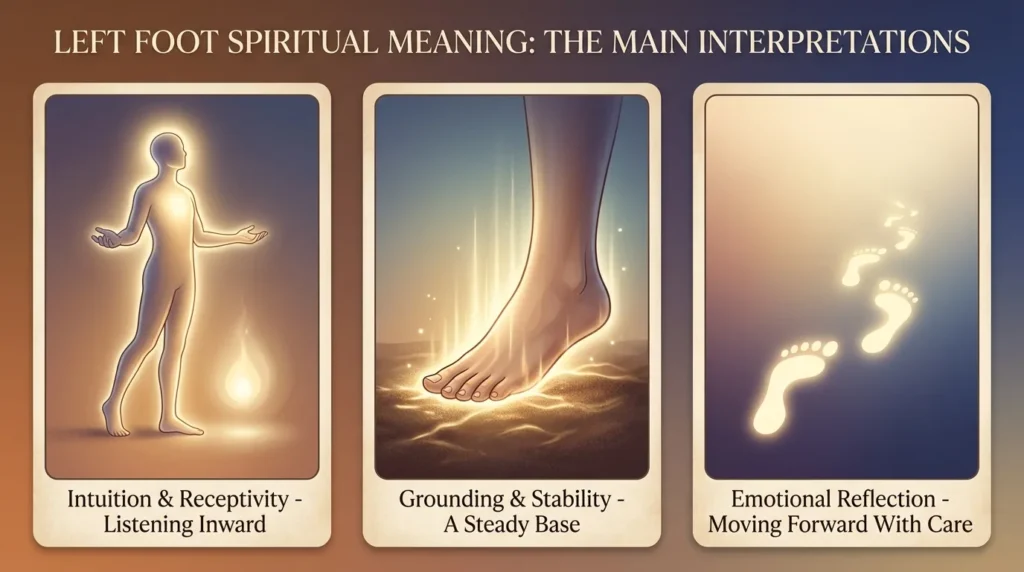
Left Foot Spiritual Meaning: The Main Interpretations
The main interpretations connect what feet do with the way people describe their lives. Feet support us, help us balance, and carry us forward. Those roles offer useful images for trust, direction, and change.
Think of left foot spiritual meaning as a lens for reflection. A symbol can help you ask a clear question about your life. It does not need to predict an event or explain every feeling in your body.
Intuition, Receptivity, and Feminine Energy
One common reading links the left foot with listening inward. Intuition here means noticing a feeling or impression before you can fully explain it. You might sense that you need more time, more rest, or a more honest conversation.
Within this reading, left foot spiritual meaning points toward receptivity. That means making room to receive help, affection, advice, or a fresh idea. Consider someone who always supports others but finds it hard to accept care. The symbol could become a reminder to let a trusted friend help.
Feminine energy is another term used in this framework. It describes qualities such as care, openness, and gentle attention. Anyone can explore these qualities. They are not limited to women, and they do not define your gender or personality.
Inner wisdom also works best beside clear facts. Before making a major choice, name what you feel and check what you know. A quiet hunch can begin a question; careful thought helps you decide what to do with it.
Grounding, Stability, and Support
Grounding gives left foot spiritual meaning a simple, practical focus: notice what supports you now. The sole touches the ground, while the foot helps support your weight. As a metaphor, that contact can stand for a steady base in life.
Your base might include a safe home, a daily routine, a caring person, or a deeply held value. Picture a busy morning when several tasks compete for your attention. Feeling your feet on the floor can become a cue to choose one clear next step.
The Earth appears in this symbolism because it is the surface beneath our feet. Some people enjoy reflecting outdoors or walking barefoot where that is safe. Shoes, a chair, or an indoor floor can serve the same reflective purpose.
This view of left foot spiritual meaning needs no claim about special currents entering the body. Here, grounding means bringing attention to your surroundings and the support you can actually name.
Emotional Reflection and Moving Forward
Another interpretation uses walking as an image for personal growth. A foot lifts, shifts, and finds support again. That sequence can remind you that change often happens through small choices.
For emotional reflection, left foot spiritual meaning can invite a question: what would help me take the next step with care? Perhaps you need to finish a conversation, set a boundary, or ask for support.
Emotional release can mean expressing something you have kept inside. Writing about a feeling or sharing it with someone you trust may fit that intention. The phrase does not establish that emotions sit inside a particular foot.
Progress can also include a pause. Resting, changing plans, and choosing a slower pace can all support a thoughtful spiritual journey. Let the image encourage a useful action rather than a strict timetable for growth.
Left Foot vs. Right Foot: How the Symbolism Differs
In the modern framework discussed here, the left side represents receiving and inner awareness. The right side represents action and outward expression. These are symbolic pairings, not a map of personality or brain function.
Seen this way, left foot spiritual meaning complements the idea of taking action. Listening can help you choose a direction. Movement gives that choice a practical form.
For example, imagine deciding whether to accept a new role. The inward part involves noticing your values and needs. Outward action involves asking questions, reviewing the details, and giving your answer. Both matter.
Some spiritual writing calls these qualities feminine and masculine. Treat those labels as optional language. Care, courage, insight, and action belong to everyone.
A balanced view of left foot spiritual meaning leaves room for both feet. Neither side carries more worth, purity, or spiritual skill. Your natural walking pattern does not measure how receptive or active you are.
Personal habits also deserve context. Leading with one foot during a familiar movement need not become a statement about your life path. Use the comparison when it brings clarity, and set it aside when it adds little.
Does the Context Change the Interpretation?
Yes. The setting matters more than a fixed list of meanings. Before exploring left foot spiritual meaning, separate what happened from the story you might attach to it.
Start with a plain description. You dreamed of walking barefoot. Your foot itched after wearing shoes. A statue drew your attention. Each observation gives you a clearer starting point than assuming they all carry the same message.
Noticing Your Left Foot or Leading With It
You may notice your left foot during a stretch, a walk, or a moment of prayer. That awareness can be an invitation to pause and pay attention. It does not require a hidden explanation.
If left foot spiritual meaning feels relevant, connect it with a specific thought. Were you thinking about support, a decision, or the pace of your day? An honest connection is more useful than forcing one.
Standing with the left foot forward can also be a simple posture. Crossing your feet or shifting weight onto your left leg does not reveal a fixed emotional state. Comfort, the activity, and your surroundings belong in the picture.
Let ordinary movement remain ordinary when that fits. Reflection is a choice, not a task you must perform each time you notice your body.
Seeing Your Left Foot in a Dream
A dream gives left foot spiritual meaning a personal setting. Focus first on the scene and your feelings. Walking with ease, searching for a shoe, and trying to stand all create different stories.
Write down three details: what happened, how you felt, and what the foot helped or prevented you from doing. Then consider whether the scene reminds you of something in waking life.
For example, finding a firm place to stand might bring support to mind. Moving along an unfamiliar path might lead you to think about change. These are possible reflective readings, not promises about future events.
Your own associations matter. A left foot might remind you of dancing, a sport, a loved one, or an old photograph. That connection can be more useful than a general dream dictionary.
Keep your reading of left foot spiritual meaning flexible. You can explore the subconscious as an idea without treating every dream image as a coded instruction.
Pain, Itching, or Tingling in the Left Foot
A search for left foot spiritual meaning sometimes begins with discomfort. Take care of the physical symptom first. Reflection can sit alongside care, but it cannot identify the cause.
The NHS lists exercise and tight shoes among possible causes of pain in the sole. It advises getting medical advice for recurring pain, pain that limits daily tasks, or tingling and loss of feeling. Severe pain or being unable to walk calls for urgent help. See its guidance on pain in the bottom of the foot.
For itching, a skin condition may need attention. Athlete’s foot, for example, can cause itchy patches between the toes and affect the sole. The NHS guide to athlete’s foot explains its signs and care.
An interest in left foot spiritual meaning does not make a symptom proof of an emotional block, a coming journey, or a message from a guide. Note when the sensation began and what makes it better or worse. Those details are useful when seeking care.
Cultural and Religious Claims: What Can Be Supported?
Specific sources give left foot spiritual meaning more depth than broad claims about ancient wisdom. A named image, passage, or teaching lets you see where an interpretation belongs.
It also helps to separate three things: what a source states, what a tradition teaches about that source, and what the image means to you. Personal reflection can build on a source without becoming a rule for everyone.
Shiva’s Raised Left Foot
A clear example comes from Hindu art. In its record for a bronze Shiva Nataraja, the Metropolitan Museum of Art explains that Shiva’s front left hand points toward his raised left foot. The gesture offers refuge to the troubled soul. See the museum’s own Shiva as Lord of Dance collection record.
This example gives left foot spiritual meaning a specific religious and artistic context. The foot forms part of a larger image of Shiva’s dance. Its meaning belongs to that image, rather than automatically applying to every person’s left foot.
A thoughtful personal reading might focus on refuge or support. Keep that reflection distinct from a claim that Hinduism assigns one meaning to all left feet.
Walking Meditation in Buddhism
Buddhist practice offers a different connection through mindful walking. In his own instructions, Buddhist teacher Thanissaro Bhikkhu describes paying attention to the feet or the breath while walking. The practice develops steady attention through an ordinary activity. Read his walking meditation instructions.
This teaching provides context for awareness of the feet. It does not establish a special left foot spiritual meaning or make one side the sole path to awakening. The focus in the cited instruction is attention as you walk.
Foot Washing in Christianity
In John 13, Jesus washes his disciples’ feet and tells them to follow his example. The passage supports reflection on service and care. It does not single out the left foot. You can read the primary text in John 13.
For a Christian reader, that distinction matters. Foot symbolism can draw on a clear biblical passage without adding a special claim about the left side. A personal lesson about accepting care should be presented as reflection on the story.
Across these examples, the source sets the limits of the claim. A religious image, a meditation lesson, and a biblical account each offer something useful. Their meanings remain richer when their differences stay clear.
Using the Symbolism for Personal Reflection
Personal reflection works best when you connect a symbol with your own experience. You need no special object, paid reading, or set ritual. Begin with one theme that fits your present life.
Let left foot spiritual meaning guide one theme: support, direction, or receptivity. Working with one theme makes the reflection easier to follow and gives it a clear purpose.
Reflect on Support, Direction, and Change
Try writing a short response to one of these prompts:
- What helps me feel steady when my day gets busy?
- Where would accepting help make a real difference?
- Which next step fits my values and current needs?
- What pace would let me move forward with care?
Keep the answer concrete. Instead of writing that you need balance, name the change you could make. Perhaps you can protect time for rest, ask someone a clear question, or finish one small task.
To make left foot spiritual meaning useful, connect your chosen theme with an action you can review. If the theme is receiving support, decide who you could speak with. For direction, identify one piece of information you need before choosing.
Return to the note after a few days. Ask whether the action helped you understand your needs. This gives your reflection a practical measure without looking for signs in every step.
Practice Mindful Awareness Without Forcing a Message
Sit in a comfortable chair with your feet supported. Notice the contact beneath your left foot, then your right. Keep your breathing easy and let both sides receive equal attention.
Observe simple details such as pressure, warmth, or the feel of your socks. A plain description is enough. You can notice a sensation without giving it a spiritual label.
If you enjoy visualization, imagine standing on a firm path. Let the image represent the support you want to build. Treat it as a creative exercise, rather than a promise that an imagined event will happen.
A brief walk is another option if walking feels comfortable. Pay attention to a few natural steps while staying aware of your surroundings. Choose your usual pace instead of changing your gait to favor the left side.
Allow the practice to end without a special insight. A moment of clear attention can be worthwhile on its own.
Ultimately, left foot spiritual meaning offers a way to reflect on intuition, support, and personal direction. Its value comes from how thoughtfully you use it. Honor the source of a belief, consider your own experience, and give physical symptoms proper care. Then choose a next step that fits your life, whether that means moving forward, accepting help, or taking time to rest.