The spiritual meaning of thunder is commonly connected with power, awakening, authority, awe, and a call to pay attention. Thunder can feel sudden and commanding, which is why people often use it as a symbol of awareness, warning, or change.
Lightning carries a related but slightly different meaning. Spiritually, it is often associated with illumination, sudden insight, revelation, clarity, energy, and rapid transformation because it appears instantly and briefly lights the darkness.
Thunder often symbolizes power, attention, awakening, and authority, while lightning commonly symbolizes illumination, revelation, clarity, and sudden change. These meanings are symbolic rather than universal rules, and religious or personal interpretations depend on context.
Thunder and lightning appear in nature together, but their symbolic meanings do not need to be identical. One is primarily experienced through sound, while the other is experienced through light. This difference helps explain why thunder is often connected with hearing, authority, and attention, while lightning is more naturally connected with seeing, revelation, and sudden understanding.
What Is the Spiritual Meaning of Thunder?
The spiritual meaning of thunder often centers on power and awareness.
Thunder interrupts silence. Even when a person is not watching the sky, a loud thunderclap can immediately capture attention. Because of this natural effect, thunder can serve as a metaphor for waking up, becoming alert, or recognizing something that has been ignored.
Its strength can also create a feeling of awe. A powerful storm reminds people that nature contains forces much greater than individual human control.
For this reason, spiritual interpretations of thunder often include ideas such as authority, humility, warning, transition, and the need to pay closer attention.
These meanings should be treated as symbolic interpretations. A thunderstorm does not automatically predict a personal event or provide a guaranteed answer to a decision.
What Does Thunder Symbolize Spiritually?
Thunder can symbolize several different ideas depending on the situation in which it is interpreted.
Power and Authority
Power is one of the strongest themes connected with thunder.
Its sound can travel across a large area, shake buildings, and command attention without warning. This makes it an effective symbol of strength and authority.
Spiritually, thunder may remind someone of power that exists beyond individual control. In religious contexts, that power may be connected with divine authority. In personal reflection, it may simply represent strength, intensity, or the realization that some forces cannot be controlled.
The symbolic meaning comes from thunder’s natural qualities rather than from a rule that every thunderstorm has a hidden message.
Awakening and Attention
Thunder can also symbolize awakening.
A sudden clap of thunder can interrupt sleep, conversation, or quiet thought. Symbolically, this makes it similar to a wake up call.
Someone may interpret thunder as a reminder to become more aware of what is happening in life, to stop ignoring an issue, or to give something greater attention.
This type of symbolism is especially common because the physical experience of thunder itself demands awareness.
The idea is metaphorical. It does not mean that every loud thunderclap is directing a person toward a specific choice.
Warning and Preparation
Thunder often accompanies an approaching or active storm, so warning is another natural symbolic meaning.
Spiritually, thunder can represent the idea of becoming alert, preparing for change, or recognizing that conditions are shifting.
A person going through uncertainty might use thunder as a personal image for caution or preparation.
However, thunder should not automatically be interpreted as a supernatural warning that something bad is about to happen.
Its symbolic value comes from the way thunder works in nature. It alerts people to a storm and encourages attention to changing conditions.
Awe and Humility
Thunder can create awe because of its scale and force.
For some people, standing beneath a storm produces a strong awareness of how small a person is compared with the natural world.
This experience can encourage humility, reverence, wonder, or respect.
In religious settings, these feelings may be associated with divine majesty. In a more general spiritual sense, they can represent respect for forces and realities greater than oneself.
Awe does not always mean fear. It can also involve admiration, wonder, and a sense of being confronted with something powerful.
Change and Transformation
Storms can rapidly transform the atmosphere.
Calm weather can become dark, loud, windy, and intense within a short time. Thunder therefore works naturally as a symbol of disruption and transition.
Spiritually, it may represent movement into a new phase, emotional release, or a period when familiar conditions are changing.
The key distinction is between symbolism and prediction.
Thunder may remind someone of change, but it does not prove that a specific life event is about to occur.
What Does Lightning Mean Spiritually?
When people ask what does lightning mean spiritually, the most common symbolic meanings include sudden insight, illumination, revelation, clarity, energy, and rapid transformation.
Lightning appears suddenly and can briefly illuminate an otherwise dark landscape. This natural characteristic gives it a strong connection with understanding and revelation.
A person may therefore use lightning as a metaphor for suddenly seeing something clearly.
It can represent a realization that arrives quickly, an unexpected insight, or a moment when confusion is replaced by understanding.
Spiritual Meaning of Lightning
Lightning has several symbolic meanings that overlap with thunder but emphasize sight, energy, and suddenness.
Illumination and Clarity
Illumination is perhaps the clearest spiritual meaning connected with lightning.
A flash can instantly make objects visible in darkness.
Symbolically, this can represent clarity after confusion, understanding after uncertainty, or becoming aware of something that was previously hidden.
This is why lightning can work well as a metaphor for insight.
The meaning comes from what lightning visibly does. Darkness is briefly interrupted by light.
Revelation and Sudden Insight
Lightning can also symbolize revelation.
Some realizations develop slowly. Others arrive almost instantly.
Because lightning appears so quickly, it can represent the second kind of understanding.
A person may suddenly recognize a truth about a relationship, a goal, a problem, or their own behavior.
This is similar to expressions such as a flash of inspiration.
The symbol does not guarantee that every thought occurring during a storm is spiritually significant. It simply provides a useful image for sudden understanding.
Energy and Power
Lightning is an intense natural electrical event, so it naturally symbolizes energy.
Spiritually or metaphorically, it can represent intensity, momentum, action, or a powerful shift.
This meaning can be positive or unsettling depending on context.
Energy can create movement and transformation, but sudden energy can also be disruptive.
This dual quality is part of what makes lightning such a strong symbol.
Rapid Transformation
Lightning happens quickly.
For that reason, it may symbolize sudden transformation rather than gradual growth.
A rapid change in perspective, an unexpected turning point, or a moment that changes how someone understands a situation can all be compared with lightning.
Again, the comparison is symbolic.
Seeing lightning does not predict that sudden transformation will occur in a person’s life.
Thunder vs Lightning Spiritual Meaning
Thunder and lightning often appear together, but their symbolic emphasis is different.
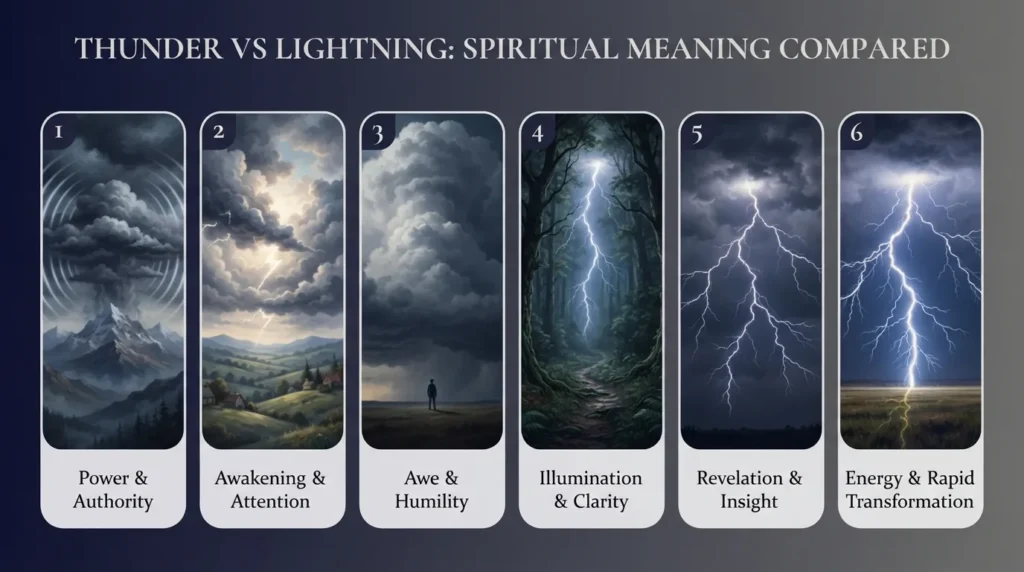
| Thunder | Lightning |
|---|---|
| Power | Illumination |
| Authority | Revelation |
| Awakening | Insight |
| Warning | Clarity |
| Awe | Energy |
| Attention | Rapid change |
Thunder is often interpreted as a call to listen or pay attention.
Lightning is often interpreted as a flash of insight or something becoming visible.
Together, they create a powerful symbolic combination of attention and understanding.
Spiritual Meaning of Thunder and Lightning Together
When thunder and lightning appear together in spiritual symbolism, they can represent power, awakening, revelation, change, and a moment that demands attention.
Thunder announces itself through sound.
Lightning announces itself through light.
This allows the two to work together as symbols of hearing and seeing, awareness and clarity, or disruption followed by understanding.
For someone going through a period of uncertainty, a storm may personally symbolize a difficult but revealing stage of life.
For another person, the same storm may simply create feelings of awe.
There is no universal rule requiring both people to interpret the experience in the same way.
What Does Thunder Mean in the Bible?
Thunder appears several times in the Bible, but it does not carry one fixed meaning in every passage.
Depending on context, it can accompany scenes of divine presence, communicate power and majesty, or appear within scenes of judgment and intervention.
Thunder and Lightning at Mount Sinai
One of the clearest biblical examples appears in Exodus 19.
When the Israelites gather at Mount Sinai, the passage describes thunder, lightning, a thick cloud, a loud trumpet sound, smoke, and the Lord descending upon the mountain. The people react with trembling.
Within this passage, thunder and lightning are part of a dramatic scene of divine presence and covenant.
The imagery emphasizes awe, holiness, seriousness, and power.
This does not establish that every ordinary thunderstorm means God is appearing in the same way. The meaning belongs to the specific event being narrated.
Thunder and the Voice of God in Psalm 29
Psalm 29 contains some of the Bible’s strongest storm imagery.
The psalm describes the voice of the Lord as powerful and majestic and connects that voice with thunder over the waters. It also refers to flashes of lightning as part of the storm scene.
The central idea is God’s power and majesty.
The storm becomes poetic imagery for divine authority over creation.
This passage explains why thunder is sometimes associated with the voice of God in Christian interpretation.
However, it should not be turned into the claim that every thunderclap is a personal spoken message from God.
Psalm 29 is poetry using the language and force of a storm to communicate majesty.
Thunder and Lightning in Revelation 4
Revelation 4 presents another dramatic example.
Revelation 4:5 describes flashes of lightning, rumblings, and thunder coming from God’s throne.
Here, the imagery belongs to a heavenly throne vision.
Thunder and lightning contribute to the atmosphere of majesty, authority, power, and awe.
The passage also echoes the kind of imagery seen around Mount Sinai, where thunder and lightning accompany an important manifestation of divine presence.
This strengthens the biblical association between storm imagery and scenes of overwhelming divine authority.
Thunder in Judgment Contexts
Thunder can also appear in contexts involving judgment or divine intervention.
In 1 Samuel 7:10, the Philistines approach Israel for battle while Samuel is offering a sacrifice. The passage says the Lord thunders against the Philistines, throwing them into confusion before Israel defeats them.
In this specific story, thunder is connected with intervention against Israel’s enemies.
This does not mean that thunder always symbolizes judgment in Scripture.
The broader biblical picture is more varied.
At Sinai, thunder is part of divine presence. In Psalm 29, it emphasizes majesty and power. In Revelation, it appears around the throne. In 1 Samuel, it accompanies intervention against an enemy.
Context determines the meaning.
What Does Lightning Symbolize in the Bible?
Lightning in biblical passages is often associated with dramatic scenes of divine power and presence.
Exodus 19 combines lightning with thunder and cloud at Mount Sinai.
Revelation 4:5 also includes flashes of lightning coming from the throne together with rumblings and thunder.
These examples make lightning part of imagery expressing majesty, authority, and overwhelming power.
It is important not to read every modern lightning storm as a direct repetition of these biblical events.
Biblical symbolism belongs to the literary and theological context of the passages in which it appears.
Is Thunder a Spiritual Warning?
Thunder can symbolize warning because it naturally alerts people to a storm or changing weather.
Someone may therefore use thunder as a personal metaphor for paying attention, preparing for change, or reconsidering something important.
However, there is no universal spiritual rule saying that thunder predicts danger or confirms that a particular choice is wrong.
A symbolic warning is different from a guaranteed supernatural message.
This distinction allows people to reflect on an experience without treating weather as a form of fortune telling.
Is Lightning a Spiritual Sign?
Lightning may feel spiritually significant, especially if it occurs during an emotional or reflective moment.
A person may associate it with sudden understanding, transformation, energy, or clarity.
That personal symbolism can be meaningful.
It is still important to remember that lightning is also a natural electrical phenomenon and that there is no universal rule proving every lightning flash carries an individual spiritual message.
Personal meaning and natural explanation do not have to conflict.
A natural event can inspire reflection without functioning as a prediction.
Thunder and Lightning in Different Traditions
Thunder and lightning have held strong symbolic importance in many cultures.
Ancient societies often associated storms with powerful divine figures because thunder and lightning were among the most dramatic forces people experienced in nature.
Different traditions gave those forces different stories, deities, and meanings.
Some emphasized divine power. Others emphasized warfare, fertility, protection, authority, or the sky.
Because these traditions differ, it is inaccurate to claim that thunder or lightning has one universal spiritual meaning across all cultures.
The common theme is usually their extraordinary power rather than one identical religious interpretation.
How to Interpret Thunder or Lightning Spiritually
If a storm feels personally meaningful, context can help you reflect on the experience without turning symbolism into prediction.
- Notice whether thunder, lightning, or both stood out to you.
- Think about your emotional reaction. Did you feel awe, fear, clarity, urgency, peace, or excitement?
- Consider what was happening in your life at the time.
- Ask whether the event reminds you of power, change, awakening, warning, or insight.
- If using a biblical or religious interpretation, check the actual passage or tradition rather than relying only on general symbolism.
- Avoid treating thunder or lightning as guaranteed instructions about a personal decision or future event.
This approach allows spiritual symbolism to remain meaningful while keeping interpretation grounded.
Frequently Asked Questions
What is the spiritual meaning of thunder?
Thunder commonly symbolizes power, authority, awakening, awe, warning, and a call to pay attention. Its meaning depends on personal, cultural, or religious context.
What does lightning mean spiritually?
Lightning often symbolizes sudden insight, illumination, revelation, clarity, energy, and rapid transformation.
What does thunder mean in the Bible?
Thunder appears in several biblical contexts. It can accompany divine presence, emphasize God’s power and majesty, or appear during scenes of intervention and judgment.
Does thunder mean God is speaking?
Psalm 29 uses storm imagery to portray the voice of the Lord as powerful and majestic, but the passage does not establish that every thunderclap is a personal message from God.
What do thunder and lightning symbolize together?
Together, they can symbolize power, awakening, revelation, sudden change, awe, and a moment that demands attention.
Is thunder a spiritual warning?
Thunder can be used symbolically as a warning or reminder to pay attention, but there is no universal rule that thunder predicts spiritual danger.
Is lightning a spiritual sign?
Lightning can hold personal symbolic meaning, especially as an image of clarity or sudden change, but there is no universal evidence that every lightning event carries a supernatural message.
Conclusion
The spiritual meaning of thunder is most commonly connected with power, authority, awakening, awe, and attention.
Lightning has a related but distinct symbolism. It often represents illumination, sudden insight, revelation, energy, and rapid transformation.
Together, thunder and lightning can create a powerful image of disruption followed by awareness, or force combined with clarity.
Biblical passages add more specific meanings. At Mount Sinai, thunder and lightning appear within a scene of divine presence and covenant. Psalm 29 uses storm imagery to express the majesty and power of God’s voice. Revelation places lightning and thunder around the heavenly throne, while 1 Samuel includes thunder in a particular scene of divine intervention.
These examples also show why context matters.
Thunder does not always mean judgment, lightning does not always mean revelation, and an ordinary storm does not automatically carry a personal supernatural message.
Their strongest spiritual value comes from the qualities they naturally display. Thunder commands attention. Lightning brings sudden light. Together, they offer enduring symbols of power, awareness, change, and moments when something difficult to ignore suddenly becomes clear.