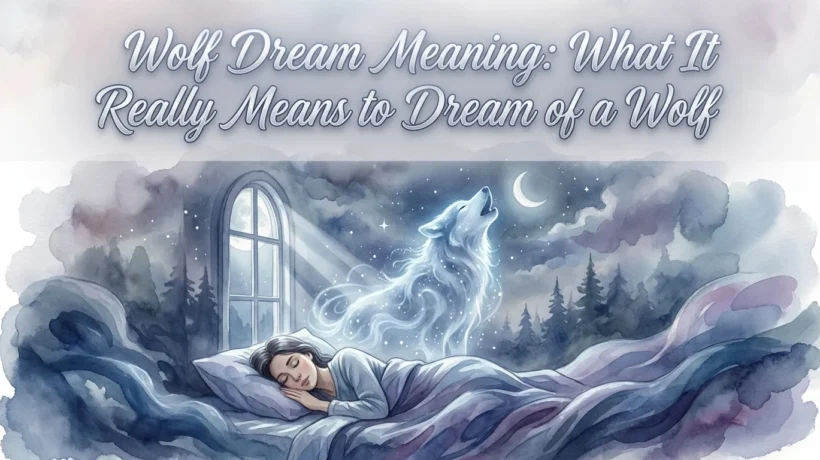
A wolf dream meaning usually points to your instincts, your inner strength, and the hidden parts of yourself that want attention. Wolves are wild, loyal, and hard to tame. When one walks into your sleep, your mind is often showing you something powerful about who you are. What the dream means for you depends on the wolf’s behavior, its color, and how you felt while it was near.
A wolf dream meaning usually reflects your instincts, inner power, and the parts of yourself you keep out of view. The wolf can appear as a guide, a warning, or a mirror of strength you have not fully claimed. Its behavior, color, and the emotion you felt shape the true message.
Key takeaways before you read on:
- The wolf’s behavior matters far more than the fact that a wolf appeared.
- Color adds meaning. White points to clarity, black points inward, grey points to balance.
- Carl Jung linked the wolf to the shadow self, the parts of you kept quiet.
- Cultures from Native American to Norse tied the wolf to strength, loyalty, and guidance.
- How the dream ended, whether you ran, fought, or made peace, often reveals the most.
Why Wolves Show Up in Dreams
Wolves live between two worlds. They are gentle with their pack, yet fierce when they hunt. That mix is exactly why your mind reaches for a wolf when it wants to show you something big inside you. The image can stand for raw instinct, deep loyalty, or a truth you have set aside.
Context always leads the meaning. A calm wolf in a quiet forest carries a very different message than a wolf circling you at night. Before you settle on one meaning, picture how the wolf acted and how you responded to it.
Wolf Dream Scenarios at a Glance
| Scenario | Likely Meaning |
| Being chased by a wolf | Avoiding a choice, feeling, or truth you keep postponing |
| A wolf attacking you | Inner tension or emotion that wants to be faced |
| A lone wolf | Independence, self reliance, or a season of solitude |
| A wolf pack | Family, belonging, and your place in a group |
| A wolf protecting you | Support arriving, or trust in your own strength |
| A wolf staring at you | A moment of clarity, your instincts asking to be seen |
| Killing a wolf | Overcoming a fear, sometimes at the cost of instinct |
| A dead wolf | The close of one chapter and the start of another |
| A werewolf | Transformation, change, or two sides of yourself |
The table gives you a starting point. Each scenario below adds more depth so you can match it to your own dream.
Wolf Dream Meaning by Scenario
Being Chased by a Wolf
This is one of the most common wolf dreams. Often it points to something you keep running from in waking life. Maybe a choice waits for you. Perhaps a feeling keeps catching up no matter how fast you move. Ask yourself what you have been putting off. That honest answer usually sits close to the message.
A Wolf Attacking You
An attack in a dream tends to reflect tension that wants your attention. Sometimes it stands for another person. Other times it stands for your own feelings, especially if you stay calm on the outside while emotion builds underneath. Notice whether you froze or fought back. Your response shows how you handle pressure when you are awake.
Dreaming of a Lone Wolf
The lone wolf carries a mix of beauty and ache. Seeing one can mean you are learning to rely on yourself and trust your own path. If the wolf looked peaceful, solitude may be serving you well. If it looks lost, the dream may be asking you to reach out and reconnect with people who care.
Dreaming of a Wolf Pack
A pack speaks to family, loyalty, and belonging. Wolves live in close groups and protect one another with real devotion. If you run with the pack, you likely feel aligned with the people around you. If you stood outside it, the dream may be nudging you to look at where you feel welcome and where you do not.
A Wolf Protecting You or a Friendly Wolf
A calm, friendly wolf is a warm sign. It often means you are building a healthy bond with your own strength. A protecting wolf can mean support is near, even from people you have not noticed yet. This dream tends to appear during growth, when you begin to trust your instincts instead of second guessing them.
A Wolf Staring at You
A steady gaze from a wolf feels personal, and it is. That stare works like a mirror. It reflects a part of you that wants to be seen and understood. If you felt calm under the gaze, your instincts and your goals may be in harmony. If it unsettled you, the dream may be inviting you to face a truth you have been avoiding.
Killing or Fighting a Wolf
This scenario brings mixed feelings, and for good reason. On one side, it can mean you are facing a real fear head on. On the other, it can hint that you are silencing your own instinct in the process. Pay attention to whether you felt relief or regret when you woke. That single feeling often tells you which reading fits.
A Dead Wolf
A dead wolf sounds heavy, yet it usually points to renewal. It can mark the end of a struggle or an old pattern that no longer serves you. If you felt sadness, you may be grieving an ending. If you felt calm, the dream may be showing you that a new chapter is ready to begin.
Dreaming of Werewolves
Werewolves live in stories across the world, so they carry rich meaning. In dreams they often stand for transformation and the pull between two sides of yourself. A werewolf can appear when a big change is close, or when you feel two directions tugging at you. The famous professor Remus Lupin in the Harry Potter books shows this idea well, a person who chooses who to be despite his wild side.
What the Wolf’s Color Adds to the Meaning
Color can sharpen the wolf dream meaning even further. These links come from long standing folklore, so treat them as a starting point for reflection.
| Wolf Color | What It Tends to Add |
| White wolf | Clarity, purity, hope, or a guiding presence |
| Black wolf | The shadow self, hidden feelings, or a truth surfacing |
| Grey or silver wolf | Balance, wisdom, and calm strength |
| Brown wolf | Grounding, loyalty, and a bond with family |
| Red wolf | Passion, energy, and strong feeling ready to be expressed |
The Psychology Behind Wolf Dreams
Carl Jung, the Swiss psychiatrist who founded analytical psychology, described the parts of ourselves we push aside as the shadow self. A wolf fits that idea with ease. When it appears, it can stand for instincts like courage, drive, or honest emotion that you have kept quiet.
Jung believed that facing these parts, rather than fleeing them, was part of what he called individuation, becoming a fuller version of yourself. Sigmund Freud read animal dreams through a different lens and tied them to urges held back from waking life. Both views agree on one thing. The wolf is worth listening to, not fearing.
Dream meaning is personal, not exact, so hold these ideas loosely. The International Association for the Study of Dreams offers a helpful reminder that animal images often connect to instinct and emotion that come before logic. Your own feeling in the dream remains your best clue.
Wolf vs Similar Dream Animals
Wolves can look like other animals in dreams, so the difference guides the meaning. A dog usually points to loyalty and comfort you already trust. A fox leans toward cleverness and quick thinking. A coyote plays the trickster, showing you where you may be fooling yourself. A bear dream tends to speak to personal power and firm boundaries, while a wolf speaks to instinct and belonging. If your dream featured a wily canine, our guide to the coyote dream meaning adds more detail.
Spiritual and Cultural Meanings of Wolf Dreams
Native American Traditions
Many Native American traditions have long honored the wolf as a symbol of loyalty, strength, and guidance. These beliefs pass through oral history, and they vary between nations. In several of them, the wolf appears as a pathfinder, an animal that helps you find your true direction.
Norse and Celtic Traditions
Norse stories gave the wolf great weight. The giant wolf Fenrir stood for fate and raw power. Warriors known as berserkers were said to channel the animal’s courage in battle. Celtic tradition linked the wolf to authority and instinct. Roman legend added the wolf that raised Romulus and Remus, the twins who founded Rome, a tale that ties the wolf to protection and beginnings.
Wolf Dream Meaning in the Bible
Scripture uses the wolf as a strong image. In Matthew 7:15, the text warns of false prophets who arrive in sheep’s clothing yet act like wolves inside. In Luke 10:3, followers are sent out like lambs among wolves. Through a biblical lens, a wolf dream may feel like a call to look closely at who you trust and to guard your peace with care.
Who Tends to Have Wolf Dreams
Wolf dreams often arrive during moments of change. People starting a new job, a move, or a fresh chapter report them often. Those learning to set boundaries may dream of a bold, watchful wolf. When life feels demanding, a chase dream can mirror the sense of a task that keeps following you. The dream tends to show up right when your instincts are working hardest.
How to Reflect on Your Own Wolf Dream
- Write down what you remember as soon as you wake, including the wolf’s color, actions, and setting.
- Note how you felt during the dream and how you feel about it now.
- Ask which part of your life needs more courage, more rest, or clearer boundaries.
- Notice whether the dream repeats, since a pattern often points to something worth facing.
- Give the dream a day or two before you decide what it means for you.
Frequently Asked Questions
Is dreaming of a wolf a good sign or a bad one?
Neither by default. A calm wolf tends to reflect healthy inner strength. A tense or threatening wolf often points to something that wants your attention. The feeling you had in the dream decides the tone.
What does a black wolf mean in a dream spiritually?
A black wolf commonly links to the shadow self and to feelings you have not fully looked at yet. Its arrival can mean a powerful truth is rising, ready to be understood and welcomed.
What does a white wolf mean in a dream?
A white wolf often points to clarity, hope, and guidance. Many read it as a calm, protective presence, a reminder that light can appear even in a hard season.
Why do I keep dreaming about wolves?
Repeating wolf dreams usually point to strong instincts or a feeling that wants to be addressed. The pattern is a gentle signal to look at what keeps returning in your waking life.
What does it mean when a wolf chases you in a dream?
A chase most often reflects avoidance. Something in your life keeps asking for attention while you try to outrun it. Turning to face the wolf in the dream can mark a real turning point.
What does a friendly wolf in a dream mean?
A friendly wolf usually reflects trust in yourself and a sense of inner balance. It can also hint that loyal, caring people stand close by, ready to support you.
What is the biblical meaning of wolves in dreams?
In scripture the wolf stands for caution and discernment. The phrase about a wolf in sheep’s clothing points to appearances that hide true intent. Through this view, the dream may invite you to trust wisely.