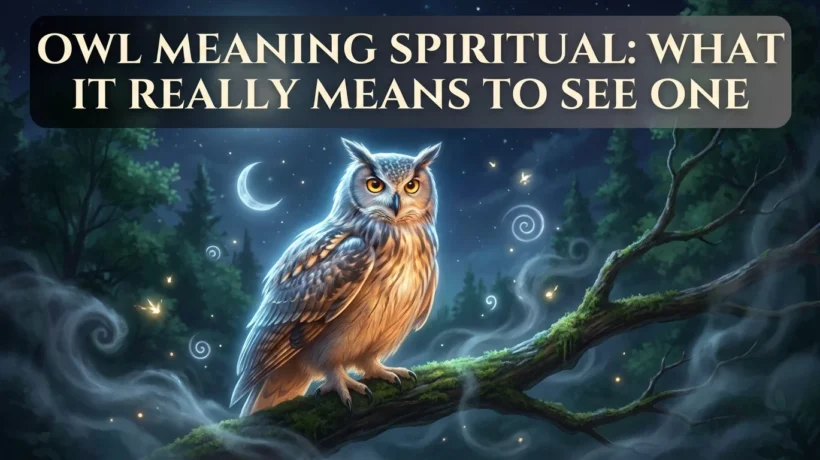
The owl meaning spiritual most people search for comes down to three ideas: wisdom, intuition, and change. Owls move quietly, hunt in the dark, and turn their heads almost all the way around. Because of that, cultures across the world have treated them as symbols of insight during confusing or uncertain times. Some traditions read the owl as a gentle nudge toward trusting yourself. Others read it as a warning. Both readings show up in the research below, and neither one cancels out the other.
Spiritually, an owl usually points to wisdom, trust in your own instincts, and a shift about to happen in your life. Every owl meaning spiritual tradition traces back to one of three sources: mythology, scripture, or folk belief passed down through a community. The exact reading changes depending on which of these three lenses you look through.
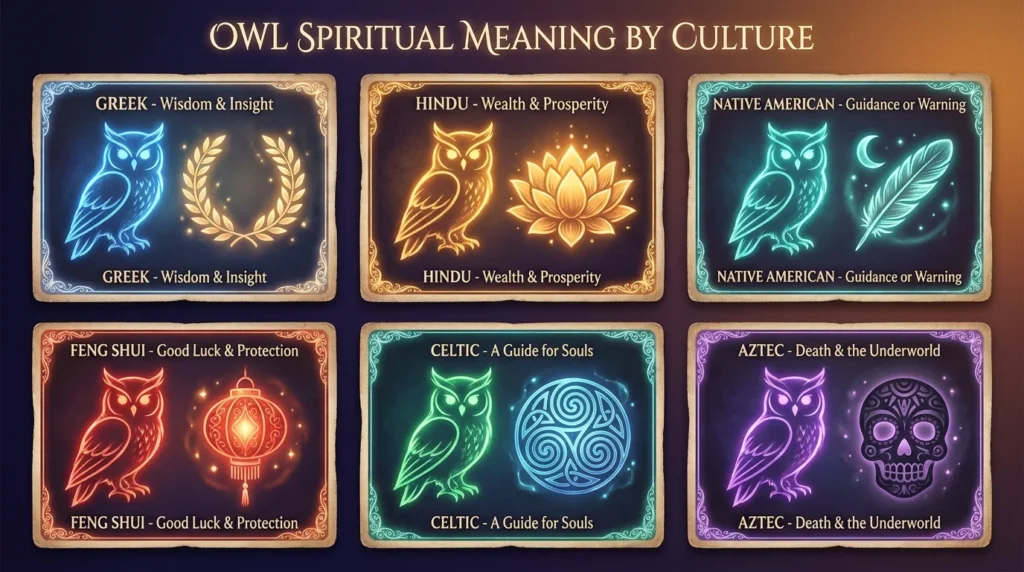
Owl Spiritual Meaning by Culture at a Glance
| Culture or Tradition | Core Meaning | Source or Origin |
| Ancient Greece | Wisdom, insight | Sacred bird of Athena, goddess of wisdom |
| Hindu tradition | Wealth, prosperity | Vahana (mount) of Lakshmi |
| Native American (varies by nation) | Guidance and protection, or a warning of death | Oral tradition; differs by tribe |
| Feng Shui and Chinese custom | Good luck, protection | Traditional cultural belief |
| Japanese custom | Good fortune | Traditional cultural belief |
| Hebrew Bible | Uncleanliness, desolation, loneliness | Leviticus, Deuteronomy, Isaiah, Psalms, Job |
| Celtic folklore | Guide for souls, hard won wisdom | Oral tradition |
| Aztec mythology | Death, the underworld | Associated with Mictlantecuhtli, god of the dead |
What Owls Represent Across Cultures
People have watched owls for thousands of years, and almost every culture built its own story around the bird.
Greek Mythology and Athena
The owl was sacred to Athena, the Greek goddess of wisdom and war strategy. Ancient Greeks placed the owl on coins and pottery as her symbol. This link is one reason wisdom still sits at the center of most owl symbolism today, even outside of Greek culture.
Hindu Tradition and Lakshmi
In Hindu tradition, the owl serves as the vahana, or divine mount, of Lakshmi, the goddess of wealth. This connection ties the owl to prosperity in Hindu belief, and it becomes especially visible around Diwali, when Lakshmi is honored.
Native American Traditions
Beliefs vary widely from nation to nation, so there is no single Native American view of the owl. Some traditions treat the bird as a protector and messenger that guides souls through change. Other beliefs, including some reported among Navajo and Apache communities by the Buffalo Bill Center of the West, treat a daytime owl sighting as a warning that death may be near. Both readings come from long oral traditions rather than a single written source, so they are best understood as traditional beliefs, not proven facts.
Celtic and Other Folk Traditions
In Celtic folklore, the owl is often linked to the Otherworld and treated as a guide for souls crossing between realms. This belief frames the owl’s wisdom as something earned by facing darkness rather than something handed out freely. Similar guide themed beliefs appear in parts of African and Aboriginal Australian folklore, though in some of these traditions the owl’s call at night is treated as an omen of misfortune rather than guidance.
Aztec Mythology and the Underworld
In Aztec mythology, the owl is closely tied to Mictlantecuhtli, the god of death who ruled the underworld known as Mictlan. Artwork shows Mictlantecuhtli wearing owl feathers, and his presence was often signaled by the hoot of an owl. This tradition places the owl firmly on the darker end of the spectrum, standing in contrast to the Greek and Hindu views above.
Christianity and Buddhism, Briefly Compared
Christian tradition, discussed in more detail below, tends to use the owl as a picture of ruin or spiritual emptiness. Buddhist teaching does not center the owl the same way, and generally uses bird imagery to point toward clarity of mind rather than desolation. The contrast is worth noting because it shows how much the owl’s meaning shifts depending on which faith tradition you are reading it through.
What Owls Mean in the Bible
The Bible mentions owls several times, almost always in a serious tone.
| Verse | What It Says | What It Points To |
| Leviticus 11:17 | Owl listed among birds not to be eaten | Ritual uncleanliness |
| Deuteronomy 14:16 | Repeats the same dietary restriction | Ritual uncleanliness |
| Isaiah 34:11 to 15 | Owls nesting where a city once stood | Judgment and desolation |
| Psalm 102:6 | Writer compares his loneliness to an owl in ruins | Isolation, grief |
| Job 30:29 | Owl paired with despair | Suffering, isolation |
Leviticus 11:17 and Deuteronomy 14:16 place the owl in the unclean category, alongside other scavengers and birds of prey. The dietary law was not really about the bird itself. It was part of a larger system meant to help ancient Israel separate ordinary life from what was set apart as holy.
Isaiah 34:11 through 15 paints a picture of judgment, describing owls nesting in the ruins of a fallen city. The image works because owls are drawn to quiet, abandoned places, so their presence signals that a place has been left behind.
Psalm 102:6 and Job 30:29 both use the owl to express loneliness rather than evil. The writer of the Psalm compares his own isolation to an owl sitting alone among ruins. Job uses almost the same image while describing his suffering.
None of these passages present the owl as a demonic or cursed creature. They use it as a picture of emptiness and grief, based on where the bird naturally lives.
Is Seeing an Owl a Good Sign or a Bad Omen?
Both views exist side by side, and neither one is more correct than the other. The answer depends entirely on which tradition shaped your beliefs growing up.
In Feng Shui, and in parts of Japanese and Chinese custom, the owl is treated as a sign of good luck, protection, and coming prosperity. Figurines and paintings of owls are placed near entryways for this reason, based on the belief that the bird’s sharp sight wards off bad energy.
In other traditions, an owl signals warning or loss. Some Native American beliefs mentioned earlier fall into this category, and similar warning based beliefs appear in some African and Aboriginal Australian folklore as well.
If you want one simple way to read an owl encounter, pay attention to how you felt in the moment rather than searching for a universal rule. A sense of calm or curiosity usually points toward guidance. A sense of dread usually points toward a warning your gut already noticed before your mind caught up.
Owl Color Meanings
Some modern spiritual writers assign different meanings to owls based on color. These readings are folk interpretations rather than facts from any single tradition, so treat them as a lens for reflection rather than a rulebook.
| Owl Color | Common Interpretation |
| White | Purity, clarity, a message from a loved one who has passed |
| Black | Deep transformation, the start of spiritual awareness |
| Brown | Protection, restored energy, grounded intuition |
| Gray | Mystery, connection to the unknown, adaptability |
| Reddish brown | A gentle nudge to check on physical or emotional health |
What It Means When an Owl Shows Up in Your Life
Context changes everything with an owl encounter. Below is a quick reference for the situations people search for most.
| Situation | Common Spiritual Reading |
| An owl outside your window | A sign of coming change, or in some traditions, a warning to pay attention |
| An owl during the day | Rare, since owls are nocturnal, so many treat it as a call to stay alert |
| An owl hooting at night | A nudge to trust your intuition during a season of uncertainty |
| An owl seeming to follow you | A reminder to slow down and look at a decision more carefully |
| An owl in a dream | Wisdom, hidden knowledge, or a warning, depending on how the dream feels |
Owl in a Dream
Dreaming about an owl carries much of the same dual meaning as a waking encounter. Many dream interpretation writers connect the image to wisdom and intuition, especially when the owl feels calm or watchful in the dream. Others link a dream owl to a coming warning, particularly when the dream feels tense or the owl appears aggressive. As with any dream symbol, the feeling you woke up with usually matters more than the owl itself.
Owl as a Spirit Animal or Totem
People who work with animal totems often describe the owl as a spirit guide for anyone moving through a season of change. Choosing the owl as a personal totem is generally tied to a desire for clearer judgment, better instincts, and the courage to look at uncomfortable truths instead of avoiding them. This idea is a modern spiritual practice rather than an ancient one, so it sits alongside the older traditions above rather than replacing them.
A Few Common Mistakes People Make When Reading Owl Symbolism
Most confusion about owl symbolism comes from treating one tradition as the only correct answer. Here are a few mistakes worth avoiding.
Treating one culture’s view as universal. An owl is not automatically a death omen just because some Native American and Aztec traditions read it that way. It is also not automatically lucky just because Feng Shui says so. Both readings are real within their own tradition, and neither one applies everywhere.
Ignoring the context of the sighting. An owl calling from a nearby forest at night is a normal part of its natural behavior. An owl appearing somewhere unusual, like inside a home or in broad daylight, carries more symbolic weight in most traditions simply because it breaks the pattern people expect.
Forcing a single fixed meaning onto every sighting. Even within one tradition, the meaning of an owl can shift based on color, time of day, and how the person felt in the moment. A rigid, one size fits all reading tends to miss the nuance every culture actually built into its owl beliefs.
How to Reflect on an Owl Encounter
If an owl sighting stuck with you enough to search for its meaning, a short reflection can help more than any fixed list of rules.
Start by writing down exactly what happened. Note the time of day, where you were, and what the owl was doing. These small details often point toward which tradition’s reading fits best.
Next, name what you were thinking about right before the encounter. Owls tend to stand out in memory during moments of decision or worry, so the timing itself can be a clue.
Finally, sit with the feeling the owl left you with rather than searching for a single correct answer. A feeling of calm usually lines up with guidance. A feeling of unease usually lines up with a warning your gut had already noticed. Either way, the owl meaning spiritual you land on should feel honest to your own experience, not forced to match someone else’s tradition.
Owl Sightings and Everyday Life
Not every owl encounter needs to carry deep spiritual weight. Owl populations are active and healthy in most wooded and suburban areas, so a hoot at night or a shape on a fence post is often simply a bird going about its normal routine. Barn owls, great horned owls, and screech owls all live close to human neighborhoods because homes and farms attract the rodents they hunt.
That said, the reason owl symbolism has lasted this long is that people naturally look for meaning in things that stand out from routine. An owl breaks the visual pattern of daytime birds, and its silent flight makes it feel different from anything else in the sky. Whether you read that difference as a spiritual message or simply as an interesting animal encounter is a personal choice, and both responses are reasonable.
FAQ
Is an owl a symbol of death?
In some traditions, yes, especially certain Native American beliefs where a daytime owl sighting is treated as a warning. In most other traditions, the owl is not linked to death at all, and instead points to wisdom or change.
Is seeing an owl good luck?
In Feng Shui and in parts of Japanese and Chinese custom, seeing an owl is treated as good luck and a sign of coming prosperity. In other traditions, it carries a warning instead, so the answer depends on which belief system you are asking about.
What does an owl symbolize in the Bible?
The Bible lists the owl as an unclean bird in Leviticus 11:17 and Deuteronomy 14:16. Isaiah 34:11 to 15, Psalm 102:6, and Job 30:29 use the owl as an image of ruin, loneliness, and despair rather than as a symbol of evil.
What does it mean when an owl visits you at night?
Many people take a nighttime owl visit as a nudge to trust their intuition during a period of change. Since owls are most active at night, this reading ties directly to the bird’s natural behavior rather than to any single written source.
What color owl is considered the luckiest?
White owls are the color most often linked to good luck and positive messages, though this reading comes from modern folk belief rather than a single ancient tradition.
Why is the owl connected to wisdom?
This idea traces back mainly to Greek mythology, where the owl was sacred to Athena, the goddess of wisdom. That connection spread through Western art and language over time, which is why it still shapes the owl meaning spiritual conversation today.