A grasshopper dream meaning usually points to forward movement, a leap of faith, or a decision you have been putting off. Grasshoppers only jump forward, never backward, and most dream interpreters build the entire symbol around that one fact. The insect’s sudden burst of motion after long stillness also shapes how the dream gets read, since it mirrors the pattern of patience followed by quick action.
Dreaming of a grasshopper generally reflects progress, intuition, and readiness to make a bold move. The exact grasshopper dream meaning shifts based on what the insect was doing in the dream, how many appeared, and how you felt when you woke up. No single reading fits every dream, since context changes the message.
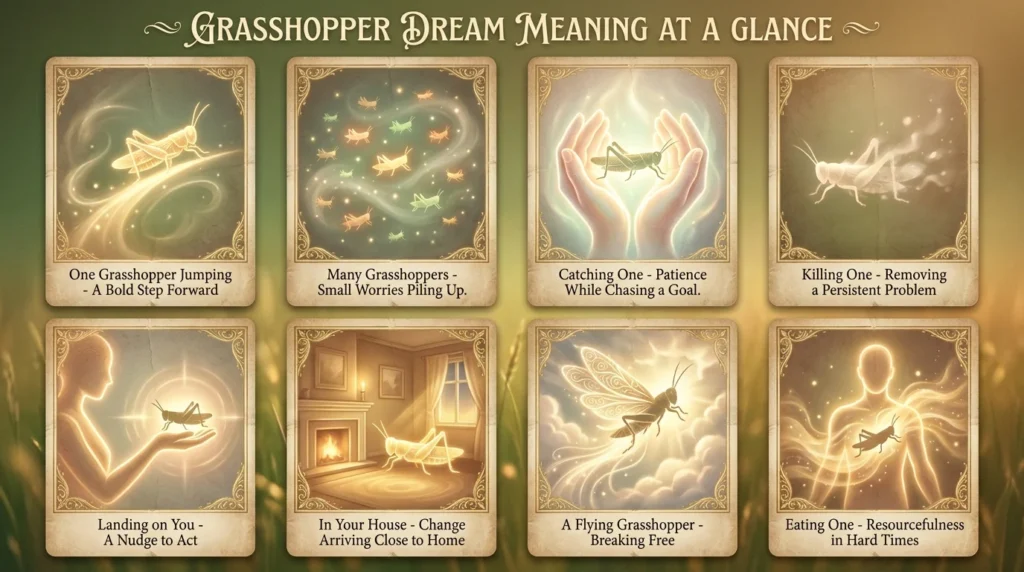
Grasshopper Dream Meaning at a Glance
| Dream Scenario | Common Interpretation |
| A single grasshopper jumping | Readiness to take a bold step forward |
| Many grasshoppers together | Small worries piling up, or feeling overwhelmed |
| Catching a grasshopper | A need for patience while chasing a goal |
| Killing a grasshopper | Removing a small but persistent problem |
| A grasshopper landing on you | A direct nudge to act on a decision you have delayed |
| A grasshopper in your house | Unexpected news or a change arriving close to home |
| A flying grasshopper | Feeling stuck, paired with the ability to break free |
| Eating a grasshopper | Resourcefulness during a difficult stretch |
What Does It Mean to Dream About a Grasshopper?
Most grasshopper dream meaning interpretations center on three ideas: agility, timing, and trust in your own instincts. Grasshoppers are built for sudden, decisive motion. They hold still for long stretches, then jump with no hesitation once they move. Dream interpreters often connect that rhythm to moments in waking life where careful waiting is followed by one quick decision.
Because a grasshopper cannot jump backward, many readings also treat the dream as a sign that whatever choice you are facing does not have an easy retreat. This is less about pressure and more about clarity. Once you commit, you are meant to move ahead rather than second guess the decision after the fact.
Common Grasshopper Dream Scenarios
The details of the dream carry more meaning than the insect itself.
Dreaming of Many Grasshoppers
A swarm of grasshoppers in a dream is often read as a pile up of small problems rather than one large crisis. The reading leans on the real world behavior of grasshopper swarms, which can strip a field bare through sheer numbers rather than individual strength. In dream terms, this usually points to several minor stresses building toward something bigger if they are left unaddressed.
Dreaming of Catching a Grasshopper
Catching a fast moving insect takes patience and quick timing. This scenario is generally read as encouragement to stay persistent with a goal that keeps slipping out of reach, rather than giving up after the first few attempts.
Dreaming of Killing a Grasshopper
This scenario is usually tied to successfully dealing with a small but nagging issue, whether that is a bad habit, a minor conflict, or a lingering worry that has been easy to ignore.
A Grasshopper Landing on You
This is one of the more direct versions of the dream. Because a grasshopper choosing to land on a person breaks the pattern of avoidance the insect normally shows, many interpreters read it as a personal signal to stop delaying a decision you already know you want to make.
A Grasshopper Inside Your House
A grasshopper appearing indoors is unusual, since the insect naturally stays outdoors in grass and fields. Dream interpreters generally read this as a sign that change is arriving somewhere close to home, whether that means your family, your living situation, or your daily routine.
Grasshopper Symbolism Across Cultures
Cultural background changes how a grasshopper dream tends to be read.
| Culture or Tradition | Common Meaning |
| Chinese tradition | Good luck, prosperity, a long family line |
| Many Native American farming cultures | Warning, since grasshoppers and locusts historically destroyed crops |
| Hunting based Indigenous cultures | Less negative, sometimes neutral or protective |
| Aesop’s Greek fable tradition | A caution about enjoying the moment without planning ahead |
The Native American view is worth explaining rather than flattening into one meaning. Farming communities that depended on crops often treated grasshoppers and locusts as a genuine threat to survival, so the insect took on a negative meaning in their stories. Communities that relied more on hunting than farming did not face the same crop losses, so their traditions carry far less of that negative weight. Both readings are accurate within their own context, and neither one represents every Native American tradition equally.
The Grasshopper in the Bible
The Bible uses the grasshopper mainly as an image of smallness rather than as a moral symbol.
| Verse | What It Says | What It Points To |
| Leviticus 11:22 | Grasshoppers listed among insects permitted as food | Dietary law |
| Numbers 13:33 | The spies describe themselves as grasshoppers next to giants | Feeling small and fearful |
| Isaiah 40:22 | People on earth compared to grasshoppers before God | Human smallness against God’s greatness |
| Ecclesiastes 12:5 | A grasshopper becoming a burden in old age | Physical decline |
Numbers 13:33 is the most quoted of these verses. The spies sent into Canaan describe feeling like grasshoppers next to the people living there, and their fear becomes a turning point in the story. Isaiah 40:22 uses the same comparison in a very different tone, placing all of humanity below God’s greatness without any fear attached to the image. Ecclesiastes 12:5 shifts the picture again, using the grasshopper to describe how even small things become heavy as the body ages. None of these verses treat the grasshopper as evil or sacred. It is used purely as a picture of scale.
The Ant and the Grasshopper: A Different Kind of Lesson
Aesop’s fable “The Ant and the Grasshopper” is not a spiritual text, but it shapes how many people already think about the insect before they ever have a dream about one. In the story, the grasshopper spends the summer singing while the ant stores food for winter. When winter comes, the grasshopper has nothing saved and must ask the ant for help.
The fable is a lesson about planning ahead, not a religious or mythological source, so it should not be treated as a spiritual claim. Still, it is worth naming here because it explains why some people wake up from a grasshopper dream with a nagging feeling about being unprepared, even when nothing in the dream itself pointed to that idea directly.
Is a Grasshopper Dream a Good Sign?
Most traditions lean positive. Chinese tradition treats the grasshopper as a sign of luck and prosperity, and many modern dream interpreters connect the insect to progress and good timing rather than danger.
The exception comes from certain farming based Native American traditions, where the grasshopper carries a warning tied to crop damage. Neither view is more correct than the other. The right reading depends on which tradition shaped how you were taught to see the insect, and on how the dream itself felt when you woke up.
Grasshopper Color Meanings in Dreams
Some modern dream writers assign meaning based on the grasshopper’s color. These are folk readings built on general color associations rather than ancient tradition, so treat them as a starting point for reflection rather than a fixed rule.
| Color | Common Interpretation |
| Green grasshopper | Growth, renewal, a fresh start |
| Brown grasshopper | A grounded, practical step rather than an impulsive one |
| Yellow grasshopper | Optimism and confidence in an upcoming decision |
| Grasshopper blending into its surroundings | A reminder to stay adaptable during a period of change |
Grasshopper or Locust: Does the Difference Matter in a Dream?
Grasshoppers and locusts are closely related insects, and many older Bible translations use the words somewhat interchangeably. In a dream, most interpreters treat a single grasshopper very differently from a locust swarm. A single grasshopper generally points to personal, individual change. A locust swarm carries much heavier symbolism tied to widespread loss, since locust swarms in real life have historically destroyed entire harvests. If your dream involved a single insect jumping around a room or yard, the grasshopper reading above applies. If it involved an overwhelming swarm stripping a field bare, the meaning leans closer to loss on a larger scale rather than personal growth.
A Few Common Mistakes People Make Reading This Dream
Most confusion around a grasshopper dream meaning comes from forcing one fixed answer onto every version of the dream.
Treating every grasshopper dream as automatically positive. Chinese tradition and many modern spiritual writers lean positive, but that is not the only lens available. A dream that felt unsettling should not be forced into a cheerful reading just because one tradition says grasshoppers bring luck.
Ignoring how many grasshoppers appeared. A single grasshopper and a swarm of them carry very different weights, yet many quick online answers treat them the same way.
Assuming the fable “The Ant and the Grasshopper” is a spiritual source. The story is a moral lesson about planning ahead, not a dream tradition, so it should inform your reflection rather than serve as proof of a specific meaning.
How to Reflect on a Grasshopper Dream
A short reflection usually works better than searching for one universal answer.
Start by writing down exactly what the grasshopper was doing. A single grasshopper jumping forward carries a different weight than a swarm covering a field, so the specific scenario matters more than the fact that a grasshopper appeared at all.
Next, think about what decision has been sitting unresolved in your life recently. Grasshopper dreams tend to show up most often during periods when a choice is close but has not yet been made.
Finally, pay attention to how the dream felt rather than forcing it into a fixed meaning. A feeling of excitement usually lines up with encouragement to move forward. A feeling of unease usually lines up with a warning that something needs more thought before you act. Either way, the grasshopper dream meaning that fits you best is the one that matches your own gut reaction, not a rule pulled from a tradition you do not personally follow.
FAQ
What does it mean when you dream about a grasshopper?
Most interpretations connect a grasshopper dream to forward movement, patience followed by quick action, and trust in your own timing. The specific meaning shifts based on what the grasshopper was doing in the dream.
Is dreaming of a grasshopper good luck?
In Chinese tradition, yes, the grasshopper is linked to luck and prosperity. In some farming based Native American traditions, the insect carries a warning instead, since real grasshoppers historically damaged crops.
What does it mean when a grasshopper lands on you in a dream?
This scenario is usually read as a direct sign to stop delaying a decision you already know you want to make, since it breaks the grasshopper’s usual pattern of staying at a distance.
What does the Bible say about grasshoppers?
The Bible lists the grasshopper as a permitted food in Leviticus 11:22 and uses it as an image of smallness in Numbers 13:33, Isaiah 40:22, and Ecclesiastes 12:5. It is not treated as a spiritual symbol of good or evil in scripture.
Does dreaming of many grasshoppers mean something bad?
Not necessarily bad, but it is usually read as a sign that several small stresses are piling up. The reading borrows from how real grasshopper swarms build into a larger problem over time.
Does the color of the grasshopper in my dream matter?
Some modern dream writers link green grasshoppers to growth and fresh starts, and brown grasshoppers to grounded, practical action. These readings come from general color symbolism rather than an ancient tradition, so use them as a starting point rather than a strict rule.
Is there a difference between dreaming of a grasshopper and dreaming of a locust?
Yes. A single grasshopper is usually read as a personal, individual sign of change. A locust swarm carries heavier symbolism tied to widespread loss, based on how real locust swarms have historically destroyed crops.
Is the Ant and the Grasshopper fable connected to dream meaning?
Not directly, since it is a Greek fable rather than a spiritual or religious source. It does explain why some people associate the grasshopper with a lack of preparation, even though that idea does not come from any dream tradition.