The peacock is one of the most instantly recognizable birds in the world, and its meaning has followed it across thousands of years and dozens of cultures. Few animals carry symbolism this consistent across so many unrelated traditions, which makes peacock symbolism worth understanding properly rather than reducing to a single vague idea.
Peacock Symbolism: The Core Meaning
Peacock symbolism centers on four consistent themes: beauty, pride, immortality, and protection or vision. Its dramatic display has made the bird a natural symbol for confidence and self expression, while its “eyed” feathers and yearly feather regrowth gave rise to ideas about watchfulness and renewal that show up again and again across cultures that had no contact with one another. The peacock meaning that emerges from all of this is remarkably stable given how many separate traditions arrived at it independently.
Beauty is the most obvious layer, and the easiest to dismiss as shallow. But most traditions treat the peacock’s display as something closer to earned confidence than vanity, a display that has to be built and maintained rather than simply worn. Pride carries a double meaning here too. It can mean healthy self assurance, or it can tip into the negative sense captured by the English idiom “peacocking,” showing off attention seeking behavior. Both readings exist side by side, and context usually makes clear which one applies.
Immortality and protection round out the core four themes, and both trace back to something real about the bird rather than pure invention. The next section explains exactly where that connection comes from.
The Real Bird Behind the Symbol
The symbolism did not appear out of nowhere. It comes directly from how the bird actually looks and behaves.
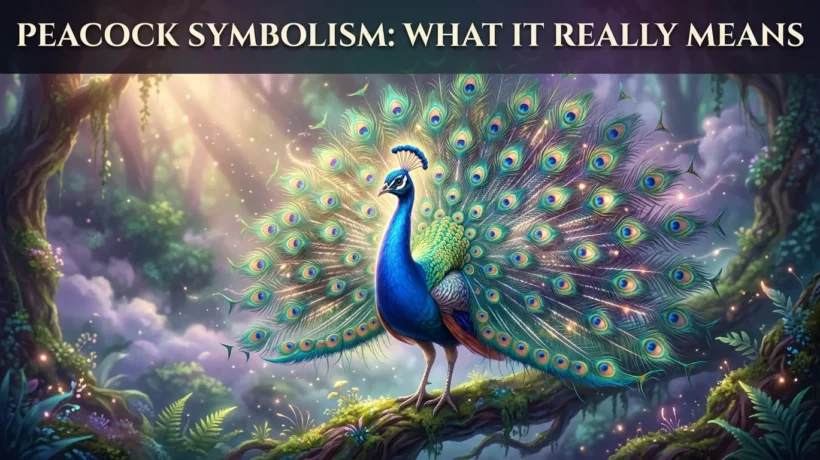
A peacock’s train, often mistaken for its tail, is made up of long, iridescent feathers that end in a circular pattern called an ocellus, or eyespot, from the Latin word for eye. The true tail feathers are shorter and stiffer, hidden underneath, and exist mainly to support the train when it is raised. A peer reviewed study on peacock courtship describes how the train is raised and vibrated in a display called train rattling, which always precedes mating and strongly influences which males peahens choose. This is genuine sexual selection at work, not decoration for its own sake, and it takes real energy and physical condition to pull off well.
The train is also molted and fully regrown every year after breeding season, which is very likely the real origin point for the immortality and renewal symbolism found in Christian, Persian, and Hindu traditions alike. A bird that visibly loses its most striking feature and grows it back each year is a natural, recurring symbol for rebirth, long before anyone wrote that meaning down. The regrowth process takes months and demands real energy investment from the bird, which fits neatly with the idea, found across so many traditions, that true renewal is not instant or effortless.
Eyespots may carry a second, practical function too. Research on eyespot patterns in other species suggests they can startle or delay predators, which lines up neatly with the ancient belief that a peacock’s “hundred eyes” offered protection and watchfulness. Whether or not the ancient storytellers knew the biology behind it, they landed remarkably close to something real.
Peacock Symbolism Across Cultures and Religions
The same bird produced remarkably similar symbolism in cultures that developed independently of one another.
Hindu Symbolism
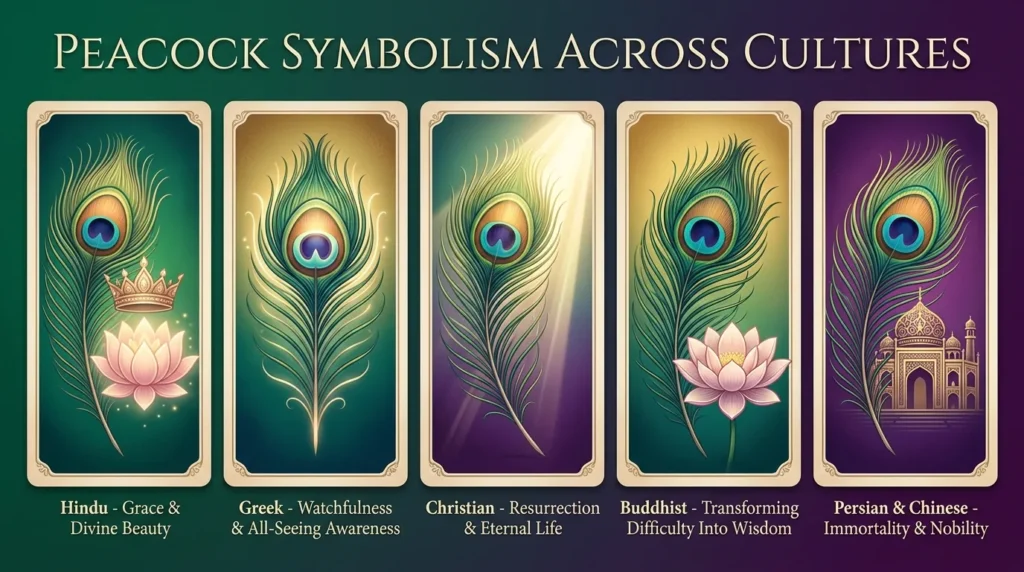
In Hindu tradition, the peacock holds real religious weight rather than simple decoration. Lord Krishna is commonly depicted wearing a peacock feather in his crown, and the peacock also appears connected to Saraswati, the goddess of wisdom and the arts. The bird’s association with grace and divine beauty runs through Hindu art and iconography going back centuries, and the peacock remains one of India’s most culturally significant animals today.
Greek Mythology
In Greek mythology, the peacock is tied to Hera, queen of the gods. According to the myth, Hera’s servant Argus, a giant covered in a hundred eyes, was killed by Hermes, and Hera placed his eyes onto the tail of her sacred bird as a tribute. This origin story is the direct root of the peacock’s long association with watchfulness and all seeing awareness, and it is worth being clear that this is myth, a meaningful cultural story, not a historical or biological claim about the bird itself.
Christian Symbolism
Early Christian art frequently used the peacock as a symbol of resurrection and eternal life, drawing on the bird’s habit of shedding and regrowing its feathers each year. Peacock imagery appears in early Christian and Byzantine tombs and church art as a visual reminder of life continuing beyond death, a theme that lines up closely with the real annual molt described in the biology section above.
Buddhist Symbolism
Buddhist tradition holds that the peacock can consume certain toxic plants without harm, and treats this as a teaching rather than a literal biological claim, a symbol of the ability to transform difficulty or negativity into wisdom rather than being destroyed by it. This is a spiritual teaching, not a documented fact about peacock diet or toxin resistance, and it is worth holding onto the distinction. Chinese Buddhism separately connects peacock feathers to Kwan Yin, a figure associated with compassion and mercy, adding a second, gentler layer to the bird’s meaning within that tradition.
Persian and Chinese Symbolism
In ancient Persia, peacocks were linked to immortality, and their image decorated palaces and temples of the Achaemenid Empire. Chinese tradition took a different angle, associating the peacock with dignity, nobility, and rank, historically tied to status and honor within the imperial court.
These traditions developed independently of one another, separated by geography and centuries, yet they kept landing on strikingly similar ideas: beauty worth displaying, watchfulness worth trusting, and a life force that outlasts a single season. That kind of convergence is rare, and it is part of why peacock symbolism feels so durable compared to symbolism built around a single culture or story.
Outside of religious and mythological tradition, the peacock has also carried a more secular kind of meaning in modern Western culture, most often as a symbol of individuality and bold self expression, showing up in fashion, design, and branding whenever a sense of confident distinctiveness is the goal. This modern layer sits comfortably alongside the older traditions rather than competing with them, since both ultimately trace back to the same idea: a creature that displays exactly what it has, without apology.
What Does a White Peacock Mean?
A white peacock is real, not a myth, and it is not albino. The white coloring comes from a genetic condition called leucism, which reduces pigment in the feathers without affecting the eyes, unlike true albinism, where pigment is absent throughout the entire body including the eyes. Because white peafowl are genuinely uncommon, the symbolism leans toward purity, clarity, and a fresh start, a variation striking enough to feel like a message on its own. Some traditions treat a white peacock as an especially strong version of the immortality symbolism already tied to the species, since the rarity itself reads as significant.
What Do Peacock Feathers Represent?
Peacock feathers carry much of the same symbolism as the bird itself, concentrated into a single, portable object. The eyespot is the center of that meaning, tied back to the Greek myth of Argus and read broadly as protection, awareness, and watchfulness. This is part of why peacock feathers show up so often in home decor and spiritual practice, treated as a symbol of guarding a space rather than simple decoration. A single feather is generally read the same way as the full display, just in a smaller, more personal form, which is part of why they are often kept, gifted, or displayed individually rather than only in full arrangements.
Is the Peacock a Good Luck Symbol?
In most traditions, yes. The peacock is far more often read as a positive omen than a negative one, tied to blessings, protection, and renewal rather than misfortune. One real exception exists in the idiomatic use of “peacock” as a verb, to peacock, meaning to show off or seek attention, which is a separate, modern usage and not part of the bird’s actual spiritual symbolism. It is worth keeping these two threads separate. One is a genuine, cross cultural spiritual reading built up over thousands of years. The other is a much newer, casual figure of speech that happens to share the same word.
What Does It Mean When a Peacock Spreads Its Feathers?
This behavior ties directly back to the real biology above. A peacock spreading and rattling its train is performing a genuine mating display, signaling health and genetic quality to a potential mate. Symbolically, this moment is often read as an invitation to display your own confidence and individuality openly, rather than holding back out of fear of being seen. A partially raised or half hearted display, by contrast, can be read as hesitation, confidence that has not fully committed to showing itself yet.
Peacock Spirit Animal Meaning
If the peacock feels like a personal totem or recurring presence in your life, it is generally read as encouragement to embrace self expression, stand confidently in who you are, and trust that your own qualities are worth showing rather than hiding. This reading pulls directly from the same beauty and confidence themes found throughout the cultural symbolism above. Someone who feels a strong pull toward the peacock as a totem is often navigating a season where visibility feels risky, a new role, a creative project, or a relationship where they are being asked to show more of themselves than usual.
What Does It Mean to Dream About a Peacock?
A peacock in a dream generally carries the same core themes as its waking symbolism: confidence, self expression, and a readiness to be seen. Displaying its full train in a dream often points to a moment where you are being invited, or are already choosing, to show more of yourself than usual. Seeing the bird resting calmly instead tends to reflect quiet confidence rather than active display, a settled sense of self rather than a need to prove anything. Scattered or damaged feathers in the dream can point to feelings around lost confidence or a setback to your sense of self, tied loosely to the real molting process described earlier.
As with any dream, the feeling you had while watching the bird usually matters more than the image itself. Confidence and admiration in the dream tend to mirror real self assurance, while discomfort or embarrassment can point to a fear of being too visible or too much. This dream peacock meaning holds up whether the bird was simply present or actively performing, since the emotional tone of the dream tends to carry the real signal either way.
The Bottom Line
Peacock symbolism holds together remarkably well across cultures that never had contact with one another, and the real biology behind the bird explains why. A yearly molt gave rise to ideas about renewal. Its hundred eyed display gave rise to ideas about protection and watchfulness. Confidence in showing what you have gave rise to ideas about pride, in both its healthy and unhealthy senses. Whatever context brought you here, whether a cultural question, a feather in your home, or a dream you woke up thinking about, that same core peacock meaning, beauty, pride, immortality, and protection, is almost always somewhere in the answer.
Frequently Asked Questions
What does a peacock symbolize?
A peacock generally symbolizes beauty, pride, immortality, and protection or watchfulness, themes found consistently across Hindu, Greek, Christian, and other traditions.
What is the spiritual meaning of a peacock?
Spiritually, a peacock is often read as a symbol of renewal and confident self expression, tied to its yearly feather regrowth and its dramatic, deliberate display.
Is seeing a peacock good luck?
Most traditions treat a peacock as a positive sign connected to blessings and protection, though the idiomatic sense of “peacocking” refers separately to showing off rather than the bird’s real symbolism.
What does a white peacock mean?
A white peacock is a real, genetically uncommon variation caused by leucism, and it is generally read as a symbol of purity, clarity, or a fresh start.
What does it mean to dream about a peacock?
It generally reflects confidence and self expression, with a fully displayed train pointing toward a readiness to be seen and a calm peacock reflecting quiet, settled self assurance.