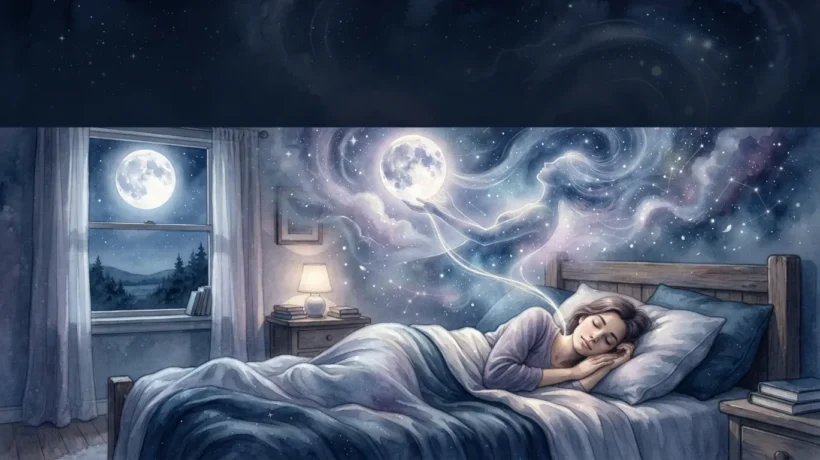
The spiritual meaning of dreaming about the moon almost always centers on intuition, emotional cycles, or a hidden part of yourself coming into view. The exact message depends heavily on the moon’s phase and how bright or dim it appeared.
Quick answer: Dreaming about the moon usually reflects your emotional state, intuition, or a cycle in your life that is turning. A full, bright moon points to clarity or completion. A dim, dark, or eclipsed moon points to confusion or a difficult stretch. The specific phase you saw sharpens the meaning considerably.
What Does It Mean to Dream About the Moon?
The moon has no light of its own. It only reflects the sun, and that single fact shapes almost every interpretation of a moon dream across every tradition. Because the moon reflects rather than generates, dreaming about it often points to reflection itself, seeing your own emotions, intuition, or hidden feelings mirrored back to you.
This is why the moon shows up so often during emotional transitions, big decisions, or quiet periods of self examination. The dream borrows the moon’s own nature, quiet, cyclical, and revealing only what light allows.
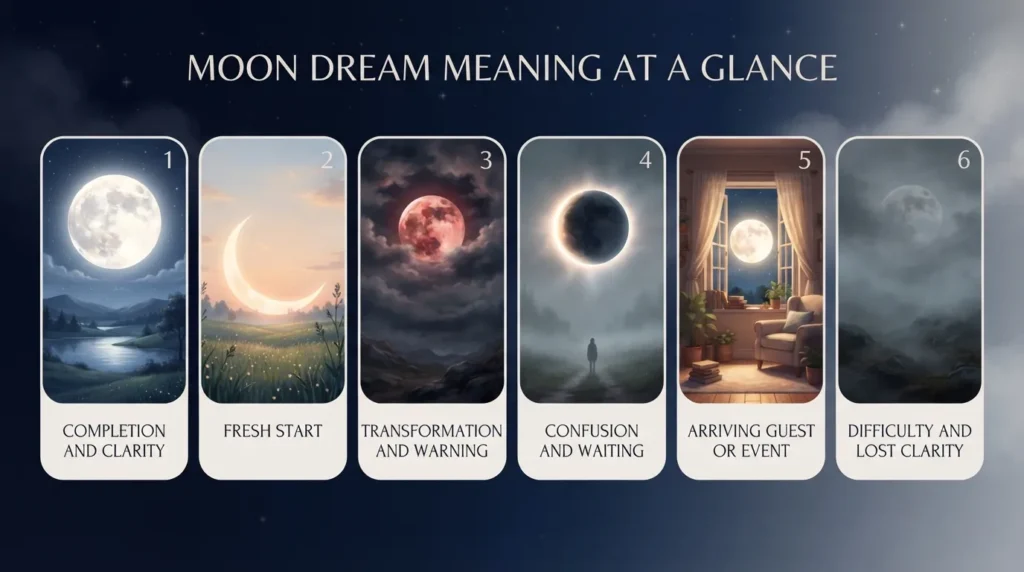
Moon Dream Meaning at a Glance
| Moon Phase or Detail | Common Meaning |
|---|---|
| Full moon | Completion, clarity, emotional fulfillment |
| New or crescent moon | A fresh start, a hidden potential just beginning |
| Blood or red moon | Intense transformation, or a warning to pay closer attention |
| Lunar eclipse | Confusion, hidden truths, or a period of waiting |
| Moon inside your house | An arriving guest or a significant personal event |
| Dark, dim, or fading moon | Difficulty, loss of clarity, or a setback |
Moon Dream Meaning Based on What You See
A Full Moon
A bright, full moon is one of the most positive versions of this dream, generally read as a sign of completion, emotional fulfillment, or heightened intuition arriving right when you need it.
A New or Crescent Moon
A slim crescent or new moon usually points to a fresh start, a small but meaningful beginning that has not fully taken shape yet.
A Blood or Red Moon
A red or blood colored moon tends to carry a heavier tone, often linked to intense transformation or a warning to slow down and pay closer attention to a situation before it develops further.
A Lunar Eclipse
An eclipse generally points to confusion, hidden information, or a period where you are being asked to wait rather than act.
The Moon Inside Your House
The moon appearing indoors, somewhere it does not belong, is often read as a sign that a guest, an important visitor, or a significant personal event, is on its way.
A Dark or Fading Moon
A moon that is dim, clouded, or disappearing generally points to a temporary setback, confusion, or a loss of clarity that is expected to pass rather than last.
Two Moons in the Sky
Seeing two moons at once is a less common but recurring version of this dream, often read as a sign of duality, two paths, two emotions, or two parts of yourself, that currently feel like they are competing for your attention.
What Triggers Moon Dreams
Moon dreams tend to cluster around specific real life moments rather than appearing at random:
- A big decision on the horizon. Many dreamers report seeing the moon right before a choice that logic alone cannot fully settle.
- An emotional transition. Grief, a relationship change, or a shift in identity often bring lunar imagery into dreams.
- A period of heightened intuition. Creative work, spiritual practice, or quiet reflection can all increase the odds of a moon dream.
- Genuine exposure to moonlight. A bright moon outside your window the same night is sometimes simply incorporated into the dream directly, without deeper meaning.
The Psychological Meaning: Carl Jung and the Anima
Carl Jung wrote extensively about the moon, connecting it closely to what he called the anima, the unconscious feminine aspect of the psyche present in people regardless of gender. In a 1929 seminar lecture, Jung pointed out that the very word lunacy comes from luna, the Latin word for moon, reflecting an old and widespread belief that the moon’s phases could affect the mind. He treated the moon as a symbol of the receptive, intuitive, reflective side of the psyche, in contrast to the sun’s association with conscious, active energy.
The Jungian analyst Erich Neumann extended this idea further, describing the moon’s periodic waxing and waning as a natural symbol for the rhythms of the unconscious itself, always shifting between visibility and darkness. Read this way, a moon dream often signals that something quiet and intuitive inside you is asking to be noticed, whether that is a feeling, an insight, or a part of your personality you do not often lead with.
The Spiritual Meaning of Dreaming About the Moon
Spiritually, the moon is widely tied to intuition, emotional cycles, and the passage of time. Because the moon visibly changes shape while remaining the same object, many spiritual writers read a moon dream as encouragement to trust that change, even difficult change, is part of a larger cycle rather than a permanent state.
A bright, clear moon is generally read as reassurance. A dim or clouded one is more often read as a nudge to be patient with a period that currently feels unclear.
Moon Dream Meaning in the Bible
The biblical meaning of a moon dream has to be built from related Scripture, since the Bible does not describe anyone having a dream about the moon directly, so any biblical reading here is an interpretation, not a direct teaching from Scripture.
The moon itself carries real meaning throughout the Bible. Genesis 1:16 describes God making the moon to govern the night, tying it to order within creation. Psalm 104:19 states that God made the moon to mark the seasons, connecting it to divine timing. Isaiah 60:19 looks forward to a time when believers will no longer need the moon for light, because God himself will be their everlasting light, a passage some readers apply to a dream where the moon feels distant or insufficient, reading it as a nudge to look past the reflected light toward its true source.
Separately, in Catholic devotional art, the Virgin Mary is traditionally depicted standing on a crescent moon, a well documented artistic and devotional tradition rather than a claim made directly in the biblical text itself. Some Catholic dream writers draw on this imagery when interpreting a moon dream, though it remains tradition, not Scripture.
Moon Dream Meaning in Islam
In classical Islamic dream interpretation, most notably the work attributed to the eighth century scholar Muhammad ibn Sirin, the moon holds unusually high importance, often representing a just ruler, a respected scholar, or a spiritual guide. A bright, full moon in its proper place is generally read as a sign of honor, prosperity, and justice. A moon that is dim, clouded, or eclipsed is read the opposite way, often pointing to a setback, the loss of a position, or difficulty ahead. The moon appearing inside one’s house is specifically read as a sign that a guest or traveler will soon arrive.
Moon Dreams Across Different Cultures
Chinese and East Asian Traditions
In Chinese culture, the moon is closely tied to family reunion and harmony, most visibly through the Mid Autumn Festival, when families gather specifically to view the full moon together. A moon dream within this cultural lens is often read through the theme of togetherness, either the presence of it or a longing for it, rather than through the more Western emphasis on intuition alone.
Greek and Roman Mythology
In Greco Roman mythology, the moon was personified as the goddess Selene in Greek tradition and Luna in Roman tradition, both associated with night, mystery, and quiet observation over the sleeping world. This mythological personification helped cement the moon’s long standing association with the feminine and the unconscious well before modern psychology gave those same themes formal names.
Moon Dreams and Sleep Timing
Some dream researchers note that dreams involving strong visual light sources, including the moon, tend to cluster in the later stages of a night’s sleep, when REM periods grow longer and dream imagery becomes more vivid and memorable. This may partly explain why moon dreams are reported so often and recalled so clearly compared to some other dream symbols, independent of whatever symbolic meaning the moon itself carries.
What to Do After a Moon Dream
- Note the phase. A full, new, or fading moon each point in a different direction, so the detail is worth writing down before it fades from memory.
- Check in with your intuition. If the dream felt calm, treat it as encouragement to trust a feeling you have been second guessing.
- Give a dark moon time. If the moon felt dim or clouded, remind yourself that phases pass, and the dream may simply be reflecting a temporary stretch rather than a lasting one.
- Look for the cycle. Ask what part of your life currently feels like it is ending, beginning, or somewhere in between.
Frequently Asked Questions
What does it mean when you dream about the moon?
It usually reflects intuition, emotional cycles, or a hidden part of yourself becoming visible. The moon’s phase in the dream shapes the exact meaning.
What does a full moon in a dream mean?
A full moon is generally read as a positive sign, tied to completion, clarity, or emotional fulfillment.
What is the psychological meaning of dreaming about the moon?
Carl Jung connected the moon to the anima, the intuitive, reflective side of the psyche. A moon dream is often read as a sign that this quieter, more intuitive part of you is asking for attention.
What does the Bible say about dreaming of the moon?
The Bible does not describe a dream about the moon directly, but the moon itself is tied to order and divine timing in verses like Genesis 1:16 and Psalm 104:19.
What does the moon mean in Islamic dream interpretation?
In classical Islamic dream interpretation, the moon often represents a ruler, scholar, or guide. A bright moon points to honor and prosperity, while a dim or eclipsed moon points to difficulty or setback.
Why does the moon feel more emotional in dreams than the sun?
Psychologically, this lines up with Jung’s distinction between the moon as receptive and reflective and the sun as active and direct. Because the moon only reflects borrowed light, dreams featuring it often carry a quieter, more introspective feeling than dreams involving the sun.
Does the moon mean something different in Chinese culture?
Yes. Chinese tradition ties the moon closely to family reunion and harmony, most visibly through the Mid Autumn Festival, so a moon dream in that cultural context is often read through the lens of togetherness rather than intuition alone.
Can the moon appear in a dream without carrying any special meaning at all?
Yes. If you spent time under a bright moon recently or simply enjoy stargazing, your mind may include it purely as visual material from the day, with no deeper symbolism attached. Context from your waking life is usually the best clue for telling the two possibilities apart. If nothing in your current circumstances feels emotionally charged, the simpler explanation is often the right one. Save the deeper reading for dreams that carry a strong emotional charge you cannot easily explain away.