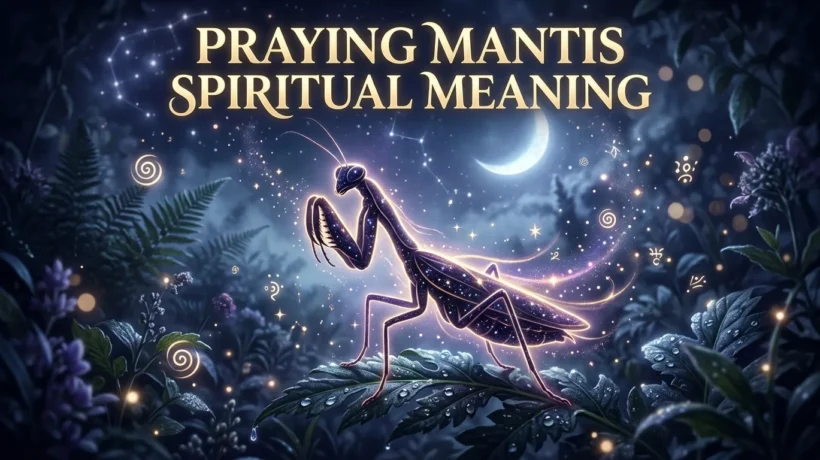
The praying mantis spiritual meaning centers on stillness, patience, and quiet prayer. Because the insect holds its front legs folded together like hands in prayer, nearly every culture that has written about it reads a sighting the same way: slow down, pay attention, and trust that the right moment is coming.
In short, the praying mantis spiritual meaning is stillness, patience, and prayerful attention. Its folded front legs look like hands in prayer, so most traditions treat a sighting as a gentle call to pause and observe before acting. It is almost never read as a warning sign.
The Praying Mantis Spiritual Meaning Across Cultures and Religions
People have attached spiritual weight to this insect for thousands of years. Its name alone hints at why. The word “mantis” comes from the ancient Greek word for prophet, seer, or diviner, according to Connecticut’s official state insect record. Early observers watched the insect freeze in place, front legs raised, and saw something closer to meditation than hunting.
Here is a quick look at how different traditions read the same insect.
| Tradition | Common Reading |
|---|---|
| Christianity | Prayer, piety, watchfulness (folk tradition, not scripture) |
| Native American folklore | Ancient wisdom, wealth, good fortune |
| Chinese culture | Discipline, courage, decisive action |
| Japanese culture | Autumn, transition, quiet introspection |
| San mythology (southern Africa) | Creation, transformation, divine trickery |
| Ancient Greek tradition | Prophecy, foresight, spiritual sight |
| Buddhism | Patience, perseverance, calm focus |
| Celtic tradition | Patience, wisdom, careful timing |
Christianity
Christians did not invent the mantis’s prayer like pose, but many have adopted it as a devotional image. Because the insect stays still with its legs folded, some believers connect it to Psalm 46:10, which says, “Be still, and know that I am God.” This is a modern devotional analogy rather than a biblical teaching, since the Bible never actually mentions the praying mantis by name. The connection is tradition, not scripture, and it is worth being honest about that difference.
Native American Folklore
Several Native American traditions describe insects, including the mantis, as beings that existed before humans walked the earth. Within this folklore, the mantis is often tied to wealth, large families, and good fortune. Elders passed these readings down through stories rather than written doctrine, so they are best understood as living oral tradition, not fixed law.
Chinese Culture
China gave the mantis one of its most famous spiritual and physical legacies: Praying Mantis Boxing, a real kung fu style built around the insect’s quick, precise strikes. Two branches of this style exist, Northern and Southern Praying Mantis, and both treat the mantis as a model of patience paired with decisive courage. You wait, you watch, and when the moment arrives, you commit fully.
Japanese Culture
In Japan, spotting a mantis often signals the arrival of autumn. Farmers and gardeners have long associated the insect with harvest season, and its still, watchful posture fits naturally with the quieter, more reflective mood that autumn brings.
African San Mythology
Among the San people of southern Africa, mythology describes a trickster and creator figure named Kaggen who sometimes takes the form of a mantis. In these stories, the mantis is not just a messenger. It helps shape the world itself, which places it among the more powerful spiritual figures in insect folklore anywhere on earth.
Ancient Greek Roots
Ancient Greek writers linked the mantis to prophecy through its very name. A creature that stood motionless, seemingly listening to something unseen, fit naturally into a culture that prized oracles and hidden knowledge. Some modern folklore writers also connect the mantis to Egyptian myths about guiding souls after death, though that specific claim is not well documented in surviving Egyptian texts, so it should be treated as a loose modern association rather than established myth.
Buddhism
Buddhist teaching does not name the mantis in any core text, but many Buddhist writers use it as a folk example of patience and calm focus. Its predatory habits, waiting motionless before a single controlled movement, are often used to illustrate disciplined attention rather than impulsive reaction. This is a teaching illustration drawn from nature, not a doctrine about insects.
Celtic Tradition
Celtic folklore leans on the mantis’s hunting style to make a similar point. Its patient, watchful approach to catching prey became a loose symbol of wisdom earned through careful timing rather than force. As with the Buddhist reading, this is folk symbolism passed through oral storytelling, not a formal religious text.
Praying Mantis Color Meanings
Color adds another layer to the praying mantis spiritual meaning. Mantises can appear green, brown, yellow, white, or black depending on species, habitat, and even temperature. Folk readings assign each shade its own tone.
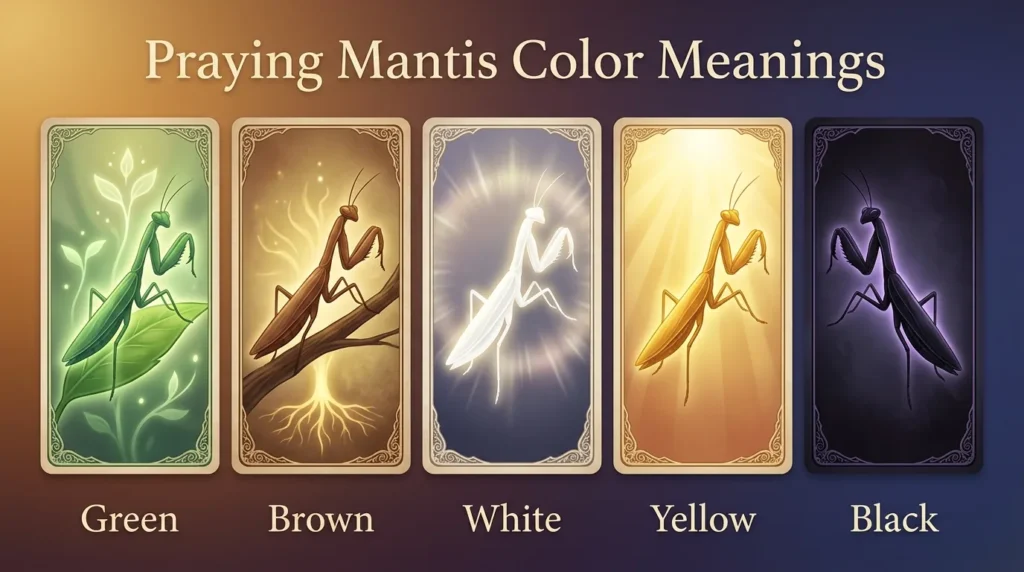
| Color | Spiritual Reading |
|---|---|
| Green | Growth, healing, and a fresh start. The most common color and the most positive reading. |
| Brown | Grounding, patience, and practical decisions rooted in daily life rather than abstract ideas. |
| White | Rare and striking. Often read as an especially strong spiritual message or a deeply answered prayer. |
| Yellow | Optimism and the arrival of good news after a long wait. |
| Black | Mystery, hidden transitions, and facing something you have been avoiding. |
What It Means When a Praying Mantis Lands on You or Enters Your Home
A mantis landing directly on your body is treated as the most personal version of this sign across almost every tradition that discusses it. The usual reading is simple: stop what you are doing, get quiet, and pay attention to whatever thought or feeling surfaces next. Folklore frames this as the insect delivering a message meant only for you, rather than a general omen for anyone nearby.
A mantis showing up inside your home carries a softer version of the same message. Many people read it as a sign that the household needs more calm, more patience, or more honest conversation. Since mantises are drawn indoors mainly by light, warmth, or insects to eat, the practical explanation and the spiritual one are not in conflict. You can gently move the insect back outside and still take the moment to reflect.
Is It Bad Luck to Kill a Praying Mantis?
Yes, and this belief shows up independently across Chinese, French, and several Native American traditions, which makes it one of the more consistent insect taboos in folklore anywhere. The reasoning is fairly poetic. Because the mantis appears to already be in prayer, harming one was seen as interrupting a private conversation with the divine.
There is also a practical layer worth mentioning. Mantises eat aphids, flies, and other garden pests, so farmers across many cultures had a real incentive to protect them long before any spiritual belief was attached. The old warning and simple garden sense point in the same direction: leave the mantis alone.
Praying Mantis as a Spirit Animal and Totem
People who feel a strong pull toward mantis symbolism often describe themselves as quiet observers. They think before they speak, notice details others miss, and dislike being rushed into decisions. As a totem, the mantis represents patient timing rather than constant motion.
There is a real shadow side to this pattern, and it is worth naming honestly. Psychologist Carl Jung described the hidden, denied parts of a person’s psyche as the shadow self, a concept that fits the mantis surprisingly well. That same stillness which looks like wisdom can slide into avoidance, and patience that looks like discipline can quietly become an excuse to never act at all. If the mantis speaks to you, it is worth asking whether you are genuinely waiting for the right moment, or simply afraid to move.
Western literature has not always been so gentle with the insect either. Poet Ogden Nash wrote a short, sharply funny poem titled “The Praying Mantis,” which leans into the insect’s carnivorous side rather than its spiritual one. This is a useful reminder that not every culture, and not every writer, has read the mantis the same peaceful way. Fittingly, the female mantis’s habit of sometimes eating the male after mating is well documented, as reported by Smithsonian Magazine, and it shows up in folklore from Italy and elsewhere as a darker, more unsettling reading of the same creature.
Common Mistakes People Make When Reading This Sign
A few patterns show up again and again when people try to interpret a mantis sighting, and most of them come from treating folklore as if it were a fixed rulebook rather than a set of overlapping traditions.
Treating one tradition’s reading as the only correct one is a common misstep, since cultures genuinely disagree with each other, and that disagreement is part of the real story rather than something to smooth over.
Assuming a mantis inside the house always means something serious overlooks a simpler explanation, since the insect is often just following light or hunting other bugs near a window.
Ignoring the biblical clarification leads some readers to assume scripture directly names the mantis, when the honest connection is devotional tradition rather than an actual biblical text.
Reading every sighting as urgent misses the core message across nearly all traditions, which points the opposite way: slow down, because there is no need to rush.
How to Respond When You See a Praying Mantis
If a mantis crosses your path and the moment feels meaningful to you, a few simple steps tend to fit the spirit of the folklore without turning it into superstition.
Pause for a minute before continuing whatever you were doing, even if it feels unnecessary at first.
Notice what you were thinking about right before you saw it, since folklore treats that thought as part of the message.
Avoid harming the insect, both out of the old folk taboo and out of basic respect for a beneficial garden predator that eats real pests.
If it is indoors, gently guide it back outside with a cup or a piece of paper rather than forcing it out or spraying it.
Give yourself permission to wait a little longer on a decision that has felt rushed, since patience is the message nearly every tradition repeats.
Frequently Asked Questions
What is the spiritual meaning of a praying mantis?
The praying mantis spiritual meaning is stillness, patience, and prayerful attention. Most traditions read a sighting as a personal reminder to slow down and trust your timing rather than as a warning of any kind.
Is seeing a praying mantis good luck or bad luck?
In most traditions, including Chinese, Native American, and African folklore, seeing a mantis is read as good luck. A smaller number of cultures, including parts of Italian and Japanese folklore, treat it as an unsettling or even ominous sign, so the reading does depend somewhat on cultural background.
What does it mean when a praying mantis lands on you?
It is generally treated as the most direct and personal version of the omen. The common advice across folk traditions is to pause, get quiet, and pay close attention to whatever comes to mind in that moment.
Is it bad luck to kill a praying mantis?
Yes, this belief appears independently in Chinese, French, and several Native American traditions. The mantis’s prayer like posture led many cultures to treat harming one as an interruption of something sacred.
What does a praying mantis symbolize in the Bible?
The Bible does not mention the praying mantis by name, so any biblical symbolism is a modern devotional analogy rather than scripture. Some Christians connect its still, prayerful posture to verses about stillness before God, such as Psalm 46:10.
What does it mean when you dream of a praying mantis?
Dream interpretation traditions generally read a mantis in a dream as a call toward patience, quiet reflection, or a decision that needs more waiting before it is made. As with waking sightings, it is rarely read as a bad sign.