
A wet dream is a normal physical response during sleep, not a sign that something is wrong with you or your character. The wet dream meaning behind it is usually simpler than people expect, tied more to biology than to any deeper message.
Quick answer: A wet dream, medically called a nocturnal emission, happens when the body releases sexual tension during REM sleep, often but not always alongside an arousing dream. It is a normal, involuntary process that can happen to both men and women, starting around puberty and continuing at any age.
What Is a Wet Dream, Medically Speaking?
A nocturnal emission, the medical term for what most people call a wet dream, is an involuntary release of sexual tension during sleep. In men this usually means ejaculation. In women it can involve vaginal lubrication or orgasm. It happens most often during REM sleep, the stage when most vivid dreaming takes place, and it can occur with or without an erotic dream that you actually remember afterward.
This is not a disorder or a sign of poor self control. It is a normal part of how the body regulates itself, and it can start as early as age ten and continue throughout adulthood.
What Causes Wet Dreams
The most consistent driver is simple biology rather than anything psychological. Testosterone drives both sexual arousal and semen production, so during puberty, when hormone levels rise quickly, wet dreams are extremely common and considered a normal part of development.
In adults, several factors can raise the frequency:
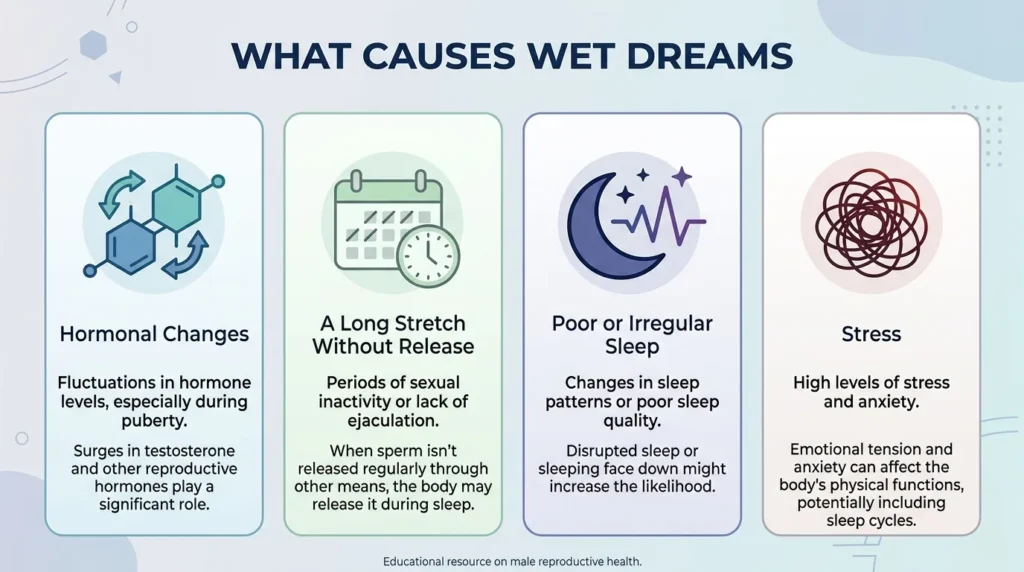
- A long stretch without sexual release. The body appears to use nocturnal emission as one way to relieve built up tension.
- Hormonal changes. Shifts in testosterone, prolactin, or thyroid hormones can all affect how often this happens.
- Poor or irregular sleep. Inconsistent sleep patterns increase fragmented REM phases, which is when most nocturnal emissions occur.
- Stress. A nervous system under constant stress tends to stay more reactive during sleep, which can make this more likely.
None of these causes point to anything being wrong. They simply explain why frequency varies so much from person to person.
Wet Dream Meaning Based on What You Dreamed About
Because the physical event and the dream content are not always linked, the specific storyline matters less here than in most other dream types. Still, a few patterns come up often in dream interpretation:
Dreaming about a stranger is commonly read the same way it is in other dream categories, as your mind exploring a quality or desire you have not consciously acknowledged, rather than a real attraction to that specific person.
Dreaming about an ex often points to unresolved feelings or memories resurfacing, not necessarily a wish to reunite.
Dreaming about someone unexpected, such as a friend or acquaintance, usually reflects comfort or familiarity rather than genuine romantic interest. The mind often reaches for a familiar face simply because it is available, not because it is meaningful.
The Psychological Meaning: Freud and Wish Fulfillment
Sigmund Freud built much of his early dream theory around the idea of wish fulfillment, the concept that dreams exist to satisfy desires the waking mind keeps in check. Many psychologists point out that a wet dream fits this model more directly than almost any other dream type, since the physical release itself is a literal, undisguised form of the satisfaction Freud believed dreams were built around.
This does not mean every wet dream reveals something you are secretly hiding from yourself. It simply means this particular dream type lines up unusually well with a theory Freud originally built to explain much stranger and more disguised dream content.
The Spiritual Meaning of a Wet Dream
Spiritually, most traditions treat a wet dream as a neutral, involuntary event rather than a moral failing. This distinction, that something happening without your intention or control does not carry the same weight as something you choose, shows up across several belief systems, even when the specific rituals attached to it differ.
Wet Dream Meaning in Islam
In Islam, a wet dream is known as ihtilam, and it is treated as a normal part of human life that carries no sin, since accountability in Islamic teaching is tied to deliberate actions rather than involuntary ones. This applies to both men and women, a point confirmed in a hadith where the Prophet Muhammad was asked whether women experience this too, recorded by Khawlah bint Hakim: “I asked the Messenger of Allah about a woman who has a wet dream, and he said, ‘If she sees water, let her perform ghusl'” (Sunan an-Nasa’i, Hadith 198).
The key practical question in Islamic teaching is whether ghusl, the full ritual bath required before prayer, becomes necessary. Ghusl is required only if there is a visible discharge. If someone recalls a wet dream but finds no discharge, ghusl is not obligatory. If discharge is present, even without a remembered dream, ghusl is required.
Wet Dream Meaning in Christianity and Other Faiths
Unlike Islam, most modern Christian denominations do not attach a specific ritual requirement to a wet dream, and mainstream Christian teaching generally treats it the same way it treats other involuntary bodily functions, as something that carries no moral weight because it was not chosen. Similarly, most other major traditions do not treat it as a spiritually significant event requiring a specific response, beyond the general principle that unintentional acts are not judged the same way intentional ones are.
Is It Normal, and When to Talk to a Doctor
Wet dreams are considered a normal, healthy part of human biology at almost any age, and having them, or not having them, are both within the range of normal. There is no set frequency that counts as too much or too little.
It is worth mentioning to a doctor if the frequency changes suddenly alongside other symptoms, such as pain, unusual discharge outside of sleep, or noticeable hormonal changes like unexplained fatigue or mood shifts, since those symptoms deserve attention on their own, separate from the wet dream itself.
Frequently Asked Questions
Is having a wet dream normal?
Yes. It is a normal, involuntary physical process that can happen at any age, starting around puberty and continuing throughout adulthood for many people.
Does a wet dream mean something is wrong with me?
No. It reflects ordinary biology, including hormone levels and sleep patterns, rather than a character flaw or a health problem.
Do you have to perform ghusl after every wet dream in Islam?
Only if there is a visible discharge. If you recall the dream but find no discharge, ghusl is not required. If discharge is present, ghusl is required even without a remembered dream.
Why do wet dreams happen more during certain periods?
Frequency often rises during puberty, after a long period without sexual release, during high stress, or alongside hormonal shifts. None of these causes are abnormal.
Does the person I dreamed about mean anything?
Not necessarily. The specific person in the dream is often incidental to the physical process itself, and dream writers generally read it the same way they read other dream figures, as a stand in for a feeling or quality rather than a literal message about that person.