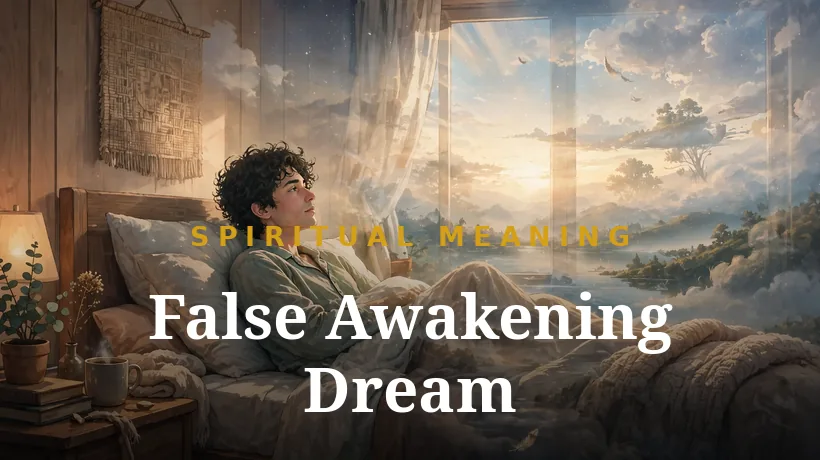
Have you ever dreamed that you woke up, started your normal morning routine, and then realized you were still dreaming? This experience is called a false awakening. It can feel so real that you may question what happened when you finally wake up.
For some people, the experience raises spiritual questions. They may wonder whether the dream points to a new stage of growth, a hidden truth, or a need to become more aware of their choices. Others may feel confused or frightened, especially when the same experience happens more than once.
A false awakening dream may symbolize self awareness, uncertainty, personal change, or a feeling that something in your life needs a closer look. Its spiritual meaning depends on your beliefs, emotions, and current experiences. It is not proof of a supernatural message, but it can be a useful prompt for reflection.
What Is a False Awakening Dream?
A false awakening happens when you dream that you have woken up, even though you are still asleep. The dream may show you getting out of bed, checking your phone, brushing your teeth, or preparing for work. These ordinary details can make the experience feel convincing.
Sometimes, you realize that something is wrong. A clock may show an impossible time, a familiar room may look slightly different, or an ordinary event may repeat itself. In other cases, you do not question the dream until you wake up for real.
A false awakening is a sleep experience, not evidence that you have left your body or entered another realm. You can still reflect on what it means to you personally.
How a False Awakening Feels So Real
Dreams often borrow familiar places, habits, and people from everyday life. When your dream recreates your bedroom or morning routine, it may seem almost identical to waking life.
The feeling of reality can make the dream more memorable. You may recall the room clearly, remember a conversation, or feel relief when you finally wake up. That emotional response can be a useful place to begin your reflection.
False Awakening vs. Lucid Dreaming vs. Sleep Paralysis
These experiences can overlap, but they are not identical.
| Experience | What happens | Common feature |
|---|---|---|
| False awakening | You dream that you have woken up | Ordinary life seems real |
| Lucid dreaming | You know that you are dreaming while the dream continues | Awareness of the dream |
| Sleep paralysis | You feel awake but cannot move for a short time around sleep | Temporary inability to move |
A false awakening may turn into a lucid dream if you realize you are still asleep. Sleep paralysis can involve fear or a sense of presence, but it is a different sleep experience. For more information, read the Sleep Foundation guide to false awakenings.
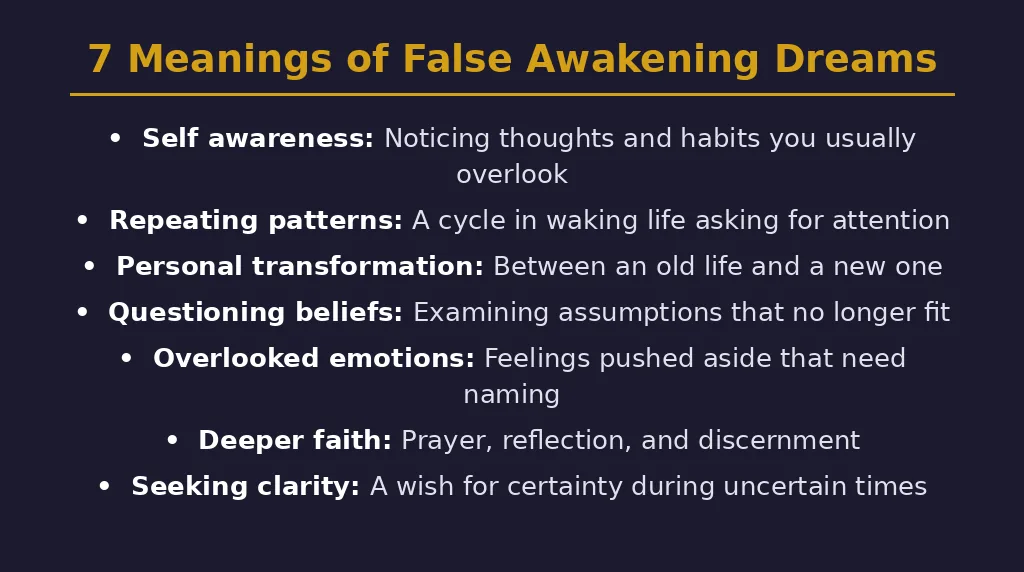
False Awakening Dream Spiritual Meaning: 7 Possible Interpretations
The spiritual meaning of a false awakening dream depends on your own beliefs and circumstances. The interpretations below are possibilities, not fixed rules. Consider which idea fits your experience instead of trying to force every detail to match a single explanation.
1. Becoming More Aware of Yourself
One possible interpretation is that the dream invites you to pay closer attention to your thoughts and habits. You may be moving through your days automatically, following the same routine without asking whether it still suits you.
The dream’s apparent awakening can serve as a symbol of noticing what you usually overlook. Perhaps you have ignored your own needs, avoided a difficult choice, or spent too much time meeting other people’s expectations.
2. Feeling Stuck in a Repeating Life Pattern
Repeatedly waking up inside a dream may remind you of a cycle in your waking life. You might keep having the same argument, returning to an unhelpful habit, or facing a problem that never seems to change.
From a spiritual perspective, you could treat this pattern as an invitation to notice what keeps repeating. That does not mean the dream predicts another setback. Instead, it may reflect something already on your mind.
3. Moving Through Personal Transformation
A false awakening may feel meaningful during a period of change. You might be starting a new job, ending a relationship, changing your priorities, or questioning a long held belief.
In this context, the dream could represent the uncomfortable space between an old way of living and a new one. You may feel ready for change but unsure what comes next.
4. Questioning What You Believe Is True
A false awakening can blur the line between dreaming and waking. Spiritually, some people interpret this as a symbol of questioning appearances or examining their assumptions.
You may be reconsidering a belief you grew up with, noticing that a relationship is different from what you thought, or realizing that a goal no longer feels right. The dream might give you a memorable way to explore that uncertainty.
5. Paying Attention to Overlooked Emotions
The emotion you feel during the dream may matter more than the dream setting. If you feel afraid, you may be dealing with stress or uncertainty. If you feel calm, the dream may simply reflect curiosity or a desire for understanding.
Try to name the strongest feeling you remember. Then consider whether you have felt something similar recently. You might be pushing sadness aside, hiding frustration, or avoiding a decision because it feels uncomfortable.
6. Exploring Your Spiritual Beliefs More Deeply
Some spiritual traditions view dreams as opportunities for reflection, prayer, or discernment. If faith is important to you, a false awakening may encourage you to consider what your beliefs mean in daily life.
You might pray, meditate, read a trusted spiritual text, or speak with a thoughtful faith leader. Let your reflection support compassion, patience, and wise choices rather than fear.
7. Seeking Clarity During an Uncertain Time
Sometimes a false awakening may reflect a wish to feel certain about your life. You may want an answer about a relationship, a career choice, or a personal challenge, yet still feel unsure about what to do.
The dream can become a prompt to slow down. Rather than searching for one hidden meaning, identify the question that feels most important to you right now.
What Repeated False Awakenings May Symbolize
Having the same kind of dream more than once can make it feel especially significant. You can explore the repetition while remembering that sleep patterns, stress, and vivid dreams may also play a role.
Dreaming That You Wake Up Multiple Times
In a repeated false awakening, you may dream that you wake up, discover you are still dreaming, and then appear to wake up again. This cycle can feel confusing or tiring.
A personal spiritual interpretation might connect the repetition with an unresolved concern or a question you keep returning to. However, repetition does not prove that you are ignoring a message. Record what happens and look for connections with your daily experiences before drawing conclusions.
Feeling Trapped or Unable to Wake Up
Feeling trapped inside a dream can be frightening. You may try to wake yourself, only to find that the dream continues.
Some people interpret this feeling as a symbol of being stuck or lacking control in a situation. You might ask whether a responsibility, relationship, or worry has been weighing on you. Still, the dream itself does not mean that you are in danger.
If these experiences happen often and affect your rest, consider your sleep routine and how you feel during the day. Seek medical advice if sleep problems are persistent or distressing.
Biblical, Religious, and Cultural Interpretations
Religious and cultural traditions shape how people interpret dreams. It helps to separate a tradition’s teachings from personal interpretations.
Biblical Perspectives on Dreams and Discernment
The Bible includes accounts of dreams that carry meaning within particular stories. For example, dreams play a role in the stories of Joseph and Daniel. These passages are often considered when people reflect on dreams and faith.
However, the Bible does not give a specific, universal interpretation of false awakenings. A Christian reader might use the experience as a prompt for prayer, self examination, and discernment without assuming that it is a direct message from God.
If you want to explore biblical accounts, read the relevant passages in context through Bible Gateway. Avoid treating a modern dream interpretation as a definite biblical teaching when the text does not state it.
Islamic and Other Spiritual Perspectives
Muslims may approach dreams through Islamic teachings and the guidance of trusted religious sources. Interpretations can vary, and a false awakening does not automatically carry a specific religious meaning.
Other spiritual traditions may connect dreams with reflection, personal growth, or awareness. These ideas can be meaningful within their own contexts, but they should not be presented as proven facts that apply to every person.
If your faith shapes your understanding of dreams, consider speaking with a knowledgeable and balanced religious adviser. Choose an interpretation that encourages sound judgment and peace rather than one that leaves you feeling threatened or controlled by the dream.
Why False Awakenings Happen: The Sleep Science Perspective
Sleep science offers another perspective: a false awakening occurs while you are asleep, yet it can feel convincingly like being awake.
The Role of REM Sleep and Vivid Dreams
Many vivid dreams occur during rapid eye movement sleep, often called REM sleep. During this stage, the brain is active and dreams can include detailed scenes and strong emotions.
A false awakening may create a realistic version of waking life while the person remains asleep. Because the setting is familiar, the dream may be difficult to distinguish from an actual morning until the person fully wakes.
For a clear overview, see the Sleep Foundation explanation of false awakenings.
Can Stress or Disrupted Sleep Contribute?
Stress and disrupted sleep may be linked with unusual or vivid dream experiences. Changes in sleep schedules, poor rest, and emotional strain can affect how sleep feels and how much of a dream you remember.
A spiritual interpretation and a sleep related explanation do not have to compete.
If the dreams bother you, try keeping a steady bedtime, allowing enough time for rest, and limiting activities that make it harder to settle down. If they regularly disrupt your sleep or leave you distressed during the day, speak with a health professional.
What to Do After a False Awakening Dream
You do not have to solve the dream immediately. A calm, practical approach can help you reflect without turning an unusual experience into a source of worry.
Record the Dream and Your Strongest Emotion
Write down what happened soon after you wake up. Include the setting, the people you remember, the moment you realized you were dreaming, and the feeling that stayed with you.
Use simple questions to guide your notes:
- Setting: Where did the dream take place?
- Emotion: Did you feel afraid, calm, confused, or curious?
- Repetition: Did the same event or object appear more than once?
- Connection: Does anything in the dream remind you of a current concern?
Connect the Dream to Your Current Life
Look at what has been happening in your life recently. Have you been facing a major decision, feeling overwhelmed, or questioning an old belief? Consider these possibilities without assuming that the dream must relate to one particular event.
You can also ask yourself what kind of support you need. Perhaps you need rest, a frank conversation, a clearer boundary, or more time to make a choice.
If you enjoy spiritual reflection, prayer or meditation may help you explore your feelings. You can also build a simple habit of recording dreams and thoughts in a dream journal.
When to Pay Attention to Your Sleep Health
An occasional false awakening is not usually a reason to panic. Still, your sleep matters. Pay attention if the dreams occur often, cause strong fear, or leave you tired and worried during the day.
Keep a regular sleep schedule and a relaxing bedtime routine. If sleep problems persist or you feel unable to tell dreams from waking life after waking, seek professional advice.
Reflection should help you understand your experience, not make you afraid to sleep.
Frequently Asked Questions
What does a false awakening dream mean spiritually?
A false awakening dream may symbolize greater awareness, uncertainty, personal growth, or a desire to question familiar patterns. The meaning depends on your beliefs and life circumstances. It is a possible prompt for reflection, not proof of a supernatural event or a prediction of the future.
Why do I keep having false awakening dreams?
Repeated false awakenings may be connected with vivid dreaming, stress, or disrupted sleep. You can also reflect on whether a recurring concern has been occupying your thoughts. Repetition alone does not prove that the dream contains a warning or hidden message.
What does it mean when you dream that you wake up but are still dreaming?
This is the central feature of a false awakening. You experience an apparent waking moment while you remain asleep. You may interpret it personally as a symbol of uncertainty or self awareness, but the experience can also be understood as a type of vivid dream.
Is a false awakening the same as a lucid dream?
No. In a false awakening, you dream that you have woken up. In a lucid dream, you recognize that you are dreaming while the dream continues. The two can overlap if you realize during a false awakening that you are still asleep.
Why do false awakening dreams feel so real?
They often recreate familiar places and routines in convincing detail. A dream version of your bedroom or morning routine may feel much like waking life. You may only notice something unusual when a detail changes or you fully wake up.
Can a false awakening be a spiritual awakening?
Some people may use a false awakening as a prompt to reflect on spiritual growth or changing beliefs. However, a false awakening is not proof of a spiritual awakening. Consider your own experiences, beliefs, and choices rather than relying on the dream alone to define your spiritual path.
Final Thoughts on False Awakening Dream Spiritual Meaning
A false awakening can feel strange because it makes a dream seem like real life. You may connect it with self awareness, a repeating pattern, personal change, or a search for clarity. These are possible ways to reflect on the experience, not universal meanings.
The false awakening dream spiritual meaning that feels most useful to you should encourage thoughtful reflection rather than fear. Notice the emotions you felt, consider what is happening in your life, and remember that sleep science can help explain the experience too.
You do not need to treat every detail as a sign. Let the dream inspire useful questions, take care of your sleep, and choose actions that support your well being.