
Dreaming of talking to dead husband usually reflects grief that is still being worked through, along with the bond you still feel with him. These dreams are one of the most common experiences after losing a spouse. They are rarely a bad sign. More often, your sleeping mind is doing something gentle: keeping a conversation going that death cut short.
If you have had this dream, you know how real it can feel. His voice, his expression, the things left unsaid, all of it can arrive so clearly that waking up brings a fresh wave of loss. That intensity is normal, and it points to how deeply the relationship still lives inside you.
Dreaming of talking to dead husband most often means your mind is processing grief and holding onto an emotional bond with him. Grief researchers link these dreams to unfinished conversations, longing, and a pattern called continuing bonds. Many faith traditions read the same dream as a comforting visit. The tone you wake up with says the most about its meaning.
What Does It Mean to Dream of Talking to Your Dead Husband?
At its heart, this dream is about connection that did not end when he died. You may be reaching for advice you still need, closure you never got, or simply the comfort of hearing him again. The specific conversation matters, but so does how you felt during it and after you woke.
A few common threads run through these dreams:
- A need for guidance on decisions you now make alone
- Words or feelings that were left unsaid before he passed
- A longing for his presence during a hard or lonely stretch
- A sense of reassurance that he is at peace
None of these meanings are fixed. Your own life, your stage of grief, and the mood of the dream all shape what it is really pointing to.
Why Grieving People Dream of Talking to a Late Husband
Losing a husband is one of the heaviest losses a person can face, and the mind keeps working on it long after the funeral. Dreams become one of the places that work happens.
Grief researcher Dr. Joshua Black, who earned his psychology doctorate at Brock University studying dreams of the deceased, found that these dreams are strikingly common. In his research, 86 percent of people who lost a spouse or partner reported having a dream of the deceased. What surprised him most was the tone. He expected these dreams to be sad, since dreams usually mirror our waking mood, yet he found that dreams featuring the deceased tend to lean positive rather than negative.
That finding matters for anyone unsettled by these dreams. A dream conversation with your late husband is not a symptom of grieving wrong. It is a widely shared part of how people grieve, and for many it brings comfort rather than pain.
The Psychology of Continuing Bonds
The strongest psychological framework for understanding this dream comes from a concept called continuing bonds. It was introduced in 1996 by researchers Dennis Klass, Phyllis Silverman, and Steven Nickman in their book Continuing Bonds: New Understandings of Grief.
Their idea challenged an older view of grief. For much of the twentieth century, healthy grieving was described as letting go, an approach shaped heavily by Sigmund Freud, who treated holding onto the dead as something to be resolved. Klass, Silverman, and Nickman disagreed. They observed that many people grieve in a healthier way by keeping a bond with the person who died, not by severing it.
Under this model, dreaming and talking with a dead husband is not a failure to move on. It is one natural form the ongoing bond can take. Other forms include sensing his presence, keeping his belongings close, talking to him at the grave, or carrying his values forward in your own choices. The relationship changes shape, but it does not simply switch off.
Common Dream Scenarios and What They Mean
The exact scene of the dream shifts its likely meaning. The table below covers the versions people report most often.
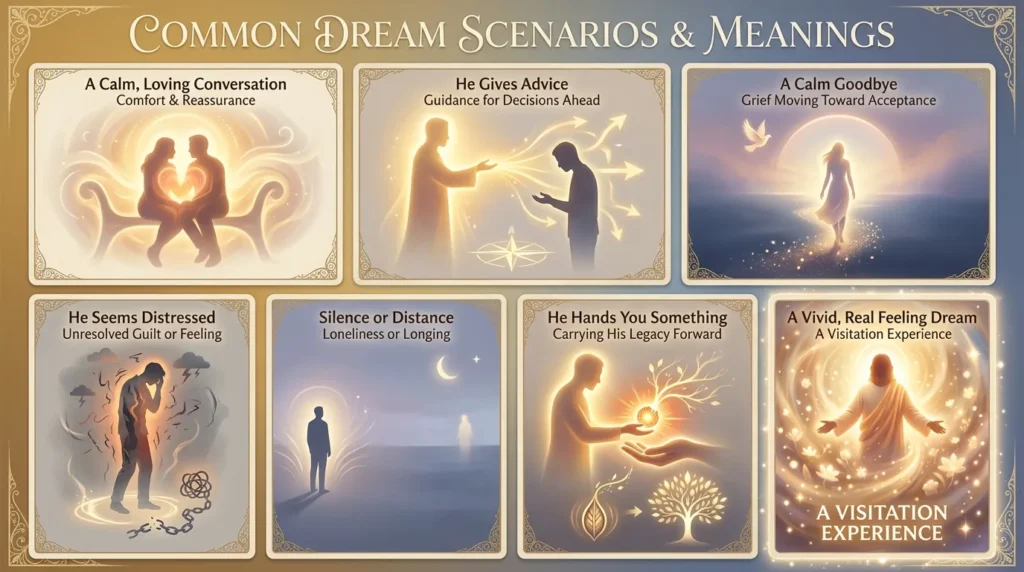
| Dream Scenario | Common Interpretation |
|---|---|
| A calm, loving conversation | Comfort and reassurance; the bond expressing itself gently |
| He gives you advice or guidance | A need for direction on decisions you now carry alone |
| He says goodbye or leaves calmly | Grief quietly moving toward acceptance |
| He seems angry or accusing | Often self directed guilt or unresolved conflict, not a real message |
| He is silent or distant | Feelings of loneliness, abandonment, or emotional distance |
| He hands you an object or a message | Your mind organizing his legacy into something you can keep |
| The conversation feels vivid and real | Often described as a visitation dream, discussed below |
Are These Visitation Dreams?
Many people describe a dream conversation with a late husband as feeling different from an ordinary dream. It seems clearer, calmer, and more real, and it stays with them. These are commonly called visitation dreams.
Here it helps to be honest about the two ways people read them. Spiritually, many traditions hold that a departed loved one can visit through a dream. Psychologically, the same experience is understood as the grieving mind preserving the relationship and processing loss in an especially vivid way. Dr. Black’s research notes that grief dreams often feel emotionally charged and unusually lifelike, which is part of why they carry such weight.
You do not have to choose one explanation to take comfort from the dream. Whether you experience it as a genuine visit or as your own mind reaching for connection, the love and reassurance felt in it are real to you either way.
Dreaming of Talking to Dead Husband in Islam
Islamic tradition has a detailed body of dream interpretation, much of it attributed to the early scholar Ibn Sirin. Within that tradition, the words of a deceased person carry particular weight. Texts credited to Ibn Sirin state that when someone asks a dead person about a matter in a dream, the answer is treated as truthful, because the deceased is understood to dwell in the world of truth rather than falsehood.
Some classical readings go further, suggesting that seeing a late loved one looking peaceful, in clean or white clothing, points to a good state in the hereafter, while seeing them distressed may be read as a sign to offer prayers and charity on their behalf.
A serious caution belongs here. Islamic scholars who write carefully on this subject stress that a dream is not proof of the exact condition of the deceased, and it is not a reliable prediction of the future. Popular dream books are often translated and reattributed loosely, so specific claims should be checked against reliable editions before anyone treats them as certain. A dream is a source of reflection, not a religious ruling. Anyone deeply troubled by one is encouraged to seek a qualified scholar rather than lean on a symbol list.
Dreaming of Talking to Dead Husband in the Bible
The Christian Bible does not directly interpret dreams of talking to a dead spouse, so any reading here is one that believers apply rather than a direct teaching. Scripture does acknowledge that God can speak through dreams. Job 33:14 and 15 describe God speaking to people in dreams and visions of the night, while they sleep.
At the same time, the Bible cautions against actively seeking to contact the dead. Deuteronomy 18:11 lists consulting the dead among practices to avoid. Many Christian readers hold these two ideas together this way: a dream of a late husband is received as possible comfort from God during grief, not as an invitation to summon or communicate with the deceased. Psalm 34:18, which says the Lord is close to the brokenhearted, is often cited as the spirit in which such a dream is understood, as nearness and comfort rather than literal contact.
Is Dreaming of Talking to Your Dead Husband a Bad Sign?
For most people, this dream is not a warning. It is a reflection of love and grief, not a prediction of anything to come.
| Often Read as Comforting | Often Read as Distressing |
|---|---|
| Reassurance that he is at peace | Guilt over choices made after his death |
| A sense of continued closeness | Feeling abandoned or unheard |
| Permission to keep living fully | Reliving the moment of loss |
| Gentle guidance for a hard decision | Unresolved conflict resurfacing |
Even a painful version of the dream is usually your mind working through something real, not a sign of danger. The emotion you wake with is the clearest clue. Comfort points toward healing, while guilt or dread points toward a feeling that still needs care and attention.
What to Do After This Dream
A dream like this rarely calls for action so much as gentle attention. A few steps can help you hold it well.
- Write it down soon after waking, including his words and how you felt, before the details fade.
- Notice the timing. These dreams often cluster around anniversaries, holidays, or big decisions, and that pattern tells you more than any single night.
- Name the practical weight you may be carrying alone, such as finances or parenting, since that pressure often feeds these dreams.
- Reach out if the dreams leave you distressed. A trusted friend, a grief support group, or a counselor can help you move through the loss rather than around it.
Frequently Asked Questions
What does it mean when you dream about talking to your dead husband?
It usually means your mind is processing grief and keeping an emotional bond with him alive. The conversation often reflects guidance you need, words left unsaid, or a longing for his presence. It is a very common and usually gentle part of grieving, not a warning.
Can a deceased husband really visit you in a dream?
Many traditions believe departed loved ones can visit through dreams, often called visitation dreams, which feel unusually vivid and real. Psychology explains the same experience as the grieving mind preserving the relationship. Either way, the comfort many people feel from these dreams is genuine.
Why do these dreams feel so real?
Grief dreams involving the deceased are often described as clearer and more emotionally intense than ordinary dreams. Researcher Dr. Joshua Black has noted this vivid, charged quality, which is part of why people remember them so strongly and find them so meaningful.
Does the Bible say anything about dreaming of a dead loved one?
The Bible does not directly interpret these dreams. It acknowledges that God can speak through dreams in Job 33:14 and 15, while also cautioning against seeking to contact the dead in Deuteronomy 18:11. Many believers read such a dream as comfort from God rather than a literal visit.
What does talking to a dead husband mean in Islam?
In the tradition attributed to Ibn Sirin, the words a deceased person speaks in a dream are treated as truthful. Still, scholars stress that a dream is not proof of the deceased’s condition or a prediction of the future, and specific symbolic claims should be checked against reliable sources.
Is it normal to keep having this dream?
Yes. Recurring dreams of a late husband are common, especially during grief or around meaningful dates. If they bring comfort, there is no need to worry. If they repeatedly leave you distressed, that is a reasonable reason to seek grief support.
Final Thought
Dreaming of talking to dead husband sits where love, memory, and loss meet. Research shows these dreams are common and often comforting. The idea of continuing bonds explains why the relationship keeps finding a voice in your sleep, and several faith traditions offer their own gentle framing of the same experience. Whatever meaning you take from it, the dream is a reminder that a bond this deep does not vanish. It simply learns to speak in new ways.