The spiritual meaning of selah is commonly understood as an invitation to pause, reflect on God’s Word, and consider the message of Scripture. This small word appears mainly in Psalms and also in Habakkuk 3. Although its original meaning remains uncertain, many Christians use it as a reminder to slow down, think about God’s truth, and respond with faith.
When you encounter Selah while reading the Bible, you may wonder why it appears at the end of a verse or in the middle of a song. The word is connected with biblical poetry and may have served as a musical or worship instruction. Its precise purpose is not fully known, so it is helpful to separate historical evidence from modern devotional practice.
The spiritual significance of selah can still hold a practical lesson for your own faith. You can treat it as a moment to think about what you have read, remember God’s character, and consider how the passage applies to your life. This is a devotional application, not a confirmed literal translation of the Hebrew word.
What Is the Spiritual Meaning of Selah?
The spiritual meaning of selah is often connected with reflection, worship, and thoughtful attention to Scripture. The word itself is not clearly defined in the Bible, but its placement in songs and prayers makes it a natural point for readers to stop and consider the message around it.
For many Christians, the spiritual meaning of selah represents a simple practice: do not rush past an important truth. When a psalm describes God’s protection, power, justice, or mercy, you can pause to think about what those words mean for your faith.
Selah as a Call to Pause and Reflect
A pause can help you absorb a message instead of reading words without thinking about them. The spiritual meaning of selah, in this practical sense, reminds modern readers to consider the meaning of a verse before moving to the next one.
For example, if you read a passage about God offering protection during trouble, you might ask yourself what trust looks like in your current situation. The pause does not change the meaning of the verse. It gives you time to consider it more carefully.
You can use this practice in several ways:
- Main truth: Identify the main truth in the passage you have read.
- God’s character: Think about what the words reveal about God’s power, mercy, wisdom, or faithfulness.
- Personal connection: Ask how the passage relates to a challenge, decision, or reason for gratitude in your life.
- Respond: Turn your reflection into prayer or a practical choice that fits the passage.
Spiritual Application Versus Literal Translation
It is important to distinguish between the historical meaning of Selah and the way people apply it today. The Bible does not provide a direct definition, and scholars have proposed different explanations for its original function.
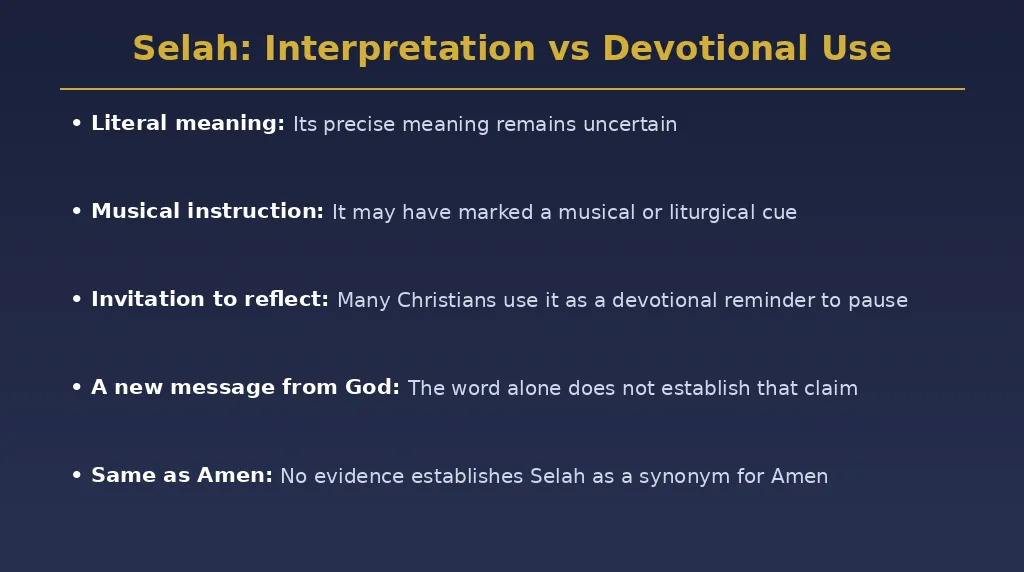
The following table separates common interpretations from devotional practice.
| Question | What can responsibly be said |
|---|---|
| What does Selah literally mean? | Its precise meaning remains uncertain. |
| Was it a musical instruction? | It may have marked a musical or liturgical cue. |
| Does it invite reflection today? | Many Christians use it as a devotional reminder to pause and reflect. |
| Does it mean God is sending a new message? | The word alone does not establish that claim. |
| Is it the same as Amen? | No confirmed evidence establishes Selah as a direct synonym for Amen. |
What Does Selah Mean in the Bible?
Selah appears in biblical poetry, especially in the Book of Psalms. It is also found three times in Habakkuk 3, a prayer written in poetic form. These settings suggest that the word served a purpose in worship, the structure of a poem, or the performance of a song.
The spiritual meaning of selah should therefore be understood with care. Its placement can encourage reflection, but the text does not explain exactly what ancient singers or worshippers were instructed to do when they reached it.
The Hebrew Word and Its Uncertain Meaning
Selah is written in Hebrew as סֶלָה and is commonly listed as Strong’s H5542. The word is generally retained as “Selah” in English Bible translations rather than replaced with a definite English meaning.
Some proposed explanations connect it with ideas such as lifting up, pausing, or marking a musical interlude. These are theories, not settled conclusions. A proposed connection to a Hebrew root does not, by itself, prove the precise meaning intended in every biblical passage.
The ancient Greek translation of the Hebrew Scriptures, known as the Septuagint, uses a term often transliterated as “diapsalma” in places where Selah appears. This has also been associated with a musical or structural break. It supports the possibility of a performance-related function but does not settle the question.
For Hebrew text and word-study tools, see STEP Bible’s biblical language tools.
Why Selah Appears in Biblical Poetry
Psalms contains prayers, songs of praise, laments, and expressions of trust. Selah appears at points within this poetry, sometimes after a strong statement or near a change in the poem’s direction.
The word occurs 71 times in Psalms and three times in Habakkuk 3, for a commonly reported total of 74 occurrences. The count can depend on the textual edition and counting method, so it is best to identify the source when precision matters.
Its placement may have helped organize the performance of a song or draw attention to a particular passage. Readers today can notice those moments without claiming certainty about the original instruction.
Is Selah a Musical Instruction?
A musical or liturgical function is one of the leading explanations for Selah. The Psalms were closely connected with worship, and some of their headings contain instructions for singers or musicians. Selah may have marked an instrumental interlude, a pause, or another feature of the performance.
However, the Bible does not spell out the exact action required. It is therefore more accurate to say that Selah may have served as a musical cue than to define it as a confirmed instruction to stop singing or to let instruments play.
Bible Verses That Help Explain Selah
The passages containing Selah offer useful examples of how the word appears in biblical poetry. Their surrounding words provide the main message for reflection. The word’s precise function remains uncertain, but the verses themselves can still be read in context.
Psalm 3:3-4: Trusting God in Trouble
In Psalm 3, David describes opposition and fear before expressing trust in God. He calls the Lord his shield and describes crying out to God, who answers him from His holy hill. Selah appears at the end of verse 4 in the King James Version.
The movement from distress to trust gives readers a meaningful point to consider. You might reflect on what the passage says about seeking God during hardship. The central lesson comes from the psalm’s words, not from treating Selah as a guaranteed translation of “pause and think.”
Psalm 46: Remembering God’s Power
Psalm 46 presents God as a refuge and strength, even when the world seems unstable. It describes dramatic images of the earth changing and the waters roaring, then returns to the assurance that God is with His people.
Selah appears at several points in the psalm, including after statements about God’s protection. Readers can pause to consider the contrast between frightening circumstances and the psalm’s message of confidence in God.
The familiar line “Be still, and know that I am God” appears in Psalm 46:10 in the King James Version. It is part of the psalm’s message, not a literal definition of Selah.
Read the passage here: Psalm 46 in the Bible.
Habakkuk 3: Worship Amid Uncertainty
Habakkuk 3 contains three occurrences of Selah, in verses 3, 9, and 13. The chapter is a poetic prayer that recalls God’s power and mighty acts. It moves through vivid descriptions of divine strength and deliverance before expressing trust despite difficult circumstances.
This setting gives modern readers another way to reflect. Faith does not demand that we pretend hardship is easy. Habakkuk’s prayer remembers God’s power while facing uncertainty, offering a model of honest worship and continued trust.
Read the full chapter here: Habakkuk 3 in the Bible.
How to Apply the Spiritual Meaning of Selah to Daily Life
You do not need to know the exact ancient meaning of Selah to build a thoughtful reading habit. The spiritual meaning of selah lets you use the word as a personal reminder to slow down when a passage deserves more attention.
Pause During Bible Study
Choose a short passage instead of trying to read a large section quickly. When a verse stands out, take a moment to identify its main point and read the surrounding verses for context.
Try this simple routine:
1. Read the passage all the way through to take in its overall message. 2. Read it again and notice a phrase that stands out. 3. Pause and ask what the passage says about God, people, or faith. 4. Write down one question or insight without forcing a conclusion. 5. Continue reading with the passage’s context in mind.
This approach keeps reflection connected to Scripture rather than speculation.
Make Space for Prayer and Reflection
Prayer can help you respond to what you have read with honesty. After reading, you might thank God for something the text reveals, ask for wisdom about a challenge, or pray for help applying a lesson.
You can also keep a short journal. Write down the verse, your reflection, and one question you want to explore further. If the meaning is unclear, consult a reliable Bible translation or study resource instead of assuming that every impression is a direct message from God.
Frequently Asked Questions About Selah
What Is the Spiritual Meaning of Selah?
The spiritual meaning of selah is commonly understood as an invitation to pause, reflect on Scripture, and respond through prayer or worship. This is a devotional application. The word’s original meaning remains uncertain.
What Does Selah Mean in the Bible?
For the spiritual meaning of selah in the Bible, remember that Selah is a term found mainly in Psalms and also in Habakkuk 3. It may have marked a musical or liturgical cue, but its exact meaning is not known with certainty. English translations often preserve the Hebrew term.
What Does Selah Mean in Hebrew?
Selah is written סֶלָה and is listed as Strong’s H5542. Proposed explanations include a pause, a musical interlude, or a connection with lifting up. None should be presented as a fully settled definition.
How Many Times Does Selah Appear in the Bible?
A commonly reported count is 74 occurrences: 71 in Psalms and three in Habakkuk 3. The total may vary depending on the textual edition or counting method used.
How Do You Pronounce Selah?
A common English pronunciation is “SEE-lah.” Some speakers use other pronunciations, including “SAY-lah.” The original pronunciation cannot be established with complete certainty from modern English guides alone.
Does Selah Mean Amen?
Within the spiritual meaning of selah, note that Selah is not established as a direct synonym for Amen. Amen is commonly used to express agreement or affirmation, while Selah’s original function remains uncertain and may have been musical or liturgical.
What Does Selah Mean in the King James Version?
In the King James Version, Selah is generally left untranslated. Readers can understand the surrounding verses, but the word itself is not assigned a definite English meaning in the text.
Understanding Selah as an Invitation to Reflect
The spiritual meaning of selah is best approached with both faith and care. The word appears in biblical songs and a prophetic prayer, yet its precise original function remains uncertain. A musical or liturgical cue is a leading possibility, while “pause and reflect” is a useful devotional application rather than a proven translation.
When you encounter Selah, read the surrounding passage and consider its message about God, faith, and life. Give yourself time to think, pray, and respond without forcing the text to say more than it does. In that way, Selah can serve as a meaningful reminder to give Scripture your full attention.