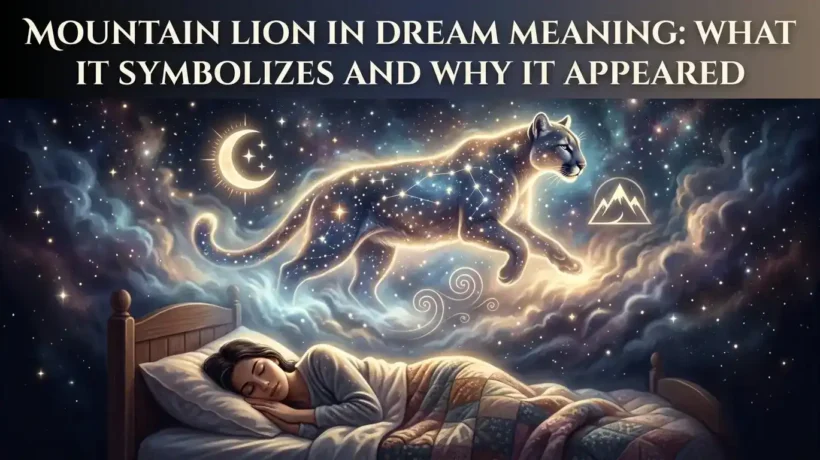
The mountain lion in dream meaning centers on quiet power, the kind that watches before it moves. You woke up with your heart going, and now you want to know what it meant. That reaction makes sense. Big cats leave a strong impression because they combine beauty with real force. Dream interpretation works best as a mirror for your own life rather than a forecast, so treat what follows as a starting point for reflection.
A mountain lion in dream meaning usually points to personal power, instinct, and independence. How you felt in the dream changes everything. Fear often reflects pressure or a person who intimidates you. Calm or awe usually reflects confidence you are growing into. Setting, action, and your recent week all shape the reading.
What a Mountain Lion in Dream Meaning Points To
The Core Symbol Is Silent Power
Lions roar. Mountain lions do not. This animal hunts alone, moves without sound, and acts only when the moment is right, which is why it shows up in dreams as a symbol of contained strength rather than loud dominance.
That symbolism tracks the real animal closely. The U.S. National Park Service describes mountain lions as solitary, traveling alone except during mating season or while a female raises young, and most active at dawn and dusk. Solitude, patience, and timing sit at the heart of this creature, so those themes tend to sit at the heart of the dream.
Common readings include personal power you have not claimed yet, instinct you are learning to trust, independence, and a strong presence somewhere in your life.
Cougar, Puma, Panther, or Catamount?
All four names describe the same animal, Puma concolor. Regional habit decides which one people use, and many readers arrive having searched the wrong word entirely.
One distinction matters though. A true black panther is a leopard or jaguar, not a mountain lion, and mountain lions are almost always tawny. If your dream cat was solid black, look at panther symbolism instead.
Start With How the Dream Felt
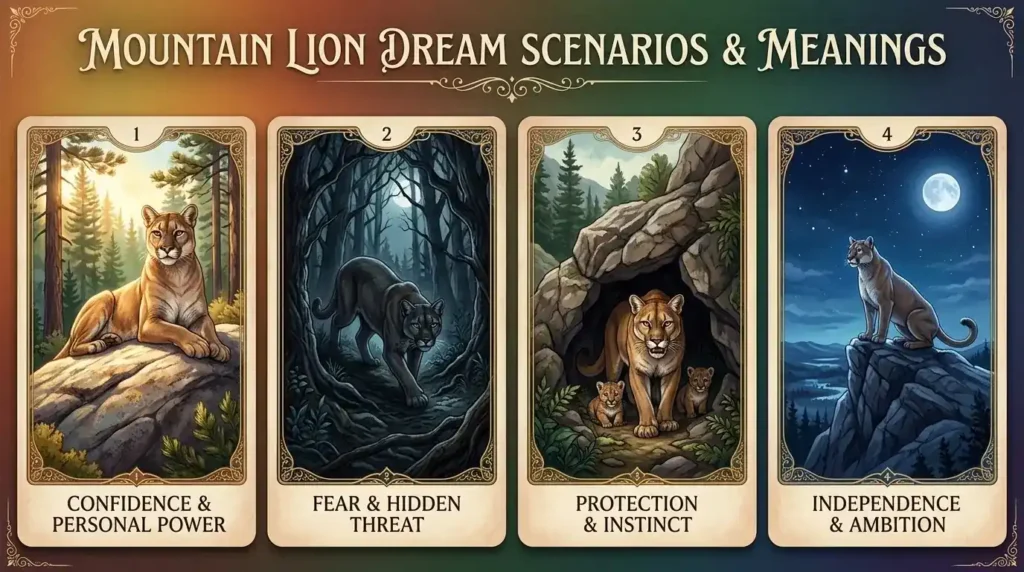
Emotion is the most useful detail you have, and it changes the reading more than any other element.
Fear or Panic
Fear usually points outward, toward something in waking life that feels bigger than you. A demanding manager, a court date, a diagnosis, a confrontation you keep postponing. Your sleeping mind reached for the biggest predator it could find and gave your stress a shape.
Awe or Respect
Awe suggests recognition rather than threat. People often report this version during periods when they are stepping into something new, such as leadership, a move, or leaving a situation that no longer fits.
Calm or Curiosity
Calm changes the whole picture. When the animal simply exists nearby and you feel steady, the dream tends to reflect confidence settling in. You may be making peace with a part of yourself you used to find difficult.
Why This Dream Appeared Now
Before reaching for symbolism, check the ordinary explanations. They are correct more often than people expect.
Something You Watched or Read
Dreams borrow heavily from recent input. A wildlife documentary, a news story about a cougar sighting, a trail closure notice, even a nature photo you scrolled past can all resurface at night. Think back across the last two or three days.
Pressure in Waking Life
Predator dreams cluster around stressful periods. Deadlines, money worries, exams, family conflict, and health scares all raise the odds of threatening dream content.
A Powerful Person Around You
Sometimes the animal is a person. Ask yourself who in your life is powerful, hard to read, and quiet about it. That combination maps onto this symbol closely.
What Dream Research Says About Predator Dreams
Here is the part most dream articles skip.
Finnish cognitive scientist Antti Revonsuo proposed the threat simulation theory in Behavioral and Brain Sciences in 2000. His argument is that dreaming evolved partly as a rehearsal system, letting early humans practice spotting and escaping danger at no physical cost. Under that view, being chased by a large predator is close to the original template for what dreams are for.
Later work gave the idea mixed support. Antonio Zadra and colleagues tested it against 212 recurrent dreams in 2006 and found that most contained threats aimed at the dreamer, though few depicted situations realistic enough to matter for survival. Susan Malcolm Smith and Mark Solms later published counterevidence questioning whether threat content appears often enough to support the theory.
So the honest summary is this. Predator dreams are common and researchers take them seriously, but no consensus explains exactly why they happen. Anyone claiming certainty is overselling.
Common Mountain Lion Dream Scenarios
Being Chased
The most reported version by far. Chase dreams usually connect to avoidance, so the useful question is what you are currently postponing. Notice whether you escaped, froze, or got caught, since that detail often mirrors how you feel about handling the situation.
Being Attacked
Attack dreams tend to arrive during periods of real pressure. Many people find the dream reflects feeling cornered rather than any actual danger. Where the animal struck can matter too, since it may point toward what feels vulnerable.
A Mountain Lion Watching You
Being watched without attack is one of the most common versions, and one of the least alarming. Observation dreams often reflect awareness, as though something in your life is asking for attention before it becomes urgent.
A Calm or Friendly Mountain Lion
Peaceful encounters are usually read as integration. Strength that once felt threatening now feels available to you. Some traditions treat this version as protective.
Killing a Mountain Lion
Frequently interpreted as overcoming an obstacle or a rival. Worth noting how you felt afterward, because relief and regret suggest very different things about the conflict you are working through.
A Mountain Lion Inside Your House
Houses commonly represent private life, family, or the self. A predator indoors moves the theme close to home, often reflecting tension in a relationship, a boundary someone crossed, or an emotion you keep behind a door.
A Cub or Baby Mountain Lion
Young animals point toward beginnings. New confidence, a new role, or a fresh responsibility that still feels fragile. Protective feelings in this version often mirror something you are nurturing in waking life.
Hearing a Mountain Lion Scream
The real animal cannot roar, but it produces a scream people describe as unsettling. Hearing one without seeing the source often connects to a warning you sense but cannot yet name.
Spiritual and Cultural Interpretations
The Jungian View of the Shadow
Carl Jung used the term shadow for the parts of ourselves we push out of view, including anger, ambition, and desire. In that framework a stalking predator often represents shadow material asking for acknowledgment. Jung read such figures as invitations to integrate rather than threats to survive.
Native American and Andean Traditions
Cougar symbolism appears across many Indigenous traditions of the Americas, though meanings vary widely between nations and should not be flattened into one message. Cheyenne tradition associated the animal with strength and protection. In the Andes, puma imagery carried themes of power and authority, appearing in Inca architecture and much older Peruvian pottery.
Biblical Symbolism
Scripture does not mention the mountain lion, since the animal lives only in the Americas. Lions appear frequently though, standing for power, judgment, and testing. Readers working from a Christian framework generally apply that broader lion symbolism, treating the dream as a call toward courage and watchfulness.
Islamic Interpretation
Classical Islamic dream interpretation, associated with the eighth century scholar Ibn Sirin, reads large predatory cats as symbols of a powerful figure, an unjust opponent, or an authority holding influence over the dreamer. Escaping unharmed is generally read as a favorable sign.
How to Read Your Own Dream
Fixed dictionary meanings only take you so far. Try this instead.
- Name the emotion first: Write the feeling before the plot. Fear, awe, and calm point in different directions.
- Note the setting: Wilderness, your home, and your workplace each frame the symbol differently.
- Note what you did: Running, freezing, hiding, and facing the animal all say something about your current coping style.
- Look back 48 hours: List anything you watched, read, or worried about. Ordinary triggers explain a lot.
- Ask the matching question: Where in my life does something powerful feel close, quiet, and hard to predict?
Keeping a short dream journal beside your bed sharpens this quickly, because patterns become visible across weeks that no single dream reveals.
When a Recurring Dream Deserves More Attention
Occasional vivid dreams are a normal part of sleep. Repeated distressing dreams that disturb your rest, follow a frightening experience, or leave you anxious during the day are worth mentioning to a doctor or a counsellor. Support exists for this, and asking about it is a practical step rather than a dramatic one.
Frequently Asked Questions
Is seeing a mountain lion in a dream a warning?
Not usually. Most readings treat it as a prompt toward awareness rather than a warning. Tense dreams often reflect current stress instead of predicting future events.
Does this dream mean danger is coming?
There is no evidence that dreams forecast events. Threatening dream content is common during pressured periods and generally reflects your emotional state.
Can this dream represent a person in my life?
Yes, and often it does. The symbol fits someone influential, hard to read, and quiet about their power. Ask who matches that description right now.
What does it mean to dream of a mountain lion attacking?
Attack dreams commonly reflect feeling cornered or overwhelmed. Consider where you currently lack room to move, since the dream often dramatizes pressure rather than danger.
What does it mean to dream of a mountain lion chasing you?
Chase dreams generally connect to avoidance. Something you keep postponing may be the subject. Whether you escaped or froze often mirrors how capable you feel.
What does it mean to see a mountain lion in a house?
Houses tend to represent private life and family. A predator indoors usually points toward tension close to home, a crossed boundary, or an emotion you keep contained.
What should I do after having this dream?
Write it down while details remain fresh, note your emotion, and look for a waking situation that matches. Reflection turns the dream into something useful.
Final Thoughts
Start with feeling, then setting, then your recent week. The mountain lion in dream meaning that fits your life will emerge from those three details far more reliably than any fixed definition. This animal appears when something powerful is nearby, inside you or around you, and it tends to ask for attention rather than alarm.