Noticing a sudden tingle on your sole or toes often sparks curiosity about the left foot itching spiritual meaning. Across generations, human feet have stood as symbols of movement, direction, and the path a person walks through life. Because interpretations differ across cultures, folklore, and spiritual traditions, understanding where each belief comes from brings helpful perspective.
The left foot itching spiritual meaning usually centers on upcoming journeys, unfamiliar experiences, or personal changes and emotional growth. While traditional folklore treats an itchy sole as a travel omen, modern spiritual frameworks emphasize intuition and new directions, though meanings vary across cultures and are never universal or proven predictions.
What Does Left Foot Itching Spiritual Meaning Suggest?
When people explore what a left-foot itch might signify, they encounter both contemporary symbolic reflection and older folk sayings. It is helpful to distinguish spiritual symbolism from historical superstition so personal reflection is never confused with fortune-telling. In some modern spiritual frameworks, the left side of the body is linked with receptive energy, while concepts like the root chakra and grounding energy are used strictly as modern spiritual-framework terms rather than universal teachings.
An Upcoming Journey or Unfamiliar Destination
The most recognizable theme involves physical travel and stepping into an unfamiliar destination. In symbolic reflection, an itch prompts you to consider upcoming trips or new environments without treating it as a guaranteed forecast.
A New Direction or Personal Transformation
Modern readers also connect an itching left foot with personal transformation and choosing a new direction. Because feet carry you forward, the sensation can remind you to check whether your current goals still fit your path.
Intuition, Emotions, and Inner Guidance
Because modern frameworks link the left side with receptivity, an itchy left foot is often associated with intuition, emotions, and inner guidance. It encourages checking in with your feelings before making a decision.
Unexpected Changes in Money or Relationships
A few secondary folk traditions mention unexpected expenses or shifting relationship dynamics, though these remain minor folk interpretations rather than core spiritual teachings.
Historical Folklore Behind Itchy Feet and Travel Omens
Long before modern spiritual writers linked body sensations to intuition or energy centers, English-speaking communities passed down oral superstitions about itchy feet and travel omens. This documented folklore is distinct from modern spirituality and reflects household sayings rather than universal laws. Folklorists in the nineteenth century gathered regional accounts showing how everyday families interpreted an itching sole.
In the 1896 folklore collection Current Superstitions, edited by Fanny D. Bergen from the oral tradition of English-speaking folk, an itching foot is tied to the belief that a person will soon walk on “strange ground.” According to the sayings preserved by Bergen, when the bottom of your foot itches, it indicates that you will tread on unfamiliar soil or visit a place you have never seen before. Local variations in the collection distinguished between the left and right feet, suggesting that one foot pointed toward a welcome visit while the other signaled an unpleasant trip, confirming that historical folklore was never universal.
Cultural Beliefs About Left Foot Itching
Comparing cultural beliefs shows how differently communities interpret an itchy left foot. These superstitions reflect local storytelling rather than fixed laws.
Indian and Hindu Cultural Interpretations
In parts of India, regional beliefs connect an itchy foot with travel, sometimes viewing the left foot as a sign of unfavorable travel or delays for men while considering it favorable for women. These customs belong to regional folklore and are not universal Hindu teachings.
English, Scottish, and American Folklore
In English, Scottish, and American folklore, traditional travel omens consistently mention walking on strange ground. When regional sayings separate the two feet, the left foot is sometimes tied to an unwelcome destination, while the right foot signals a warm welcome, though neighboring towns sometimes reverse those roles.
Turkish and Other Regional Superstitions
In Turkish superstitions and neighboring regional traditions, an itching left foot is occasionally linked to difficult journeys, unexpected obstacles on the road, or restless plans. Because these sayings are passed down orally, beliefs vary by community and family.
Does Left Foot Itching Mean Different Things for Men and Women?
Gender-based interpretations appear in several folk traditions that historically linked the right and left sides of the body with different symbolic roles for men and women. Because regions developed these sayings independently, conflicting lucky and unlucky interpretations are common, leaving no universal rule.
What Left Foot Itching Means for Women
In certain South Asian folk traditions, the left side is viewed as auspicious for women, meaning an itchy left foot may point to a fortunate trip or positive household news. In Western folklore, gender rarely alters the meaning.
What Left Foot Itching Means for Men
In those same Eastern traditions, the right side is favored for men, so an itchy left foot is sometimes linked to inconvenient travel or minor expenses, whereas other cultures make no gender distinction.
Spiritual Meaning of Itching in Different Parts of the Foot
While symbolic guides often break down foot itching by exact spot, location meanings are not standardized across traditions. No matter which part of your foot tingles, a localized itch never predicts a specific future event.
| Foot Location | Traditional and Symbolic Themes | Reflective Focus |
|---|---|---|
| Bottom or sole | Travel omens, unfamiliar ground, and movement. | Preparing practically for upcoming trips or new places. |
| Top of the foot | Ongoing changes, movement, or possible obstacles. | Reviewing plans and staying patient with minor delays. |
| Heel | Personal stability, foundations, and direction. | Checking whether your daily routines and support feel solid. |
| Toes | Small decisions, adjustments, and upcoming changes. | Paying attention to practical details and immediate choices. |
| Entire foot | Broader transition, journey, or mindset shift. | Looking at the overall direction of your current chapter. |
| Both feet | Movement, balance, or competing directions. | Weighing options carefully before committing to change. |
What Does Left Foot Itching at Night Mean Spiritually?
In modern spiritual interpretations, a left foot itching at night is associated with quiet reflection, dreams, and subconscious thoughts surfacing before sleep. Symbolically, it may invite you to notice whether you feel restless about an upcoming change.
However, it is essential to distinguish nighttime symbolism from physical causes that feel stronger after dark. As the Cleveland Clinic guide on itchy skin notes, evening drops in skin moisture, temperature shifts, and fewer distractions make skin itchier in bed, so a nighttime itch never confirms a spiritual message.
Is There a Biblical Meaning of Left Foot Itching?
To state the facts clearly, the Bible does not identify left-foot itching as a divine sign, omen, or prediction. Scripture never links itchy skin to supernatural forecasts, though it uses feet as symbols of readiness and humble service.
Ephesians 6:15 and Readiness for Your Journey
In Ephesians 6:15, believers are instructed to fit their feet with the readiness that comes from the gospel of peace. This verse highlights spiritual preparation and carrying peace into daily life, with no connection to an itchy foot prediction.
John 13 and the Meaning of Washing Feet
In John 13, Jesus washes His disciples’ feet before Passover to model humility, service, and care for others. This biblical account teaches servant leadership and stands apart from modern or historical superstitions.
When an Itchy Left Foot Has a Physical Cause
In everyday life, an itchy foot almost always has a physical cause. Persistent itching should be cared for medically rather than automatically interpreted spiritually.
Common Reasons Your Left Foot May Itch
Several common triggers can cause your left foot to itch:
- Dry skin: Low humidity, hot showers, or tight footwear can strip natural moisture from the heel and sole.
- Athlete’s foot: According to the NHS guide to athlete’s foot, this common fungal infection causes itching, scaling, and redness between the toes and across the sole.
- Eczema: Inflammatory conditions like atopic or dyshidrotic eczema can produce itchy patches or tiny blisters.
- Contact dermatitis: Skin may react to shoe adhesives, dyes, sock fabrics, or laundry detergents.
- Allergic reactions: Bug bites, pet dander, or floor cleaners can trigger localized itching on bare skin.
Warning Signs and When to Seek Medical Attention
Seek medical advice from a doctor or pharmacist when symptoms do not improve or interfere with daily life:
- Persistent or worsening symptoms: The itch lasts longer than two weeks or keeps worsening despite care.
- Pain or swelling: Your foot becomes painful, warm, or noticeably swollen.
- Signs of infection: You notice spreading redness, pus, oozing blisters, or deep cracks in the skin.
- Spreading irritation: The rash spreads across the foot, affects the toenails, or makes walking uncomfortable.
How to Reflect on an Itchy Left Foot Without Assuming a Prediction
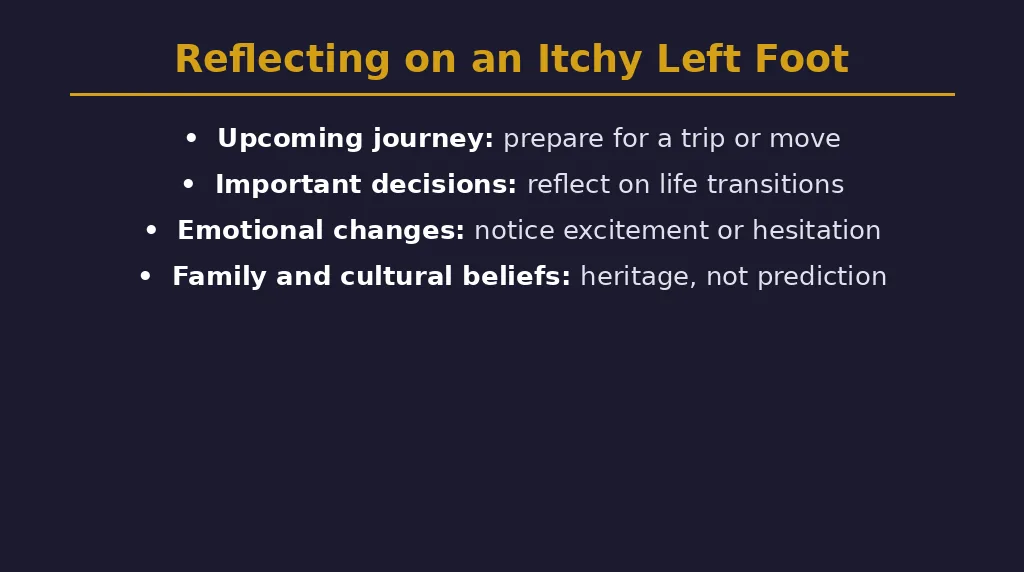
When your skin is healthy, a passing itch can prompt grounded mindfulness guided by practical judgment rather than fear or certainty:
- Upcoming journey: Consider whether a planned trip or move needs practical preparation.
- Important decisions: Reflect calmly on life transitions or choices currently ahead of you.
- Emotional changes: Notice your personal feelings and whether you feel excited or hesitant about a change.
- Family and cultural beliefs: Enjoy traditional sayings as cultural heritage without treating them as universal truths.
Frequently Asked Questions About Left Foot Itching Spiritual Meaning
What Does It Mean Spiritually When Your Left Foot Itches?
In modern spiritual frameworks, an itchy left foot focuses on intuition, receptivity, and stepping into a new chapter, while older folklore links it to travel. Neither interpretation is a guaranteed prediction.
Is Left Foot Itching a Sign of Good Luck or Bad Luck?
Luck interpretations vary by culture with no universal rule. Some Western and Turkish traditions link the left foot to an inconvenient trip, whereas certain South Asian customs consider it fortunate for women.
What Does It Mean When the Bottom of Your Left Foot Itches?
Traditional English and American folklore says an itchy sole means you will walk on strange or unfamiliar ground. Modern symbolic readings connect the sole to your daily path and foundation.
What Does Left Foot Itching Mean for a Woman?
In some regional Indian folk traditions, an itching left foot is viewed as an auspicious sign of travel or positive change for a woman, though many other cultures make no gender distinction.
Is There a Biblical Meaning of Left Foot Itching?
No, the Bible does not identify left-foot itching as a divine sign or prophecy. Passages like Ephesians 6:15 and John 13 use feet to illustrate peace and humble service, not skin omens.
Does an Itchy Left Foot Mean You Are Going to Travel?
Walking to an unfamiliar destination is the most famous folk superstition about itchy feet, recorded in nineteenth-century collections. Still, it remains a traditional saying rather than a reliable travel prediction.
Final Thoughts on the Spiritual Meaning of an Itchy Left Foot
Exploring the left foot itching spiritual meaning shows how historical travel folklore, cultural superstitions, religious teachings, and modern reflection differ. While stories about unfamiliar ground and inner direction are intriguing, an itchy foot is never a reliable prediction of future events. Rule out skin irritation first, and use practical judgment.