dont dream its over meaning: Crowded House Song Meaning and History
By Sarah Whitman
📅
⏱ 10 min read
dont dream its over meaning: Song Meaning, History and Lyrics
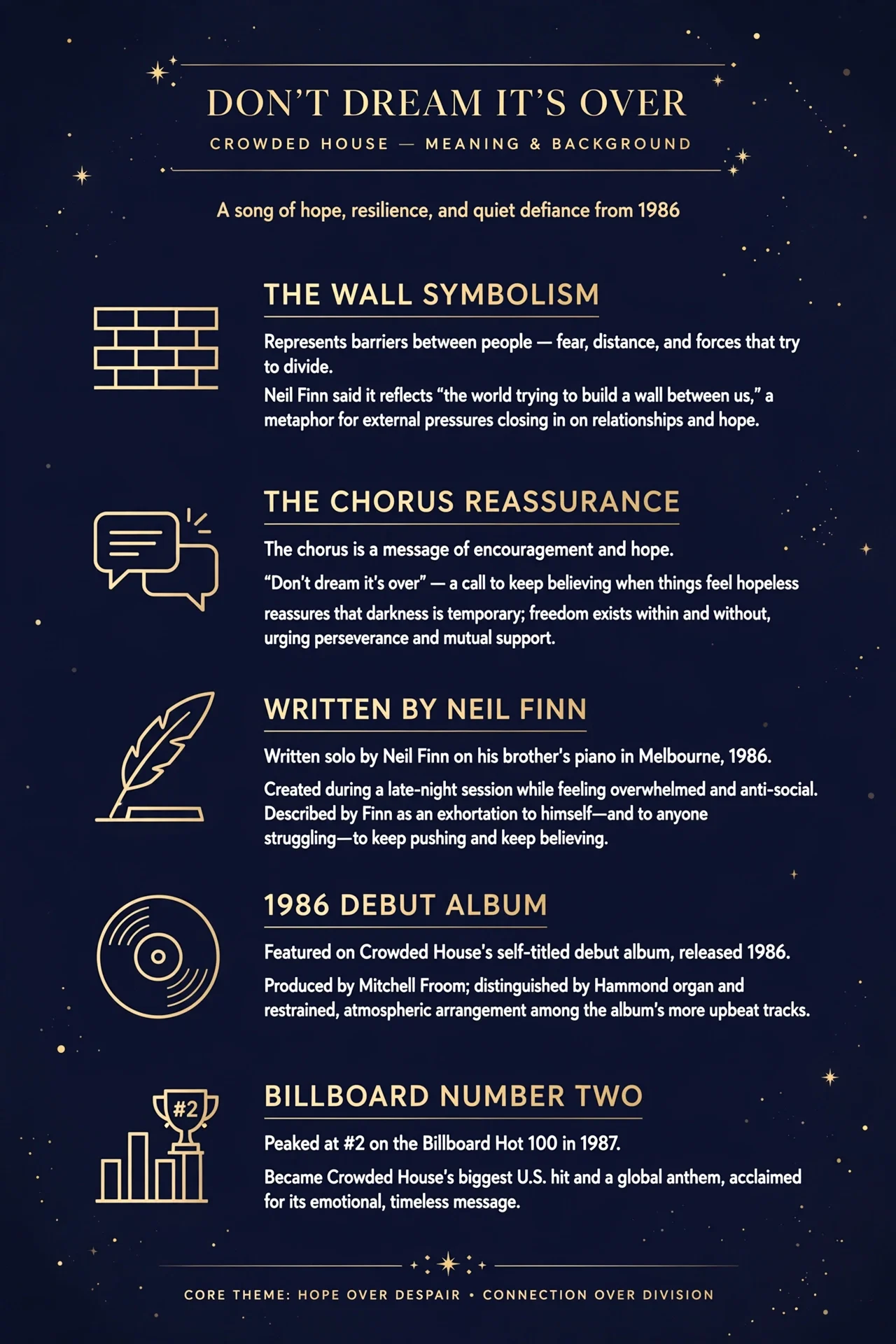
dont dream its over meaning points to a Crowded House song about hope and human connection. Neil Finn wrote the song. Crowded House released it on their debut album in 1986. It climbed to number two on the Billboard Hot 100. Only Belinda Carlisle stood above it with Heaven Is a Place on Earth. The song asks listeners to hold on. It speaks against fear and division. People search for its meaning because the words feel deep yet open. Each listener finds a personal story inside it. This guide explains the song meaning, its writers, and famous versions.
Verses paint pressure and walls. The chorus answers with calm resolve. Together they form a quiet anthem. Sections unpack one clear layer. Lyrics, history, covers appear. Readers will find the full story laid out below.
The title puzzles listeners. It reads as warning. Good news seems to end there. The song means the reverse. It urges hope to continue. That twist hooks curiosity.
Quick Answer
dont dream its over meaning points to a 1986 Crowded House song about hope. Neil Finn wrote it as a call for connection in a divided world. Verses describe pressure and walls. The chorus answers with reassurance. Hope can outlast fear, the song says. It remains a loved anthem of the eighties.
What Is dont dream its over meaning About
The song carries one big idea. People can stay close even when life pulls them apart. Pressure comes from many sides. Bills pile up. News turns dark. Relationships strain. The song admits all of this. Then it offers a steady hand.
Hope sits at the center. The lyrics refuse despair. They name fear but choose courage. Connection becomes the answer. One person reaches another. That bond holds firm.
The mood stays calm and warm. Music never shouts. The voice stays gentle. That calm makes the message stronger. Listeners feel steadied and calm.
Many hear a love song here. Two people guard their bond. Others hear a wider call. Communities resist division. Both readings fit. The writing stays open on purpose.
Groups hear it too. Friends hold together through hard years. Families bridge old gaps. Neighbors choose kindness over suspicion. The lyric scales up with ease. One bond becomes many.
Time has tested the message. The eighties had their own fears. New decades brought new ones. The song still fits. Its hope feels fresh in each era.
Lyrics stay open on purpose. Finn avoids narrow tales. He paints with wide strokes. Each listener fills the gaps. That freedom keeps the song personal.
The song rewards repeat listens. New lines surface each time. The depth keeps giving.
Who Wrote the Song
Neil Finn and Crowded House
Neil Finn wrote the song. He led Crowded House as singer and songwriter. The band formed after Split Enz ended. Finn brought melodic skill and honest words. His style feels personal yet wide. Listeners place their own lives inside his lines.
Finn writes with plain words. He trusts simple lines. His melodies lift those lines. Critics praise his craft. Fans feel his honesty. That mix made the song travel far.
He grew up in New Zealand. Music filled his home. Split Enz gave him a start. Crowded House gave him a voice. The song shows his mature style.
The 1986 Debut Album
It opened the debut album Crowded House in 1986. The single became the breakout hit in America. Radio played it across the country. The album introduced a smart melodic sound. Critics praised its warmth. Fans still call it the band’s signature song.
The album sold well across America. Radio embraced the single. The band toured behind it. Their name spread fast. That debut set their path.
dont dream its over meaning: Verse by Verse
The verses build the story in three moves. Each verse adds a layer. Pressure grows. Then hope answers. The arc feels complete.
First Verse: Freedom and Pressure
First verse opens with opposites. Freedom lives within and without. A flood rises against a paper cup. That image feels impossible. Life can feel too large to hold. Then a companion appears. Battles lie ahead. Many are lost. The singer still walks on. Company makes the road lighter.
The flood image hits hard. Water means trouble. A cup means small tools. The gap between them feels huge. Yet the singer keeps walking. Hope walks beside trouble.
Second Verse: War, Waste and Walls
The second verse turns to the wider world. Headlines speak of war and waste. Suspicion creeps into small things. A damaged car sits outside. Eyes watch possessions. The singer turns to the TV page. Distraction feels easier than truth. The world feels unstable. Fear moves through daily life.
These details feel modern. Headlines still shout. Screens still distract. The verse could describe today. That timeless feel keeps it alive. Listeners nod along.
Final Verse: Walking Toward Closeness
Movement returns in the final verse. The singer walks again. Steps count toward another heart. Shadows gather ahead. The song still leans toward healing. Release comes near. Closeness feels possible. Hope wins the last word.
The walk feels steady. Each step lands with purpose. The heart ahead glows brighter. Darkness stays behind. Light leads forward. The song ends on motion.
What Does the Wall Symbolize
Its central image is a wall. It stands for barriers between people. Those barriers take many shapes.
• Distance grows between lovers.
• Hearts shut down after conflict.
• Societies split along lines.
• Bad news builds fear.
Each wall divides. The song answers with refusal. They lose in the end. Quiet courage beats loud division.
Walls appear in every era. Politics builds them. Fear builds them. Pride builds them. The song names the builders plainly. They come in many forms. Yet the answer stays one. Refuse their power.
That refusal feels quiet. The song speaks it softly. Calm voices carry far. The lyric trusts the listener. It offers strength through steadiness.
The Chorus as Reassurance
The chorus works like a calm voice. Hey now sounds gentle. It calms like a friend speaking. The hook repeats through the song. Each return steadies the listener. Anxiety fades. The bond feels worth the fight. That title line anchors everything. It turns fear into resolve.
The hook feels like a hand on a shoulder. It steadies without preaching. Repetition does the work. Each return deepens trust. The listener breathes easier. That is smart songwriting.
Hey now opens the door. The phrase feels spoken. It breaks the fourth wall. The singer talks straight to you. That direct touch builds intimacy.
The Title Debate: Command or Observation
Fans debate the title’s grammar. One reading gives a command. Do not dream that it is over. Keep fighting. Stay hopeful. The other reading gives an observation. Do not dream. It is over. Give up. The phrasing settles it. Stress falls on hope. The song pushes back at despair. It tells the listener to keep going.
Most fans land on the hopeful reading. The music supports it. Warm tones suggest comfort. The lyric arc bends toward light. Context backs hope too. Finn wrote from care and courage.
Language nerds love this puzzle. Punctuation changes sense. A comma shifts the weight. Songs often play this game. Meaning hides in small marks. Here the small mark carries the whole song.
Famous Versions Compared
Many artists have sung this song. Each version keeps its core. The table shows the most known ones.
Version
Year
Note
Crowded House original
1986
The defining recording. Mitchell Froom produced it.
Paul Young
1991
A big UK hit. Smoother than the original.
Miley Cyrus and Ariana Grande
2015
A charity performance. It reached young fans.
U2
Live shows
Played as a tribute. A nod to the Finns.
The original still stands tallest. Its raw warmth wins. Each cover proves the melody lasts. A great song survives new voices.
Paul Young gave it polish. His 1991 version charmed the UK. It smoothed the edges. Some fans prefer that sheen. Others miss the grit. Both views hold truth.
Miley Cyrus and Ariana Grande sang it for the Happy Hippie Foundation. Their playful take reached young ears. It showed the song’s wide arms. U2 played it live as tribute. Their nod honored the Finns. Each version adds a layer.
Song Timeline: 1986 to Today
The story moves in clear steps. 1986 brings the debut album and the single. The song climbs to number two on the Billboard Hot 100. Only Belinda Carlisle stood above it with Heaven Is a Place on Earth. 1991 brings the Paul Young cover. It becomes a UK hit. Later years bring more covers and live tributes. The dont dream its over meaning keeps finding new ears. Each age hears its own hope in it.
New steps added listeners. The eighties made it a hit. A decade later, polish came with Paul Young. Youth arrived with new covers. The song keeps renewing itself. That renewal is its power.
How the Music Supports the Lyrics
Mitchell Froom produced the track. His touch gave warmth and polish. A Hammond organ hums through it. The sound feels like a hymn in a small room. Soft rock meets gentle pop. The groove stays light. Clean guitar textures float. Neil Finn sings with calm control. His voice stays relaxed. Restraint carries the message. Quiet strength beats loud drama.
The mix stays clean and open. Space sits between notes. That space lets words breathe. The vocal stays clear in front. Focus stays on feeling.
Drums keep a soft pulse. Bass walks gently. Keys add color. Guitar stays light. Each part serves the song. Every part stays humble.
Finn’s voice ties it together. It sounds honest and lived in. Warmth flows through each line. The calm feels earned. That earned calm moves people.
Why the Song Still Matters
The song fits troubled times. Every era brings its own walls. The message stays useful. Hope remains a choice. Connection still heals. New listeners find it each year. Old fans return to it. The melody holds them all.
New films keep using it. Shows keep playing it too. Each use finds fresh ears. The cycle keeps turning. Each return feels earned.
Its lesson stays simple. Hold on to people. Hope outlasts trouble. Calm beats noise. Those truths stay young.
Readers who love song stories can explore [the blog](https://dreamsmeaniings.com/blog/) for more guides. Each guide unpacks one more favorite. Music and dreams meet there.
Frequently Asked Questions
What is the main meaning of “Don’t Dream It’s Over” by Crowded House?
At its core, the song is about holding on to connection and hope. Outside pressure tries to divide people. The phrase works as encouragement to keep going.
Is the song about a relationship or something bigger?
Many hear both at once. It can sound like a love song about guarding a bond. The images of walls, war, and waste open a wider reading. That reading covers division in the world.
Why is the chorus so important to the song’s meaning?
The chorus turns the song into reassurance. Verses describe pressure and conflict. The hook answers with resilience and unity.
What does the wall symbolize in the lyrics?
It stands for barriers between people. Those barriers can be emotional, political, or social. The key point stays hopeful. Such walls appear, yet hope outlasts them.
How does the music support the lyrics?
Its gentle groove and soft guitar keep the song steady. Calm vocals carry quiet strength. That restraint matches the lyric message.
Did Neil Finn write “Don’t Dream It’s Over”?
Yes. Neil Finn wrote it. Crowded House released it on their self titled debut album in 1986. It became one of the band’s best known songs.
Sarah Whitman writes about dream symbolism and interpretation, drawing on a background in comparative religion and psychology. Her interest in dreams started with studying how different traditions biblical, Islamic, and Jungian, explain the same recurring symbols in completely different ways, and that's the lens she brings to every guide on Dreams Meaniings: cross-checking scripture, classical dream texts, and psychological research before writing anything down.