
Dreaming about someone who has died is one of the most common experiences of grief, and for most people, it’s far more comforting than upsetting, even when it catches them off guard. It doesn’t mean something is wrong with you, and it doesn’t mean the person is trying to send you a warning. Most often, it means your mind and heart are still finding ways to stay connected to someone you loved.
Dreaming about someone who has died is a normal, well documented part of grief. Research shows the majority of these dreams are experienced as positive, even comforting, and they’re now understood as a healthy way of maintaining a bond with someone you’ve lost, not a sign of unresolved grief or anything to worry about.
If you’re reading this because you just woke up from a dream like this, take a breath. What you’re feeling right now, whatever mix of comfort, confusion, or fresh grief it is, is shared by nearly everyone who has ever lost someone. Below is what grief research, Islamic tradition, and scripture each have to say about it, along with the specific scenarios people search for most.
What Dreaming About Someone Who Has Died Really Reflects
For a long time, the dominant idea in grief psychology was that healthy mourning meant “letting go” and fully detaching from the person you lost. That idea has been replaced by something called continuing bonds theory, introduced by grief researchers Klass, Silverman, and Nickman in 1996. Their work showed that maintaining an ongoing connection with someone who died isn’t a failure to move on. It’s a normal, healthy part of how people carry loss with them. Dreaming about that person is one of the clearest, most natural ways this bond continues to show up.
This isn’t just theory. A peer reviewed study published in the journal Omega in 2021 found that the majority of bereaved people have dreams of the person they lost, and that these dreams, even when the content is emotionally heavy, are overwhelmingly experienced as comforting rather than distressing. A separate, smaller 2016 study conducted in India found that even terminally ill patients often dream of loved ones who died before them, suggesting these dreams may reflect a deep, ordinary human need for connection near the edges of life, not anything unusual or concerning.
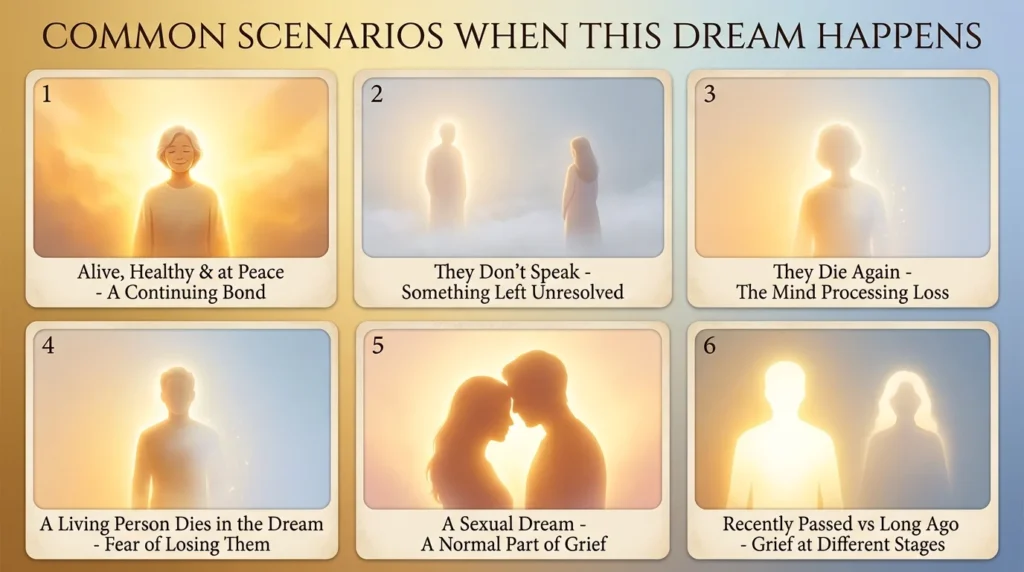
Common Scenarios When This Dream Happens
The specific shape of the dream usually says more than the fact that you had it at all.
They Appear Alive, Healthy, and at Peace
This is the most frequently reported version of this dream, often called an “alive again” dream by grief researchers. The person usually looks well, sometimes younger or healthier than they were near the end of their life, and the dream often carries a strong sense of warmth or relief. Many people describe waking up from this dream feeling lighter, even if they cried during it. This is generally read as one of the clearest expressions of a continuing bond, your mind offering you a version of them at peace.
They Don’t Speak to You
A dream where the person is present but silent, or where you try to reach them and can’t quite connect, can feel unsettling. This usually reflects something still unresolved for you rather than any message from them. It’s common when there wasn’t a chance to say goodbye, or when there’s something you wish you’d said while they were alive.
They Die Again in the Dream
Reliving the death, or watching it happen again in a dream, is one of the harder versions of this experience. It can feel like a setback, but grief researchers note that even dreams that revisit painful moments often help the mind process and integrate the loss, rather than signaling that something is going wrong in your grieving. If a dream like this leaves you shaken for more than a day or two, it’s worth being gentle with yourself and reaching out for support.
Someone Who Is Still Alive Dies in the Dream
It’s worth separating this one out clearly, since it’s a different experience entirely. Dreaming that someone currently alive in your life dies is usually not about grief at all. It more often reflects worry about their wellbeing, fear of losing them, or a big change happening in that relationship. If this is the dream you actually had, it’s a related but distinct topic from dreaming about someone who has already died.
A Sexual Dream About Someone Who Has Died
This one carries a lot of quiet shame for people, and it shouldn’t. Dreaming about intimacy with someone you’ve lost, especially a partner, is a well documented and completely normal part of grief. It doesn’t mean anything is wrong with you, and it isn’t disrespectful to their memory. It often simply reflects how much you loved them, how present they still are in your emotional life, and sometimes a very human longing for closeness that grief itself can intensify.
Recently Passed Versus Long Ago
Dreaming of someone who died recently often reflects grief that’s still raw and actively being processed, and these dreams can be more frequent or more emotionally intense in the first months after a loss. Dreaming of someone who died years ago, sometimes out of nowhere, often happens during a life event, big or small, where their absence is suddenly more noticeable, a milestone, a holiday, or simply a quiet moment that reminded you of them.
The Islamic Meaning of a Dream About the Deceased
Islamic tradition takes dreams seriously, though always with care rather than certainty. According to a hadith recorded in Sahih Muslim, dreams are understood to fall into three categories: a true dream from Allah, a dream from shaytan meant to disturb, and a confused dream that simply reflects one’s own thoughts. The Qur’an also recounts the Prophet Yusuf’s dream as an example of a meaningful vision (12:4 to 6), which is part of why some dreams are taken seriously within this tradition.
If a deceased loved one appears smiling, healthy, or at peace, many scholars view this as a comforting sign, possibly reflecting Allah’s mercy toward them. If they appear distressed, tearful, or in poor condition, the recommended response isn’t fear, but action: offering du’a (supplication) for them, and giving charity or performing a good deed on their behalf, since these are traditionally believed to benefit the deceased. Scholars caution against treating any dream as a certain, literal message, and instead encourage responding with prayer, remembrance, and reflection rather than panic.
A Gentle Word on the Bible and Comfort in Grief
Scripture doesn’t directly address this particular kind of dream, and it’s worth being honest about that rather than stretching a connection that isn’t really there. What the Bible does offer is real comfort for grief itself. Psalm 34:18 describes God as close to the brokenhearted. 1 Thessalonians 4:13 speaks to grieving with hope rather than without it. Revelation 21:4 describes a promise of no more tears, death, or pain.
Many people find that a dream about someone they lost arrives during a season when these verses feel especially relevant, not because the dream itself is a message, but because both point toward the same human need: comfort in the middle of loss.
If You Want to Sit With This Dream a Little Longer
There’s no requirement to analyze a dream like this, but if it feels helpful, a few gentle questions can help you understand what it stirred up.
- How did I feel when I woke up, comforted, sad, unsettled, or some mix of all three?
- Is there something I wish I’d said to this person while they were here?
- Has something recently reminded me of them, even in a small way?
- Do I need to give myself permission to grieve again today, even if it’s been a long time?
There’s no right way to answer these, and no need to force an answer at all. Sometimes the dream itself is enough.
If This Dream Brought Up Fresh Grief
If this dream has stirred up grief that feels heavy right now, that’s a completely normal response, and you don’t have to carry it alone. It’s okay to talk about the dream with someone you trust, to let yourself feel whatever it brought up, and to reach out to a grief counselor or support group if the loss still feels raw, no matter how much time has passed. There’s no timeline you’re supposed to be on.
Frequently Asked Questions
Is it normal to dream about someone who died?
Yes, extremely normal. Research shows the majority of bereaved people have these dreams, and most describe them as comforting rather than distressing.
Why do I keep dreaming about someone who died?
Recurring dreams like this usually reflect an ongoing, healthy bond with that person, especially around anniversaries, milestones, or moments that remind you of them, rather than anything to be concerned about.
What does it mean when the person who died appears alive and healthy in your dream?
This is one of the most common and comforting versions of this dream, sometimes called an “alive again” dream. It often reflects your mind offering a peaceful, healed image of the person you lost.
What does it mean when someone who died doesn’t speak to you in a dream?
This usually points to something still unresolved for you, like an unsaid goodbye, rather than a message from them.
What is the Islamic view on this kind of dream?
Islamic tradition takes these dreams seriously but cautiously. A peaceful appearance is often seen as comforting, while a distressed one is met with prayer and charity on the deceased’s behalf, rather than fear.
Is it normal to have a sexual dream about someone who died?
Yes, and it’s more common than people realize. It reflects how present that person still is in your emotional life, not anything to feel ashamed of.