
A dream of an intruder usually points to a boundary that’s been crossed somewhere in your life, not necessarily a physical one. Your home in a dream often represents your inner world. Someone entering it without permission tends to reflect a sense that your space, your trust, or your sense of safety has been violated in some way.
A dream of an intruder generally reflects a boundary being crossed, whether that’s a relationship, a personal limit, or a part of yourself you’ve been avoiding. How you responded in the dream, fighting back, hiding, or freezing, often says more than the intruder itself.
This is an unsettling dream to wake up from, and it makes sense to want real answers rather than vague reassurance. Below is a full, grounded breakdown of what it can mean, including specific scenarios, a genuine Jungian perspective, and the biblical view.
What a Dream of an Intruder Really Reflects
At its core, this dream is about boundaries, physical, emotional, or psychological, and what happens when they’re crossed without your consent. A house in dream symbolism is widely tied to your inner self, so an intruder entering it often points to something getting past your defenses that shouldn’t have.
This dream tends to show up when:
- Someone in your life has overstepped a limit you didn’t clearly set or enforce
- You’re going through a period of real vulnerability or change
- You feel like your privacy, trust, or personal space has been compromised
- You’ve been avoiding a part of yourself, an emotion, a memory, or an impulse, that’s now demanding attention
- You’re under general stress and your mind is processing a broader sense of threat
A Genuine Jungian Perspective
Jungian analysts Joseph Lee, Deborah Stewart, and Lisa Marchiano, hosts of the podcast This Jungian Life, have discussed intruder dreams at length, connecting them to what Carl Jung called the shadow, the parts of ourselves we push aside or don’t consciously accept. From this view, an intruder isn’t only a threat. It can also be something that carries the potential to protect, repair, or teach, even while it feels unwelcome.
This lens reframes the dream slightly. Rather than only asking what you’re afraid of, it’s worth asking a different question. What part of yourself has been left outside, unacknowledged, and is now finding a way to get your attention?
Common Intruder Dream Scenarios
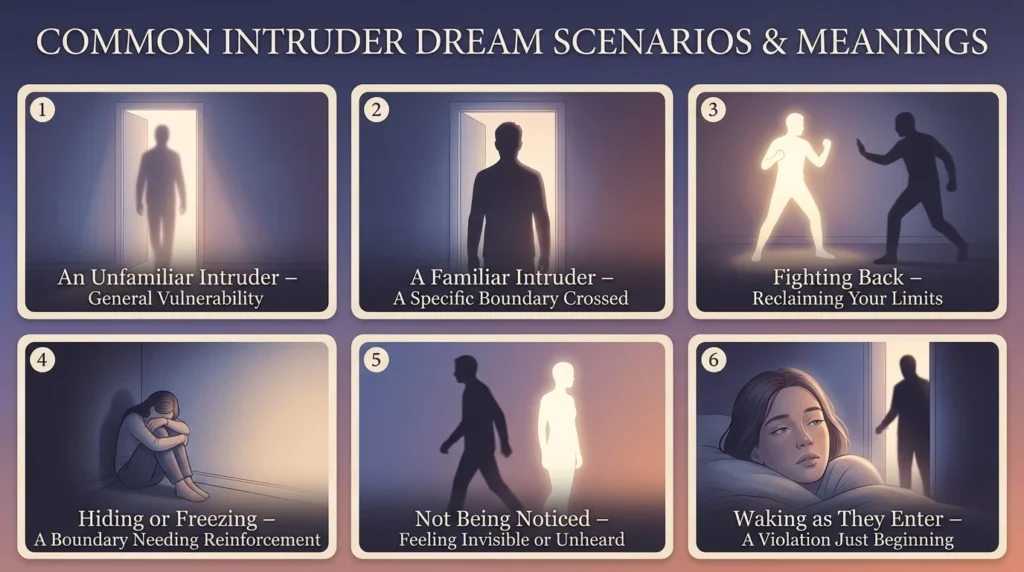
An Intruder You Don’t Recognize
A stranger breaking in often points to a general sense of vulnerability rather than a specific person or situation. This version is common during stressful stretches of life when you feel exposed without being able to pin down exactly why.
An Intruder You Know
If the intruder has a familiar face, even a distorted one, this usually points to a specific relationship where a boundary has already been crossed, or where you sense one is at risk of being crossed soon.
Fighting Back
Successfully confronting or fighting off the intruder is generally a positive sign. It reflects real strength and a growing willingness to defend your own limits, even if you haven’t fully put that into practice in waking life yet.
Hiding or Freezing
Hiding from the intruder, or feeling frozen and unable to act, often reflects a real situation where you feel unable to assert yourself, at work, in a relationship, or within your own family. This is less about weakness and more a signal that a boundary needs active reinforcement.
The Intruder Doesn’t Notice You
Watching an intruder move through your space without seeing you can point to feeling invisible or unheard in a situation where you’d expect to matter. It often reflects a wish to be acknowledged rather than fear of the intruder itself.
Waking Up as They Enter
Waking within the dream right as the intruder arrives often reflects a boundary violation that’s just beginning, or one you’re only now becoming consciously aware of, even if it’s been building for a while.
The Spiritual Meaning of an Intruder Dream
Spiritually, an intruder is often read as a symbol of something demanding your attention before it can be resolved, sometimes an old wound, sometimes a genuine warning to pay closer attention to your boundaries. This reading comes from long standing spiritual tradition rather than scientific evidence, so it’s worth treating as one lens rather than a fixed truth.
Common spiritual interpretations include:
- A call to strengthen boundaries you’ve let slide
- A reminder that avoided parts of yourself eventually ask to be seen
- A sign that trust has been placed somewhere it shouldn’t have been
- An invitation to protect your peace more deliberately going forward
The Biblical Meaning of an Intruder Dream
The Bible doesn’t address intruder dreams directly, but it speaks often about safety and protection, especially at night, when this dream tends to feel most vivid. Psalm 91:5 reads, “you will not fear the terror of night, nor the arrow that flies by day.” The psalm as a whole describes real refuge and safety, even in the face of unseen threats.
Many people read an intruder dream through this lens. It’s less a sign of danger and more an invitation to seek genuine peace and protection, spiritually and practically, in the areas of life that currently feel exposed.
What Psychology Generally Says About This Dream
Beyond the Jungian framework above, general dream psychology often connects intruder dreams to unprocessed stress, unexpressed anger, or a boundary that’s been quietly ignored for too long, sometimes disguised in waking life as simply being agreeable or avoiding conflict. This is a general psychological framework rather than a finding tied to this dream specifically, and it should be treated as one possible reading, not a rule for every dream.
What This Dream Might Say About Your Life Right Now
This dream often mirrors a real boundary question you’re facing. Ask yourself a few honest questions after you wake up.
- Where in my life has a limit been crossed without my full consent?
- Is there a part of myself I’ve been avoiding that’s now asking to be acknowledged?
- Did I fight back, hide, or freeze in the dream, and what does that say about how I respond to real conflict?
- What would it look like to protect this boundary more clearly going forward?
Write the dream down while it’s fresh. Note whether you recognized the intruder, how you responded, and how you felt when you woke up. Those details usually carry more meaning than the intrusion itself.
Frequently Asked Questions
What does it mean to dream about an intruder in your house?
It generally reflects a boundary being crossed somewhere in your life, since your home in a dream often represents your inner world and sense of safety.
What does it mean if you fought off the intruder in your dream?
This is generally a positive sign, reflecting real strength and a growing willingness to defend your own limits, even if you haven’t fully practiced that yet in waking life.
What does it mean if you couldn’t move or hide from the intruder?
Dreams where your body won’t cooperate often show up when you’re carrying real hesitation about speaking up somewhere in waking life. Take it as a nudge to practice asserting yourself in smaller moments, so it feels less impossible when it actually counts.
What does it mean to dream about an intruder you recognize?
A familiar face changes the target of the dream. Rather than a general sense of unease, it’s worth looking directly at that relationship and asking whether a line has already been crossed there, or is close to being.
Is dreaming of an intruder a bad sign?
Not necessarily. It’s a common, well documented dream tied to stress, boundaries, and personal safety, not a prediction of anything happening in waking life.