A blood dream meaning usually connects to strong emotion, whether that is pain, guilt, sacrifice, or a loss of energy. The exact message depends on whose blood you saw and how it appeared.
Quick answer: Blood in a dream often points to something emotionally intense that needs your attention. Your own blood can mean stress, pain, or exhaustion. Someone else’s blood often points to worry for that person. Small amounts, like a nosebleed, usually point to minor pressure. Large amounts point to something bigger.
What Does Blood Symbolize in a Dream?
Blood carries weight in almost every culture because it is tied to life itself. In a dream, it rarely stays literal. Instead, it becomes a stand in for something you feel deeply: pain, sacrifice, guilt, or a truth you have been avoiding.
This is why a blood dream meaning is almost never about actual injury. Your mind reaches for blood because it is the clearest image it has for something serious happening beneath the surface.
Blood Dream Meaning Based on What You See
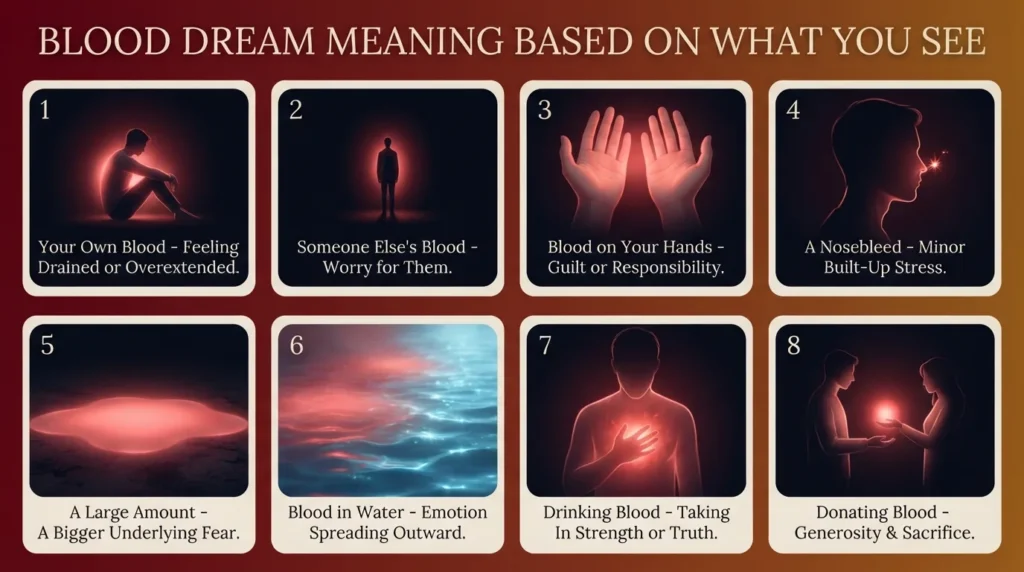
Your Own Blood or Bleeding from a Wound
Seeing your own blood often points to feeling drained, hurt, or overextended. If you were calmly stopping the bleeding, the dream may be telling you that recovery is within reach. If you felt helpless watching it, the dream leans toward a sense of being overwhelmed right now.
Someone Else’s Blood
This version often points to worry for that person, or to the emotional cost of caring for them. Many dreamers report this dream during a season of caregiving or when they feel responsible for someone else’s pain but cannot fix it.
Blood on Your Hands
This scenario is widely read as guilt or responsibility, though no formal study confirms this link. It often shows up after a decision you regret, or during a season when you feel involved in a situation that turned messy.
A Nosebleed
Nosebleeds tend to be smaller and more embarrassing than other blood dreams. They usually point to a minor stress that has quietly built up rather than one big event.
Menstrual or Period Blood
This version often carries a gentler tone than other blood dreams. Many dream writers connect it to natural cycles, release, or the start of something new, rather than danger.
A Large Amount of Blood
A large pool or heavy flow of blood usually matches a bigger fear. The scale of the blood in the dream tends to mirror how large the underlying stress feels to you.
Blood in Water or a Pool
Blood mixing into water often points to emotion that has spread beyond one part of your life into everything else. Where a wound stays contained, water carries the blood outward, which many dream writers read as a sign that a private struggle is starting to affect other areas: work, sleep, or relationships that seemed unrelated at first.
Drinking Blood
This scenario tends to unsettle people more than most, but it is usually read gently. It often points to taking in strength, energy, or a hard truth that you need in order to keep going, rather than anything violent. Some readers connect it to a season where you are relying on inner reserves you did not know you had.
Donating Blood or a Blood Transfusion
Giving blood in a dream is commonly linked to generosity, sacrifice, or giving support to someone who needs it, sometimes at real cost to yourself. A transfusion, receiving blood, tends to point the other way: needing support, strength, or energy from someone else during a hard stretch.
Animal Blood
Blood from an animal rather than a person often softens the dream’s intensity. It may point to a smaller, more manageable version of the same emotional theme, such as a minor conflict rather than a major one.
The Psychological Meaning: Freud, Jung, and Emotional Release
Sigmund Freud, the founder of psychoanalysis, often linked blood in dreams to repressed emotion. In his framework, a dream is a place where feelings that are too intense for waking life get a chance to surface. Blood, being visible and undeniable, was one of the clearest ways the mind could show that something inside had reached a breaking point.
Carl Jung took a related but wider view. For Jung, a wound that bleeds in a dream can point to the shadow self, the parts of a person’s emotional life that get pushed down because they feel too heavy or unwanted. A blood dream, in this reading, is less about the body and more about a truth that has been sitting quietly, waiting to be noticed.
Neither Freud nor Jung wrote a specific study naming blood dreams as a category. Their frameworks, repression and the shadow, are the named theories behind these readings, not proof of a fixed meaning.
Why Blood Feels More Intense Than Other Dream Symbols
Blood tends to stay with people longer than most dream images, and there is a simple reason for that. Unlike a falling dream or a dream about being late, blood carries a built in sense of urgency. Waking life has trained your brain to treat visible blood as something that needs immediate attention, so the dreaming mind borrows that same urgency to make sure you notice the underlying feeling. This is likely why blood dreams, even mild ones, often feel more vivid and harder to shake off the next morning than other common dream symbols.
The Spiritual Meaning of Blood in Dreams
Spiritually, blood is often tied to life force. Many spiritual writers describe a blood dream as a signal that your energy, time, or emotional reserves are being spent faster than you can replace them.
This reading fits a simple idea: something you value is being used up, and the dream is asking you to notice before it runs out. Rather than a warning of danger, many people experience this dream as a nudge toward rest, boundaries, or honest self care.
Blood Dream Meaning in the Bible
The Bible never describes anyone having a dream specifically about blood, so any biblical reading here is an interpretation, not a direct teaching.
Blood carries deep meaning throughout Scripture. Leviticus 17:11 states plainly that “the life of the flesh is in the blood,” which is why many readers treat blood, even in a dream, as something sacred rather than simply frightening. In Genesis 4, after Cain kills his brother Abel, Abel’s blood is described as crying out, tying blood to conscience and accountability.
Blood is also central to the idea of forgiveness in the New Testament. Hebrews 9:22 teaches that “without the shedding of blood there is no forgiveness,” and Matthew 26:28 records Jesus describing his own blood as “the blood of the covenant, which is poured out for many for the forgiveness of sins.” 1 John 1:7 adds that “the blood of Jesus Christ his Son cleanses us from all sin.”
Taken together, many Christian readers treat a blood dream as an invitation toward honesty, forgiveness, or spiritual renewal, rather than as a bad omen.
Blood Dream Meaning in Islam
Outside a Christian framework, classical Islamic dream interpretation, most famously the dream dictionary attributed to the eighth century scholar Ibn Sirin, treats blood dreams as tied strongly to context and feeling in the dream rather than to blood itself. In that tradition, how the dreamer feels about the blood, at ease or afraid, often shapes whether the dream is read as encouraging or as a caution. This is presented here as a documented traditional interpretation, not as settled fact.
What to Do After a Blood Dream
- Name what feels drained. Write down one relationship, job, or habit that takes more from you than it gives back.
- Check in on guilt. If the dream involved blood on your hands, ask yourself honestly whether there is something you need to repair or forgive, in yourself or someone else.
- Rest before you react. A blood dream often shows up during high stress. Sleep, a real break, or a quiet conversation with someone you trust can matter more than analyzing the dream further.
- Watch the pattern, not just one dream. If blood dreams keep repeating, treat that as a sign to look closely at your stress level rather than brushing it off.
Frequently Asked Questions
What does it mean when you dream about blood?
It usually points to strong emotion that needs attention, such as stress, guilt, grief, or exhaustion. The exact meaning shifts depending on whose blood it was and how much of it you saw.
What is the spiritual meaning of blood in a dream?
Spiritually, blood is often tied to life force and sacrifice. Many people read a blood dream as a sign that their energy or emotional reserves need protecting, or as a call toward forgiveness and renewal.
What does the Bible say about dreaming of blood?
The Bible does not describe a specific dream about blood, but blood itself carries deep meaning throughout Scripture, tied to life, sacrifice, and forgiveness, as seen in verses like Leviticus 17:11 and Hebrews 9:22.
Is dreaming of blood always a bad sign?
No. Context decides the tone. Flowing or uncontrolled blood tends to point to stress or fear, while blood that stops, or a wound that heals in the dream, often points to recovery.
What does blood on your hands mean in a dream?
Many dream writers connect this to guilt or a sense of responsibility for something that went wrong. There is no formal study confirming this, so it is best treated as a common interpretation rather than a fixed rule.